What Is Oxygen Delivery, and Why Can a Normal SpO2 Be Misleading?
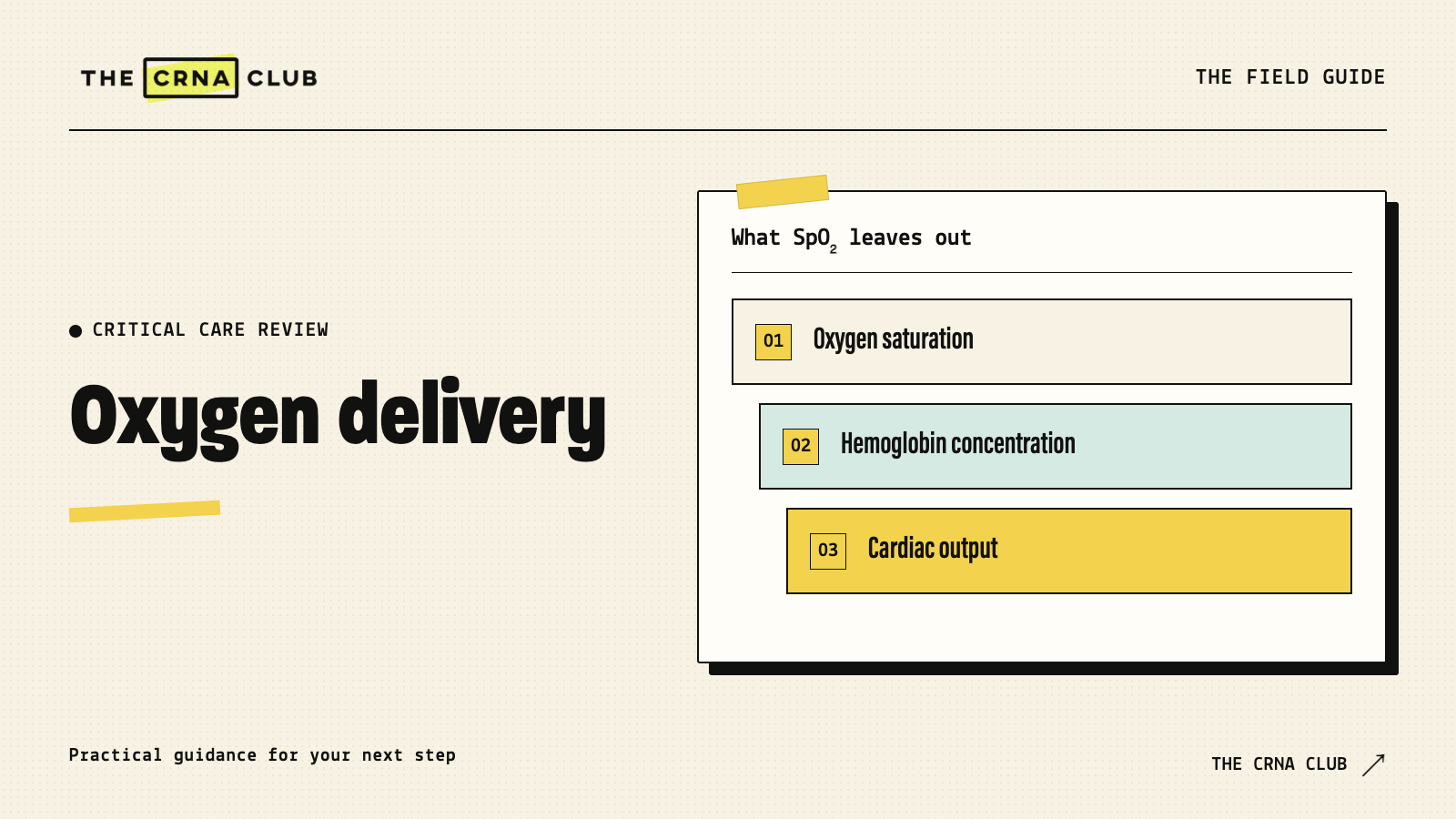
Oxygen delivery (DO2) is the amount of oxygen reaching the systemic tissues each minute. It depends on arterial oxygen content and cardiac output. So a normal SpO2 tells you only part of the story. You still need to know how much hemoglobin is carrying oxygen and how much blood the heart is moving.
Sachi, CRNA
CRNA
In This Article (8 sections)
- How are SpO2, PaO2 and oxygen content different?
- What is the oxygen delivery formula?
- What happens when two patients have the same saturation?
- Does more oxygen always fix low oxygen delivery?
- When should you question the pulse oximeter?
- How would you explain this in a CRNA interview?
- Our Final Thoughts
- Practice the physiology
If you’re studying for the CCRN, we suggest the CCRN Toolkit to organize your review, work through the video lessons and practice applying the physiology. For broader clinical and interview preparation, try The CRNA Club platform free for seven days. The toolkit and platform trial are separate offers.
How are SpO2, PaO2 and oxygen content different?
SpO2 estimates the percentage of hemoglobin binding sites occupied by oxygen. PaO2 is the pressure of oxygen dissolved in arterial blood. Arterial oxygen content, written CaO2, describes the amount of oxygen in a volume of blood.
Those measurements answer different questions. A patient with hemoglobin of 7 g/dL and another with hemoglobin of 14 g/dL might both have a saturation of 98%. Their oxygen content will be very different because they have different amounts of hemoglobin available.
Keep the terms straight:
- Saturation: how much of the available hemoglobin is oxygenated.
- Content: how much oxygen is in the blood.
- Delivery: how much oxygen that blood transports each minute.
The WHO’s educational modules on clinical use of blood connect oxygen content to hemoglobin, arterial saturation and dissolved oxygen. Start with those variables when a reassuring monitor number doesn’t fit your patient’s appearance.
What is the oxygen delivery formula?
Use these conventional equations, with saturation entered as a fraction:
CaO2 = (1.34 × hemoglobin × SaO2) + (0.003 × PaO2)
DO2 = CaO2 × cardiac output × 10
For this calculation:
- Hemoglobin is in g/dL.
- SaO2 is arterial oxygen saturation. Enter 98% as 0.98.
- PaO2 is in mmHg.
- Cardiac output is in L/min.
- CaO2 comes out in mL oxygen/dL blood. DO2 comes out in mL oxygen/min.
Why multiply by 10? There are 10 deciliters in one liter. Your oxygen content and blood-flow units need to match.
We use 1.34 mL oxygen per gram of hemoglobin here. Other references use slightly different binding coefficients. Keep the coefficient and units consistent within your calculation.
The CCRN Toolkit’s lessons and practice questions help you connect a formula to a patient scenario. After reviewing it, try explaining why each variable changes the result before doing another set of questions.
What happens when two patients have the same saturation?
Consider these hypothetical calculations. Both use a measured SaO2 of 98% and PaO2 of 100 mmHg.
| Example | Hemoglobin | Cardiac output | Calculated CaO2 | Calculated DO2 |
|---|---|---|---|---|
| A | 14 g/dL | 5 L/min | 18.68 mL/dL | 934 mL/min |
| B | 7 g/dL | 5 L/min | 9.49 mL/dL | 475 mL/min |
| C | 14 g/dL | 2.5 L/min | 18.68 mL/dL | 467 mL/min |
For Example A:
CaO2 = (1.34 × 14 × 0.98) + (0.003 × 100) = 18.68 mL/dL.
Then 18.6848 × 5 × 10 = 934.24 mL/min, rounded to 934.
Example B has the same saturation and cardiac output, but half as much hemoglobin. Example C has the same oxygen content as A, but half the cardiac output. Both deliver substantially less oxygen per minute in this model.
These examples show how the equation works. They don’t establish an individual patient’s transfusion threshold or treatment target.
Does more oxygen always fix low oxygen delivery?
If arterial saturation is low, improving oxygenation addresses one contributor to reduced oxygen content. But raising PaO2 when hemoglobin is already nearly saturated adds relatively little dissolved oxygen at ordinary clinical pressures.
Look at Example A again. The dissolved component is 0.3 mL/dL, compared with 18.38 mL/dL carried on hemoglobin. That arithmetic explains why oxygen alone doesn’t correct anemia or low cardiac output.
When you’re explaining a patient, work through the whole chain:
- Check whether the saturation reading is believable and whether the patient is hypoxemic.
- Review the hemoglobin concentration and recent changes.
- Assess circulation and available cardiac-output information.
- Consider oxygen demand, including fever, work of breathing and agitation.
- Follow the patient’s response rather than stopping at a normal SpO2.
For the flow side of the explanation, review preload, afterload and perfusion. Oxygen delivery also differs from oxygen use at the tissue level, so a calculated global value doesn’t prove every organ is receiving and using enough oxygen.
When should you question the pulse oximeter?
Question a number that doesn’t fit the patient or has poor signal quality. The FDA describes limitations involving circulation, skin pigmentation and other measurement conditions.
In particular, pulse oximetry sometimes overestimates saturation in people with darker skin tones. Conventional pulse oximeters also don’t reliably distinguish carboxyhemoglobin from oxyhemoglobin. Suspected carbon monoxide exposure calls for appropriate assessment and co-oximetry, even with a reassuring SpO2.
For a calculated CaO2, understand where the arterial saturation value came from. A saturation calculated by a blood-gas analyzer isn’t the same measurement as saturation measured by co-oximetry.
How would you explain this in a CRNA interview?
Practice answering this original question: “Your patient’s SpO2 is 99%. Does that prove oxygen delivery is adequate?”
A useful answer starts with the physiology:
“No. Oxygen delivery depends on arterial oxygen content and cardiac output. A normal saturation doesn’t tell me the hemoglobin concentration or blood flow. I’d connect the oxygenation data with the hemoglobin, circulation and signs of perfusion, then look for the reason they don’t agree.”
We suggest practicing the explanation aloud, then changing one variable. What happens if the hemoglobin falls? What happens if cardiac output falls? Use the Mock Interview Lab to practice clinical answers after you’ve worked through the calculation yourself.
Our Final Thoughts
When a saturation looks reassuring, keep asking how much oxygen is being carried and how much blood is moving. Once you explain those two pieces, the oxygen-delivery formula has a practical use.
Practice the physiology
Use the CCRN Toolkit for a study plan, video lessons and practice questions. To work on clinical concepts alongside interview preparation and the wider learning library, start the seven-day platform trial.