What practice-test score means I am ready for the CCRN?
Sachi, CRNA
CRNA
In This Article (10 sections)
- Why doesn’t the official passing score set your practice target?
- What information should you examine instead?
- Is 70% on new CCRN questions more useful than 90% on repeats?
- What should you do with correct guesses?
- How much does the pattern over time matter?
- What does timing tell you about readiness?
- How do you decide whether to keep or change your examination date?
- How do you avoid studying indefinitely?
- Our Final Thoughts
- Take the Next Step
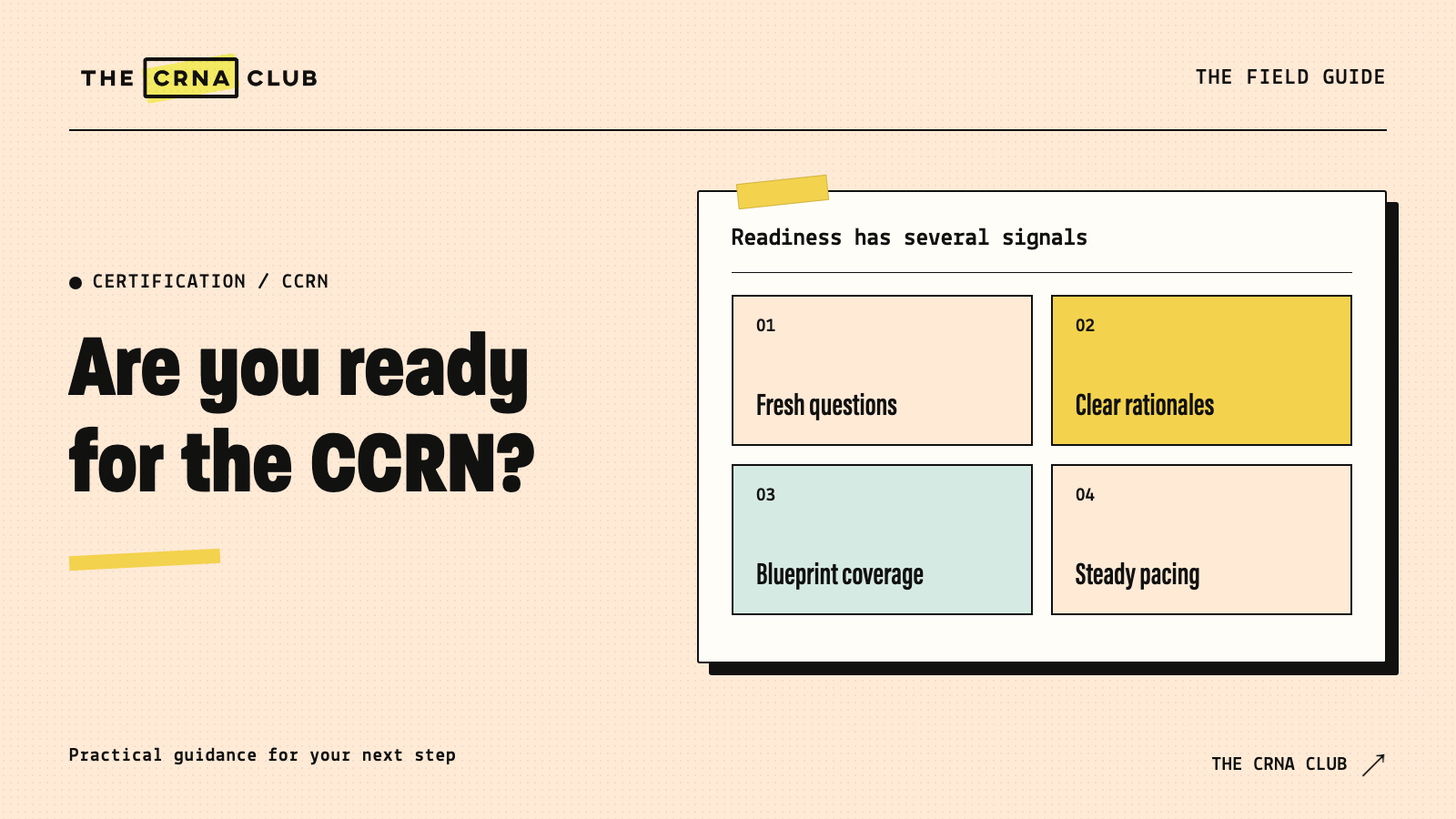
There isn’t one CCRN practice percentage proving you’re ready. Look at whether you explain unfamiliar questions, cover the current outline and finish a realistic session without rushing through everything you don’t know. A repeated-set score won’t answer all of those questions.
We suggest using our CCRN Toolkit to work on the gaps behind your score. The video lessons help with explanations, the questions give you practice, and the planner makes room for another review before your date.
If you’ve been searching for a number because you want permission to stop worrying, I get it. Let’s give you something more useful to check than the same dashboard average.
Why doesn’t the official passing score set your practice target?
The official raw cut score belongs to the certification examination. A practice percentage belongs to the questions and conditions in that particular set. Differences in content, familiarity and difficulty prevent you from treating the two as interchangeable measures or guarantees of the same outcome.
As checked November 3, 2026, AACN lists the adult CCRN cut score as 83 of 125 scored items. Dividing those numbers gives a mathematical proportion. It doesn’t validate the same proportion as a readiness threshold for a commercial bank.
Also distinguish a cut score from a pass rate. The cut score describes the examination standard. A pass rate describes how a group of candidates performed. Neither tells you the probability you personally will pass based on yesterday’s practice session.
If a resource recommends its own practice target, read how it defines the result. We don’t want you treating a toolkit practice percentage as an AACN passing score. Use our questions to find what needs review, then check whether you explain it more clearly after the lesson.
What information should you examine instead?
Review your recent unfamiliar practice, current topic coverage, explanation quality and timing. Look for a pattern across several useful sessions rather than waiting for one perfect result. Unresolved gaps need specific follow-up work, even when the total percentage looks reassuring.
AACN’s preparation guidance supports self-assessment against the outline and further study where needed. The worksheet below is a personal planning aid built around that task. It isn’t an official predictor.
-
Have I covered the applicable scope? Check your topic checklist and recent review notes. Investigate any whole areas that remain unexamined.
-
Do I explain my choices? Reason through the answer before opening explanations. Correct guesses or remembered answer positions deserve another check.
-
Does learning transfer? Try fresh examples after focused review. If improvement appears only on the repeated set, investigate what remains unclear.
-
Is timing manageable? Use a realistic session and review your notes afterward. Repeated rushing or long stalls on the same issue need attention.
-
Do I know the next task? Name a specific remaining gap and schedule its review. “Keep doing more” without an identified purpose doesn’t give you that next step.
You aren’t trying to remove every uncertainty before testing. You are trying to understand the uncertainties well enough to make a responsible decision about your next step.
Is 70% on new CCRN questions more useful than 90% on repeats?
Neither result tells you readiness by itself. New questions sometimes reveal gaps a repeated set hides, while repeats still help you review. Look at how you reached each answer and what remains unexplained. Use the result to choose your next lesson or practice task, rather than declare either percentage enough.
Compare these hypothetical sessions:
| Set | Result | What else happened? | Next useful task |
|---|---|---|---|
| 20 unfamiliar mixed questions | 14 correct out of 20 = 70% | Three of the correct answers were guesses | Review the six misses and three uncertain explanations. Choose a lesson for the main gap, then try fresh examples later |
| 20 repeated questions | 18 correct out of 20 = 90% | You remembered several answers before working through the question | Cover the choices and explain the reasoning. Use a different set to check whether you apply it without familiar cues |
In the first session, nine explanations need attention: six missed questions plus three correct guesses. You don’t need to subtract guesses and create another readiness score. Keep the notes so the 70% doesn’t hide which concepts need work.
In the second session, the 90% might include both learning and answer memory. Check the explanation before deciding the topic is finished. Repeating that set again won’t tell you as much about a different example as unfamiliar practice will.
Use your toolkit lesson for a missing concept and give the later check a place in the planner. Compare fresh mixed sessions under similar conditions over time. These numbers are examples of different study tasks, not pass predictions or score targets.
What should you do with correct guesses?
Treat an uncertain correct answer as a learning need. A guess contributes to the percentage but doesn’t establish understanding. Explain the concept afterward, identify the missing connection and check a different example later. Keep that uncertainty visible when deciding whether the topic is adequately reviewed.
You don’t need to subtract every guess to invent a new formal score. A practical note beside the item or topic is enough.
Suppose ten correct responses include four choices you couldn’t explain. The session still contains useful work. It also contains four reasons for follow-up, and those deserve calendar time.
This habit keeps the dashboard from telling a more confident story than your own reasoning. It also helps you choose focused review instead of assuming the whole question bank is too easy or too hard.
How much does the pattern over time matter?
A pattern across comparable unfamiliar sessions provides more information than one isolated result. Examine what has changed in your explanations and which errors repeat. Improvement should lead to clearer reasoning or broader coverage, not only higher scores after repeatedly seeing the same questions.
Keep an eye on the direction of your unresolved work. Are you closing gaps and finding smaller, more specific questions? Or does each session add another large unfamiliar subject you haven’t scheduled?
That distinction helps with planning. If gaps are getting more precise, targeted repair might fit the remaining calendar. If broad areas remain untouched, you need a wider review of the plan and possibly the timeline.
Our CCRN overview gives general examination context. Use the official outline beside your personal notes so a reassuring trend in one subject doesn’t conceal missing coverage elsewhere.
What does timing tell you about readiness?
Timing shows how you work under the conditions you chose. Review where time goes: understanding the task, retrieving content, weighing two options or repeatedly changing answers. A timed score without this review doesn’t explain whether the next session needs teaching, reading practice or a more realistic rehearsal.
The goal isn’t to rush every question. You need enough room to process the item and keep moving through the session.
If you’re slow because you don’t understand the topic, use the relevant lesson before another timed set. If you understand it but keep rereading the question, practice naming what it asks. Same problem on the clock, different follow-up work. Your study plan should make room for whichever one is happening.
Record interruptions too. A practice session broken up by errands differs from one completed in a quiet block. Neither makes you a better or worse candidate. They provide different information about your current preparation.
How do you decide whether to keep or change your examination date?
Consider remaining coverage, repeated gaps, realistic available time and the current scheduling rules. Don’t let a single difficult evening make the entire decision. Write what still needs to happen before the appointment and check whether your actual calendar has room to do it.
A hypothetical nurse has two protected study blocks remaining. Her review shows one defined topic needing repair and a need to confirm logistics. Another nurse has the same calendar but several broad unfamiliar areas. Their next decisions need different conversations.
If you are considering changing the appointment, read the current official instructions and any applicable fees before acting. Historical podcast comments or a colleague’s old testing experience don’t establish today’s policy.
When a CRNA deadline drives the pressure, check the program’s exact credential requirement and submission timing. Our CCRN requirement and strategy guide helps frame that separate task. Don’t assume every program uses the same rule.
How do you avoid studying indefinitely?
Define the remaining work instead of chasing a feeling of total certainty. Write the gaps you will address, the unfamiliar check you will use and the appointment when you will reconsider the plan. Anxiety sometimes persists even after preparation improves, so separate the feeling from the evidence you have gathered.
A short planning note might say: “Review this connection Tuesday, check fresh mixed questions Thursday, verify logistics Friday.” Each task ends somewhere. “Study until I feel ready” has no clear stopping point.
Try the CCRN review in our seven-day membership trial if your readiness check keeps revealing concepts you need explained. Start with one of those topics. Work through the lesson and practice, then check your reasoning. You’re trying the actual help you need, rather than watching a topic you already know.
Before making the decision, write the evidence beside the concern. “My mixed practice includes unresolved topics” suggests a learning task. “I worry despite explaining the recent material clearly” asks for a different response. Keeping those statements separate helps you choose the next useful step.
Our Final Thoughts
Use your practice percentage as a starting point for review. Examine the task behind it, the reasoning you explain and the work still on your calendar. You don’t need perfect certainty. You do need an honest picture of your preparation and a clear next decision.
Take the Next Step
Use the CCRN Toolkit to work through the lessons and practice your remaining gaps need. For help organizing your final review, the free certification planner includes one lifetime free plan. Put specific topics on the calendar instead of only writing down a target score.