What resources should I use to study for the CMC exam for CRNA school?
Sachi, CRNA
CRNA
In This Article (11 sections)
- Which official documents should guide your resource choice?
- What makes CMC resource selection different from broad CCRN review?
- How do you audit CMC coverage without reading everything first?
- How should you evaluate a CMC teaching course?
- What should you look for in CMC practice questions?
- Which reference books should you use for CMC?
- How do you know whether a resource is too narrow for your background?
- What should you verify before committing to the examination plan?
- Where does CRNA Club membership fit?
- Our Final Thoughts
- Take the Next Step
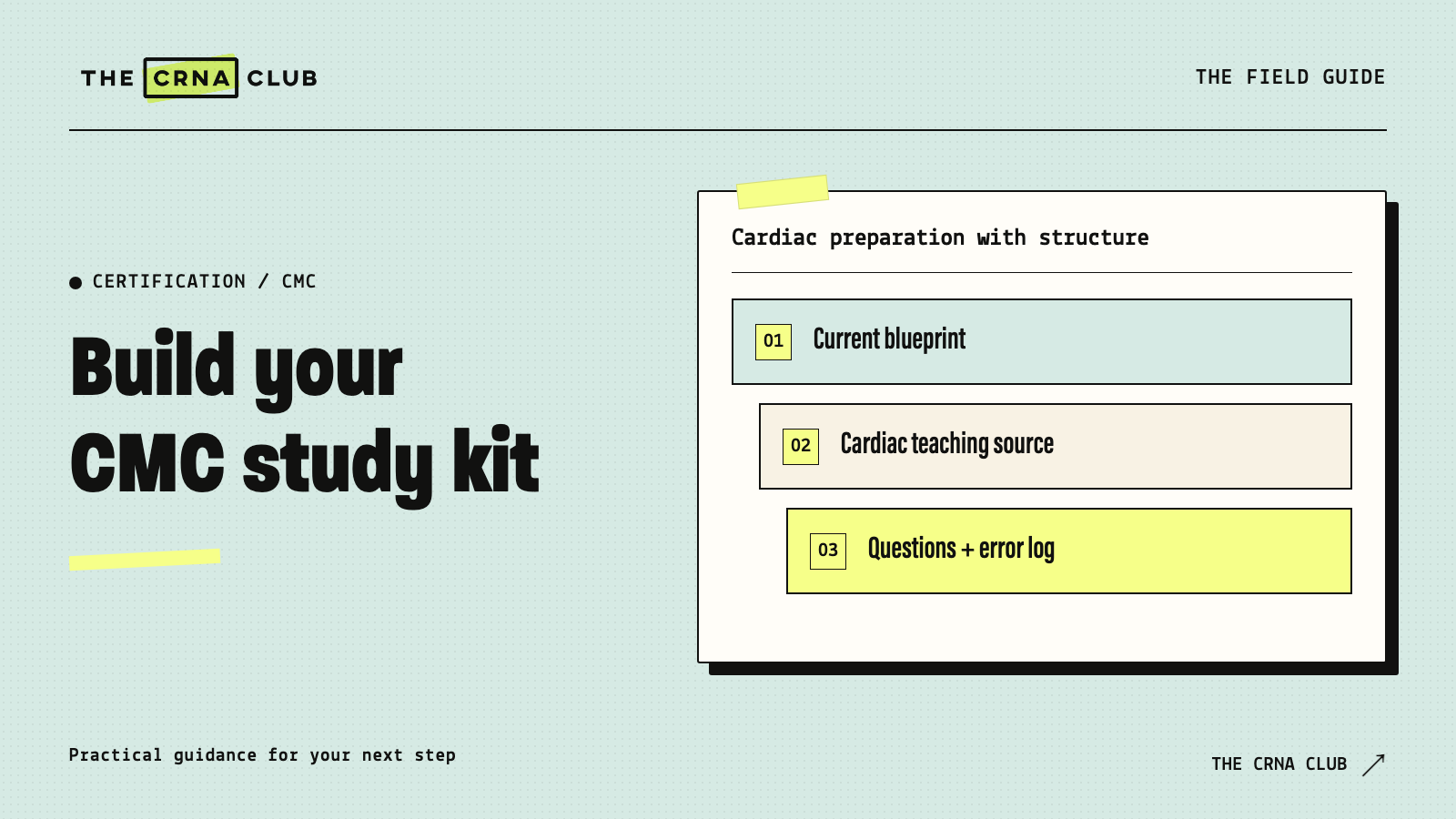
For CMC exam preparation, we suggest our CMC Review inside CRNA Club membership. You get cardiac-medicine teaching alongside CMC practice questions and a study planner. Use a lesson for the concept you’re missing, then practice and give the follow-up review a place around your shifts.
Keep the AACN test plan for your exam date beside those tools. Revised CMC exams begin November 19, 2026. The official outline tells you the scope. Our teaching and practice help you work through it, including topics outside your familiar acute cardiac cases.
Your CCRN preparation gives you a useful start. Let’s look at what to keep and where focused CMC teaching helps.
Which official documents should guide your resource choice?
Use the AACN plan applying to your date to check what you need to cover. Then work through our CMC lessons and use references for particular gaps. You don’t have to read every book first. Keep the bibliography for the topic needing a fuller explanation or a current clinical check.
AACN’s revision notice states the revised examinations apply on and after November 19, 2026. It also says existing study materials remain relevant and useful. So compare the materials with the applicable plan rather than replacing everything automatically.
For appointments on or after that date, use the revised CMC test plan. If you test earlier, use the official version applicable before the change.
Write the appointment date and plan version at the top of your resource audit. That simple step prevents two different blueprints from becoming one study schedule.
What makes CMC resource selection different from broad CCRN review?
CMC preparation needs focused cardiac-medicine scope while still addressing the noncardiac problems, interventions and monitoring included in its plan. Broad review material supplies useful foundations, but it doesn’t automatically provide the depth or coverage needed for every CMC topic.
In our CMC review, follow the patient information through to your interpretation and response. What does the finding mean? Why would an intervention fit? What would show whether it helped? The lesson should make those connections clearer, rather than give you another list to memorize.
Our CCRN overview covers the broader base-certification context. Keep that foundation, then ask which CMC-specific areas require more focused teaching.
Say you know the basic cardiac terms, but a case combines a condition, a medication effect and a monitoring result. You recognize each one and still don’t understand how they fit. Use the relevant CMC lesson for that connection before adding more definitions to your notes.
How do you audit CMC coverage without reading everything first?
Choose a manageable section of the applicable outline and locate its teaching in your current material. Record whether the explanation is clear, partial or absent. Repeat the audit while studying, with a brief whole-plan review so entire areas don’t remain invisible.
Use a personal crosswalk:
-
Cardiac conditions: Find disease and assessment teaching that explains how the findings fit the problem.
-
Noncardiac conditions: Locate topics affecting the cardiac patient’s broader care. Check whether familiar cardiac review leaves them unexplained.
-
Interventions: Find the procedures, medications and support within scope. Explain why a choice fits and how you would evaluate the response.
-
Monitoring and diagnostics: Find measurement and test-interpretation teaching. Explain what the information means and what it doesn’t establish alone.
These labels summarize study jobs. Use the actual official outline for exact topics and weights.
If a topic uses different terminology in your book, search the related heading before declaring it missing. When the explanation remains partial, name the missing connection and choose a targeted supplement.
How should you evaluate a CMC teaching course?
Start with a topic you find difficult in our CMC review. Watch the explanation, close it and explain the idea yourself. Then try practice. That’s a better way to judge the teaching than choosing a familiar subject and deciding it all sounds clear. Use the seven-day trial for the part you need help learning.
For example, choose a monitoring lesson you’ve been avoiding. Afterward, explain what the measurement tells you and what context affects it. What would you compare next? If you still can’t say, return to that step before moving to another video.
Also check whether you find the exact topic quickly during practice review. When a missed question reveals a gap, you need a route back to the explanation without restarting hours of unrelated content.
Don’t assume course organization or automated practice weights already reflect an upcoming examination revision. Compare your final schedule with the applicable official plan and add the review you still need.
What should you look for in CMC practice questions?
Look for opportunities to interpret information and examine the reason behind a choice. Review uncertain answers, including correct guesses. A useful rationale helps identify a gap, but you sometimes need a fuller lesson or reference to understand the background it assumes.
Before choosing access, check what the practice function actually includes and whether you will use it alongside teaching. More items don’t automatically supply a missing explanation.
After a set, write the learning issue in your own words. “Cardiac” is too broad. “I don’t understand why this finding changes the interpretation” gives the next session something to investigate.
Then return to a different example after learning. Immediate repetition helps with recall, while unfamiliar practice gives another check of application. Keep the purposes distinct rather than treating every percentage as equivalent evidence of readiness.
Which reference books should you use for CMC?
Use one for a question your current teaching hasn’t answered. The CMC bibliography effective November 19, 2026 lists these options, among others:
| Reference | When we’d reach for it | A specific reading task |
|---|---|---|
| AACN Essentials of Critical Care Nursing, fifth edition | A broad adult critical-care explanation when a rationale assumes background you haven’t learned | Find the section related to the missed condition or monitoring concept, then explain the finding that confused you |
| Kern’s Cardiac Catheterization Handbook, seventh edition | A more focused catheterization reference when the procedure or measurement is unfamiliar | Follow the explanation of right-heart catheterization and locate what the recorded pressures represent |
Those editions appear in the revised bibliography. The list notes that newer versions may be available; being listed doesn’t mean an edition is the newest. Check workplace or library access before buying a large reference for one narrow question.
For example, a missed question sends you back to the meaning of wedge pressure. Use our CMC hemodynamic-monitoring teaching first, then the relevant reference section if the anatomy or measurement remains unclear. Close it and explain what the pressure estimates and what limits that estimate. You have a question to answer, not a whole textbook to finish.
For additional questions, AACN’s practice-exam service offers CMC access through its subscription tiers. Compare the access window with when you’ll study. Our CMC Review combines teaching, CMC questions and planning within membership when you want those functions together.
How do you know whether a resource is too narrow for your background?
Check the topics outside your usual practice and see whether the source explains them. A resource feels complete when it repeatedly teaches familiar material, even while leaving the areas you haven’t encountered less clear. Use your own exposure map alongside the official outline.
A hypothetical nurse comfortable with acute cardiac emergencies needs to check broader condition management and noncardiac topics. Another nurse from a different qualifying cardiac setting might need more support interpreting unfamiliar monitoring or devices.
Don’t compare the two by unit prestige or assume one has an automatic advantage. The next teaching task follows the actual gap.
Our certifications-beyond-CCRN guide helps place CMC and CSC within a broader plan. Keep actual eligibility separate from a resource’s ability to teach a topic you haven’t practiced.
What should you verify before committing to the examination plan?
Confirm current base-certification, licensure and clinical-practice requirements with AACN. A study product doesn’t establish eligibility or replace qualifying hours. CMC eligibility and a CRNA program’s clinical requirements are also separate decisions.
Use AACN’s current CMC page for the complete conditions. If your role or hours are unclear, ask the certifying body before building an expensive preparation plan around an assumption.
Then compare resource access with your schedule. Mark workdays and available learning blocks first, assign topics next and reserve review time after practice. A subscription period only helps if it covers the work you realistically expect to do.
Where does CRNA Club membership fit?
Membership brings CMC review, CMC questions and a planner together. We suggest using them as one process: find the gap, learn the explanation, practice it and schedule another check. Compare your coverage with the AACN outline for your appointment, particularly around the November 2026 change.
Start the seven-day membership trial with one difficult CMC topic and your real study schedule. Work through the lesson and questions, then plan the next review. You’ll be trying the teaching and tools on the work you actually need to do.
Choose membership for CMC features. The CCRN Toolkit is the focused CCRN option. If you already own useful CCRN references, keep them for foundations and use CMC teaching for the topics needing greater depth.
Before adding a resource, choose one unfinished row in the audit and state what you need it to explain. A sample should help with that row. If it only repeats the material you already understand, keep looking for the missing teaching function.
Our Final Thoughts
Choose CMC resources around the official scope and the explanation you need next. Keep useful foundations, audit unfamiliar areas and give references specific jobs. A connected learning process will serve you better than collecting another long list without knowing how to use it.
Take the Next Step
Try our CMC review, practice questions and planner through the seven-day membership trial. Want to start with a calendar? The free certification planner includes one lifetime free plan. Compare your topics with the AACN outline for your date.