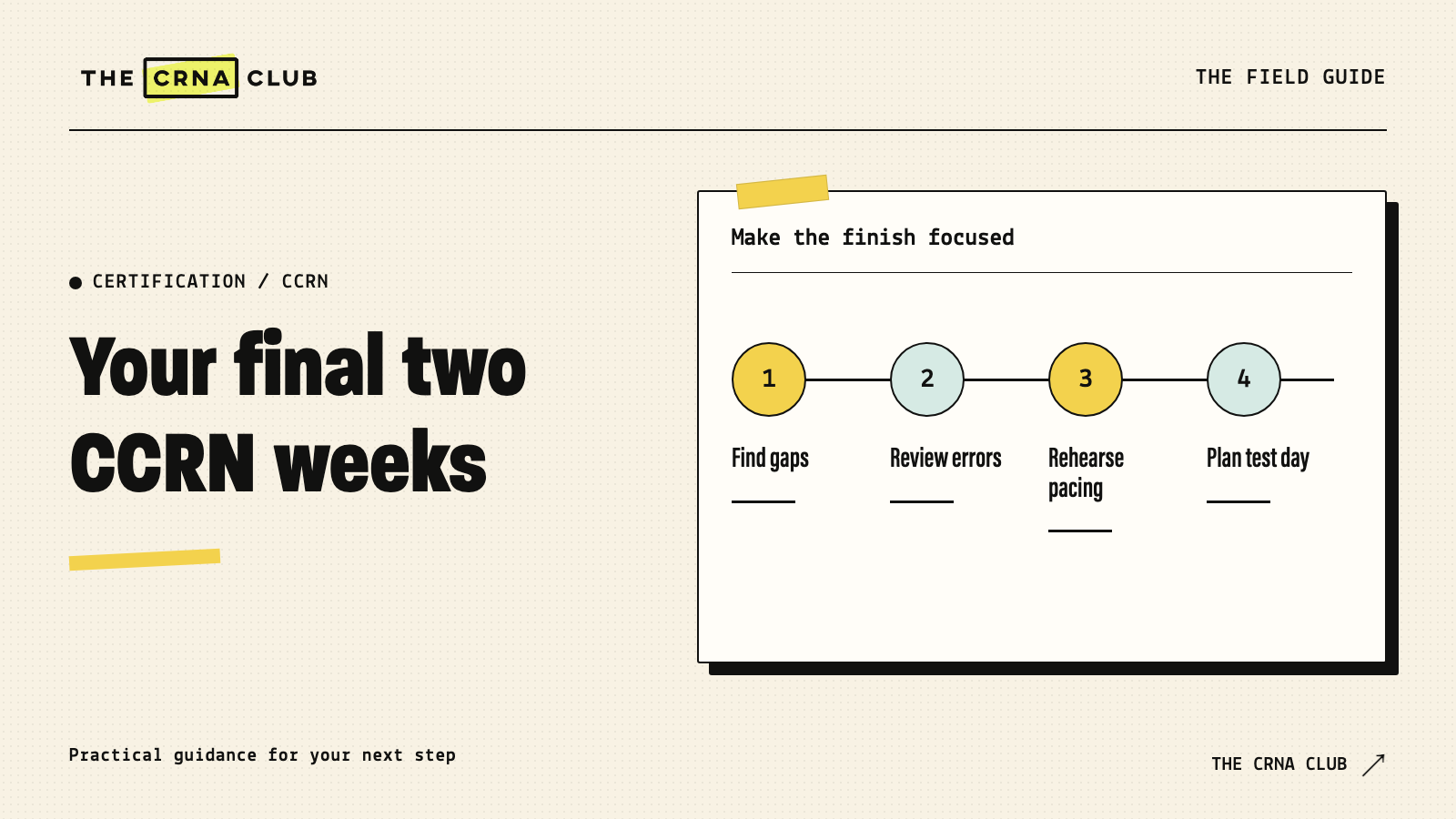
What should I focus on during the last two weeks before the CCRN?
Sachi, CRNA
CRNA
In This Article (10 sections)
- What should you review before making the final plan?
- How do you decide which gaps deserve the most attention?
- What should you study on days 14–8 before the CCRN?
- What should you review on days 7–1 before the CCRN?
- Should you take a full practice test every day?
- Should you buy another resource at this point?
- What test logistics should you verify?
- What if your final review shows you aren’t where you expected?
- Our Final Thoughts
- Take the Next Step
Use the last two weeks before the CCRN for the gaps you’ve actually found, fresh practice and test-day preparation. Don’t start three new study plans because one difficult set made you nervous. Write the remaining work and give it time on the calendar.
We suggest using our CCRN Toolkit for targeted video review, practice questions and planning. Choose the lesson explaining the concept you’re still missing. You don’t need to restart the entire course to use it well.
If you already have useful materials, keep them. The free certification planner gives you one lifetime free plan to organize the review around your remaining shifts.
What should you review before making the final plan?
Look at the topics you’ve covered and the explanations still giving you trouble. Which needs a lesson? Which needs a quick closed-book review? Then count the usable blocks before your date. A long list of everything making you nervous won’t tell you which task fits tonight.
AACN’s preparation guidance starts with the test plan and areas needing further study. Keep that scope beside your own notes rather than building the final period around remembered examination topics from strangers.
Make the remaining-work list specific: “I can’t explain why PaCO2 and bicarbonate move differently in this example” is a learning task. “Do another 200 questions” is an activity with no defined gap. Name the explanation first, then choose the lesson or practice block.
Our CCRN overview gives general examination context. Use official AACN documents for the exact current format and policies that apply to your appointment.
How do you decide which gaps deserve the most attention?
Consider the gap’s breadth, its place in the applicable outline and the work needed to address it. A defined misunderstanding sometimes needs one focused explanation. A broad unfamiliar area needs a larger discussion about remaining time. Don’t treat both as tasks you will squeeze into the same final evening.
A sample review list helps:
-
One specific connection remains unclear: Focused teaching, independent explanation and a later fresh example.
-
A familiar concept is hard to retrieve: Brief closed-book review and another check after a delay.
-
Many topics remain unfamiliar: Reassess the overall timeline and available learning capacity.
-
Timing repeatedly breaks down: Review where minutes go, then plan an appropriate rehearsal.
-
Instructions remain unchecked: Read current official documents and appointment information.
This is a planning worksheet, not a validated readiness scale. It helps you assign work rather than convert uncertainty into another percentage.
Also check topics you have been avoiding. A comfortable review list sometimes excludes the area you most need to address. Be honest about that before deciding the plan is nearly finished.
What should you study on days 14–8 before the CCRN?
Use the earlier week for the explanations you still need to learn, then check them with new questions. We suggest naming the weak topic before opening the lesson. “ABG interpretation” or “applying the Synergy Model to a patient situation” gives you something more useful to work on than “review everything.”
This example assumes you’ve already worked through the outline and those are your two main remaining gaps. It also assumes shifts on days 13, 12 and 11 before the exam. Move the blocks around your own work and recovery. They aren’t seven extra study days.
| Days before the exam | Example block | Specific task | What you keep afterward |
|---|---|---|---|
| 14 | 60 minutes | Check the whole outline against your notes. Identify two unfinished explanations, choose the matching lessons and check appointment instructions early | Two named gaps and any practical question needing an answer |
| 13 | Shift day | No essential new learning assigned. Brief recall only if rested and it fits | A short note of anything you still can’t explain |
| 12 | Shift day | Keep the heavier lesson off this day | Recovery time stays protected |
| 11 | Shift day | Optional short review of an earlier error-log entry | One question for the next focused block |
| 10 | 75 minutes | Review the needed part of ABG Interpretation & Acid-Base, then explain the reasoning with the lesson closed | The step that became clearer and any remaining question |
| 9 | 60 minutes | Try a small unfamiliar set on that topic, review the rationales and include correct guesses | A shorter, more specific error list |
| 8 | 60 minutes | Review AACN Synergy Model teaching and explain how a new practice scenario connects a patient’s need with a nursing competency | Your explanation of why the action fits the situation |
Both named lessons are in our CCRN review. Use the part addressing your gap rather than restarting the full course. The durations are starting examples, so shorten the set or add another block if the explanation needs more time.
After the day-nine questions, ask what changed. Can you explain the part you couldn’t explain on day fourteen? If not, return to that specific step. If the outline check instead exposes several whole areas you’ve never studied, estimate that larger workload before treating this countdown as enough time to finish it.
What should you review on days 7–1 before the CCRN?
Use the final week to check the repaired topics in mixed practice, work on the few explanations still unclear and finish practical preparation. Keep the rest of the outline in view. We suggest a mixed set because a topic-specific chapter title can tell you which kind of answer to expect before you’ve read the question.
Continue the example with shifts on days six, five and four. The larger session sits on day seven, with a shorter follow-up after the shift stretch:
| Days before the exam | Example block | Specific task | What you do with the result |
|---|---|---|---|
| 7 | 90 minutes | Attempt fifteen unfamiliar mixed questions in a timed block, then review misses and guesses. Leave part of the block to identify the next task | Check whether the earlier ABG and professional-practice explanations carry into different questions; note where time went |
| 6 | Shift day | No essential new topic assigned | Keep any optional recall brief |
| 5 | Shift day | Optional review of one corrected explanation if it fits | Leave unresolved questions for the next protected block |
| 4 | Shift day | No catch-up marathon planned | Preserve recovery instead of stacking every missed task here |
| 3 | 45 minutes | Revisit the specific errors from day seven and explain them without the answers open | Choose a targeted lesson excerpt or different example only where needed |
| 2 | 20 minutes | Recheck your actual identification, location or delivery, arrival instructions and any question raised earlier | Keep the confirmed appointment details together |
| 1 | Optional 15-minute review | Explain a few concepts you’ve already reviewed, then stop adding material simply to fill the day | Finish practical preparation and keep your planned sleep time |
The fifteen-question set is an example, not a recommended readiness threshold or a full-length exam rehearsal. Choose a size that leaves time for the explanations. If timing is a recurring concern, use the timed attempt to identify whether you’re stalling on content, rereading the task or rushing later questions.
Adjust the countdown after that review. One missed detail might need a short comparison. A broad untouched subject needs more teaching and practice than the same checkbox suggests. If the work no longer fits, read the current appointment-change rules and reconsider the date rather than forcing the gaps into the final evening.
You can move these sessions to other days. Keep the sequence: learn the missing explanation, practice it, check it later in mixed questions, then use the feedback to choose the last useful review.
Should you take a full practice test every day?
Use larger practice sessions when they answer a specific question about application or timing, and leave time to review them. Daily full-length attempts aren’t a universal requirement. Repeating lengthy sessions while leaving explanations untouched sometimes makes the remaining gaps harder to see and address.
If you choose a rehearsal, define its conditions before beginning. Note whether the material is unfamiliar and how interruptions will be handled. Afterward, examine the uncertain choices and where time went.
A tired interrupted session and a protected focused session provide different information. Record the difference before concluding the lower result erased your preparation.
Also avoid using one familiar high score as the only reason to stop reviewing. The useful question is what you still explain independently and which areas remain unresolved.
Should you buy another resource at this point?
Add a resource only if you identify a specific gap and know how the new material addresses it within the remaining time. A clear explanation of one difficult concept sometimes helps. A large new course with no defined role often adds a second unfinished plan.
Try to locate the explanation in what you already have first. Use a current reference, a targeted lesson or a focused discussion with an educator when needed.
Write the purchase decision in plain language: “I need help understanding this connection, and this sample explains it clearly.” If the sentence is “I feel anxious and everyone recommends it,” return to the remaining-work list before paying.
Try our CCRN teaching through the seven-day membership trial if you need a clearer explanation for a defined gap. Start with that lesson and practice the concept afterward. The help is in resolving the topic you’re stuck on, rather than finishing another whole library before your date.
What test logistics should you verify?
Read the current official instructions relevant to your appointment, including identification, location or delivery arrangements, arrival requirements and policies for changes. Use the actual documents rather than an old blog’s checklist. Write down any unresolved question while you still have time to obtain an answer.
AACN’s handbook and document page is a starting point for current certification materials. Your appointment information also matters. A colleague’s prior test-day experience doesn’t establish the exact requirements for your date.
If you are considering rescheduling, check the current rules before acting. Don’t assume a historical podcast’s uncertain comment about timing or fees remains accurate.
Keep this task short and complete. Once you have verified and recorded the instructions, you don’t need to reopen the same pages every evening unless something changes.
What if your final review shows you aren’t where you expected?
Identify the difference between a defined gap, broad missing coverage and anxiety despite clearer understanding. Those findings require different next steps. Compare the actual remaining work with the calendar, and investigate appointment changes when the learning needs no longer fit the available time.
One difficult set doesn’t make the whole decision. Look at its conditions and your broader record. Several sessions revealing large untouched areas tell you something different from a single new question on a familiar topic.
If a CRNA application deadline is driving the pressure, verify the program’s specific policy. Our CCRN application strategy guide helps frame the questions to check. Don’t assume every program’s submission timing is identical.
Our Final Thoughts
Give the final two weeks a realistic purpose. Use your own gaps, preserve time to learn from practice and finish the practical checks early enough to resolve questions. A focused plan gives you a better next session than another search for someone else’s perfect countdown.
Take the Next Step
Use the CCRN Toolkit for the lesson, practice and planning your final review needs. Or start with the free certification planner if you already have teaching materials. Put the remaining topics and your real workdays into the plan.