Which CCRN population and pathway fits my actual nursing role?
Sachi, CRNA
CRNA
In This Article (11 sections)
- What is the difference between population and pathway?
- Which pathway fits direct patient care?
- What does Knowledge Professional mean?
- What does Tele-critical Care mean?
- How do you handle hours across different patient populations?
- What should you check when your role changes?
- Does the correct CCRN pathway settle CRNA admission eligibility?
- How do you choose preparation materials after confirming the route?
- What should you do before submitting the certification application?
- Our Final Thoughts
- Take the Next Step
Choose the CCRN population and pathway matching your actual patients and role. Adult, pediatric and neonatal describe populations. Direct Care, Tele-critical Care and Knowledge Professional describe how your practice meets eligibility. Work through those two choices separately with AACN’s current requirements.
Once you’ve confirmed the route, our free certification planner helps organize your review. It includes one lifetime free plan. If you need adult CCRN teaching and practice, we suggest our CCRN Toolkit for video lessons, questions and planning together.
Older abbreviations sometimes make this confusing. Knowledge Professional doesn’t mean pediatric, and Tele-critical Care doesn’t mean neonatal. Start with what you do and whom you care for, then select materials for that population.
What is the difference between population and pathway?
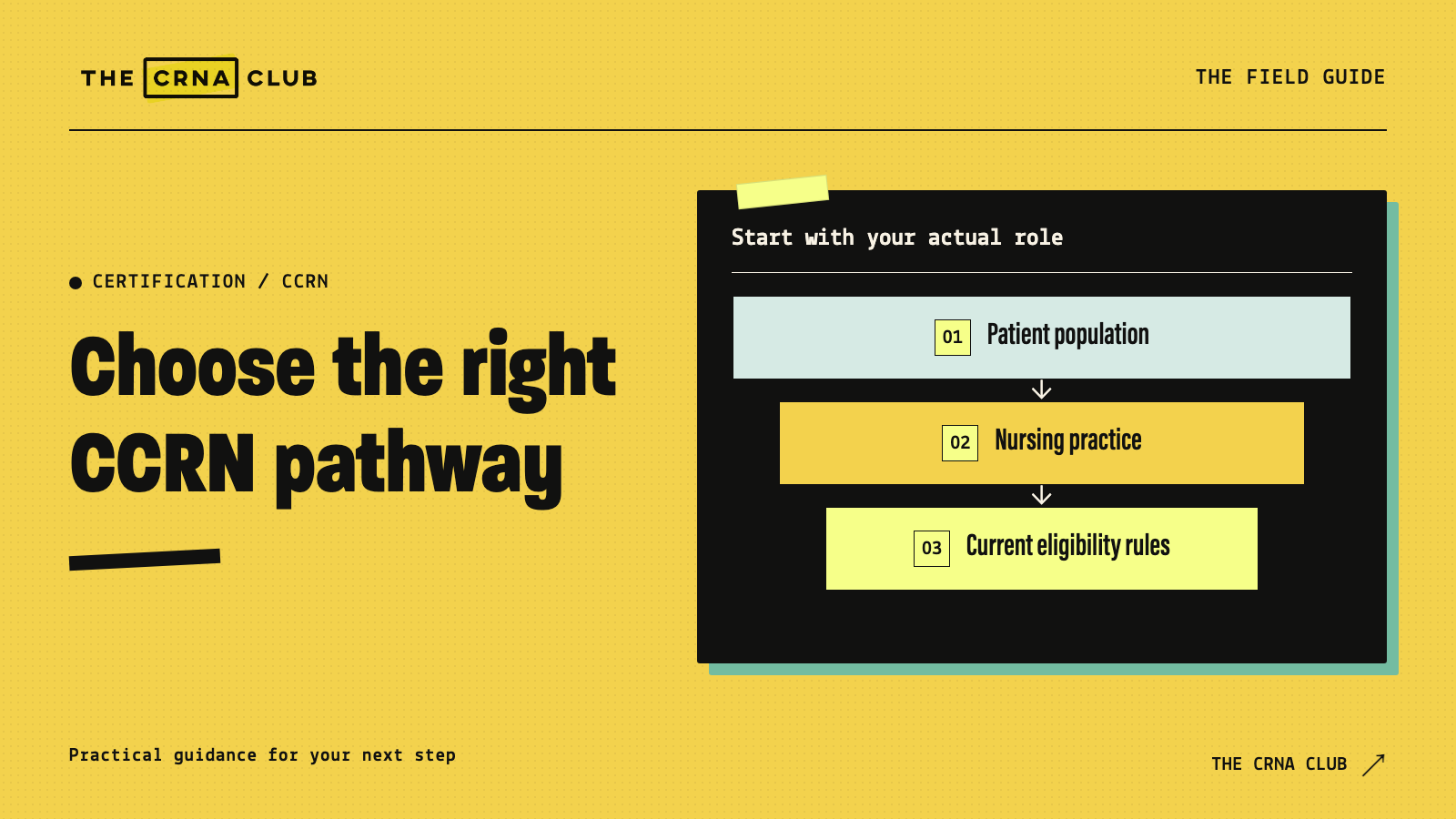
Population identifies the adult, pediatric or neonatal care relevant to the credential. Pathway identifies the kind of practice used for eligibility. Work through both questions separately, using the current handbook for the combination relevant to your actual role and patient care.
AACN’s current CCRN FAQ describes the population-specific structure and available pathways. It also explains that eligible practice hours relate to the population of the examination you are applying for.
A personal decision sheet starts simply:
-
Which patients? Adult, pediatric, neonatal or a documented mixture.
-
What role? Actual duties, including how care is provided or influenced.
-
Which period? Dates relevant to the current eligibility requirements.
-
What hours? Qualifying activity for the relevant population and pathway.
-
Who verifies? The person meeting current verification criteria.
-
What school policy? A separate check for your target programs.
Don’t begin with “which version looks better?” Begin with an accurate description of practice, then confirm which official requirements it meets.
Which pathway fits direct patient care?
Use the Direct Care requirements when your qualifying practice involves direct care of acutely or critically ill patients in the relevant population. The unit’s name alone doesn’t settle eligibility. Review actual acuity, duties and hours against the current criteria before applying.
AACN’s adult Direct Care page gives current requirements when adult care is relevant. Use the appropriate population-specific information if it isn’t.
Say your role includes more than one patient population. Write down the adults, children or neonates you cared for, your duties and the relevant dates. That gives AACN something specific to answer if the route is unclear. Your hospital’s name for the unit won’t explain the whole role.
Also check how the current rules treat particular activities. Don’t rely on an old lesson’s blanket statement about charge, orientation or teaching hours. Actual duties and official criteria matter.
If the role includes several kinds of work, describe the mixture accurately rather than selecting the most convenient label.
What does Knowledge Professional mean?
Knowledge Professional is an eligibility pathway for nurses whose work influences care without primarily or exclusively providing direct care. It isn’t a synonym for pediatric CCRN. Check the relevant population and current pathway requirements, including qualifying activities, hours and verification.
The official adult Knowledge Professional page describes roles such as educator or manager as possible examples while clarifying that a job title doesn’t automatically establish eligibility.
If you’re an educator influencing adult critical-care nursing, describe that work against the Knowledge Professional requirements. Another educator might have different duties and hours. Use the title to introduce the role, then explain what you actually do.
Don’t assume moving into a nonbedside role automatically qualifies you. You still need the current conditions and accurate evidence. If unclear, ask AACN about the specific duties and dates before purchasing preparation materials around an assumed pathway.
What does Tele-critical Care mean?
Tele-critical Care is a pathway involving care through a centralized or remote system connected to bedside care. It isn’t the neonatal examination. Use the current official criteria to check the work performed and any applicable combination of activities.
AACN’s adult Tele-critical Care page explains the role and directs candidates to its handbook. Read that page rather than inferring the scope from an old abbreviation or a colleague’s description.
The key question is what the role actually involves. Working remotely for a hospital doesn’t automatically make all work tele-critical care. Similarly, occasional use of audiovisual communication doesn’t by itself establish the pathway’s requirements.
Keep the description factual and ask a specific eligibility question when needed. A clear answer prevents the wrong study materials or application route from becoming your plan’s starting point.
How do you handle hours across different patient populations?
Track the populations separately and use the official rules for the credential you intend to pursue. A combined total doesn’t automatically count entirely toward one population. If your practice meets requirements for more than one population, AACN describes the possibility of obtaining credentials for both under the relevant conditions.
Say you’ve recorded 1,000 adult hours and 900 pediatric hours. Added together, that’s 1,900 hours. But you don’t have 1,900 adult hours. Keep the population totals separate before comparing them with the handbook’s full requirements.
The example doesn’t determine eligibility because the full requirements also include dates, duties and other conditions. It shows why the record needs population-specific detail before comparison with the handbook.
Don’t relabel patients or duties to reach a threshold. A verifier needs an accurate account, and the credential represents a specific scope of practice knowledge.
What should you check when your role changes?
Record when the duties changed and compare each period with the applicable current criteria. Initial certification and renewal sometimes involve different questions, so use the right document for the action you intend to take. Don’t assume an old eligibility conclusion applies unchanged after a major role transition.
If you move from bedside work into education, keep the dates and duties for both periods. Check which current document applies to initial certification or renewal. Don’t assume the route you used before answers every question about the new role.
Keep the old and new roles visible in the record. A general statement such as “five years at this hospital” doesn’t explain how much qualifying work occurred in the relevant period.
Also preserve verification information while it is accessible. If a supervisor changes, accurate records make it easier to identify the person meeting the current requirements rather than reconstructing duties later.
Does the correct CCRN pathway settle CRNA admission eligibility?
No. A certification’s eligibility rules and a CRNA program’s clinical or credential requirements are separate policies. Check both. A role fitting an AACN pathway doesn’t automatically establish that every program accepts the experience or uses the credential the same way.
For example, Akron’s current nurse anesthesia bulletin specifies its own clinical experience criteria. That is a program rule, not a definition AACN applies universally.
Use your target program’s current wording for the exact cycle. If it leaves your experience or credential unclear, ask with an accurate description of patient population, duties and dates.
Our CCRN application strategy guide helps frame the separate admissions check. Don’t turn a useful certification answer into an assumed school policy.
How do you choose preparation materials after confirming the route?
Choose materials for the relevant population and applicable examination scope, then audit your own gaps. A resource described only as CCRN preparation needs a closer look if its population isn’t clear. Adult teaching doesn’t automatically cover pediatric or neonatal preparation in full.
Our CCRN overview provides a broad starting point. Use the official population-specific plan for exact coverage.
Try our adult CCRN teaching and study tools through the seven-day membership trial if that matches the population you’re preparing for. Use the current population-specific AACN outline for your coverage check. Don’t assume adult teaching is a complete pediatric or neonatal review.
Use the planner after confirming the goal. Mark your workdays and dates, then review whether the calendar fits. The tool helps organize studying. AACN answers the eligibility question, and each CRNA program decides its own admissions requirements.
If you need clarification, write a concise description before contacting AACN. Include the population you care for, the role’s main duties, the dates involved and the specific requirement you cannot interpret. Ask which current pathway document applies or whether the described activity qualifies. Don’t ask only whether your job title counts. The more accurate description gives the official response something concrete to address and helps your verifier understand the same record later. Keep the reply with the relevant application documents.
What should you do before submitting the certification application?
Review the population, pathway, dates, activities and verification together. Resolve unclear hours or duties with the official source before applying. Then confirm your preparation plan uses the corresponding current outline and your school notes keep admissions requirements separate.
Write the conclusion in one sentence with its evidence. You should explain why the selected route fits your work without relying on an old acronym expansion or unit label.
Our Final Thoughts
Separate the patients from the pathway, then verify the details against your actual practice. The right route starts with an accurate record and current requirements. Once that is clear, preparation and school planning have a much more reliable foundation.
Take the Next Step
After confirming the credential and route, use the free certification planner to organize review around your schedule. It includes one lifetime free plan. Bring the applicable outline and real workdays so the calendar supports the goal you verified.