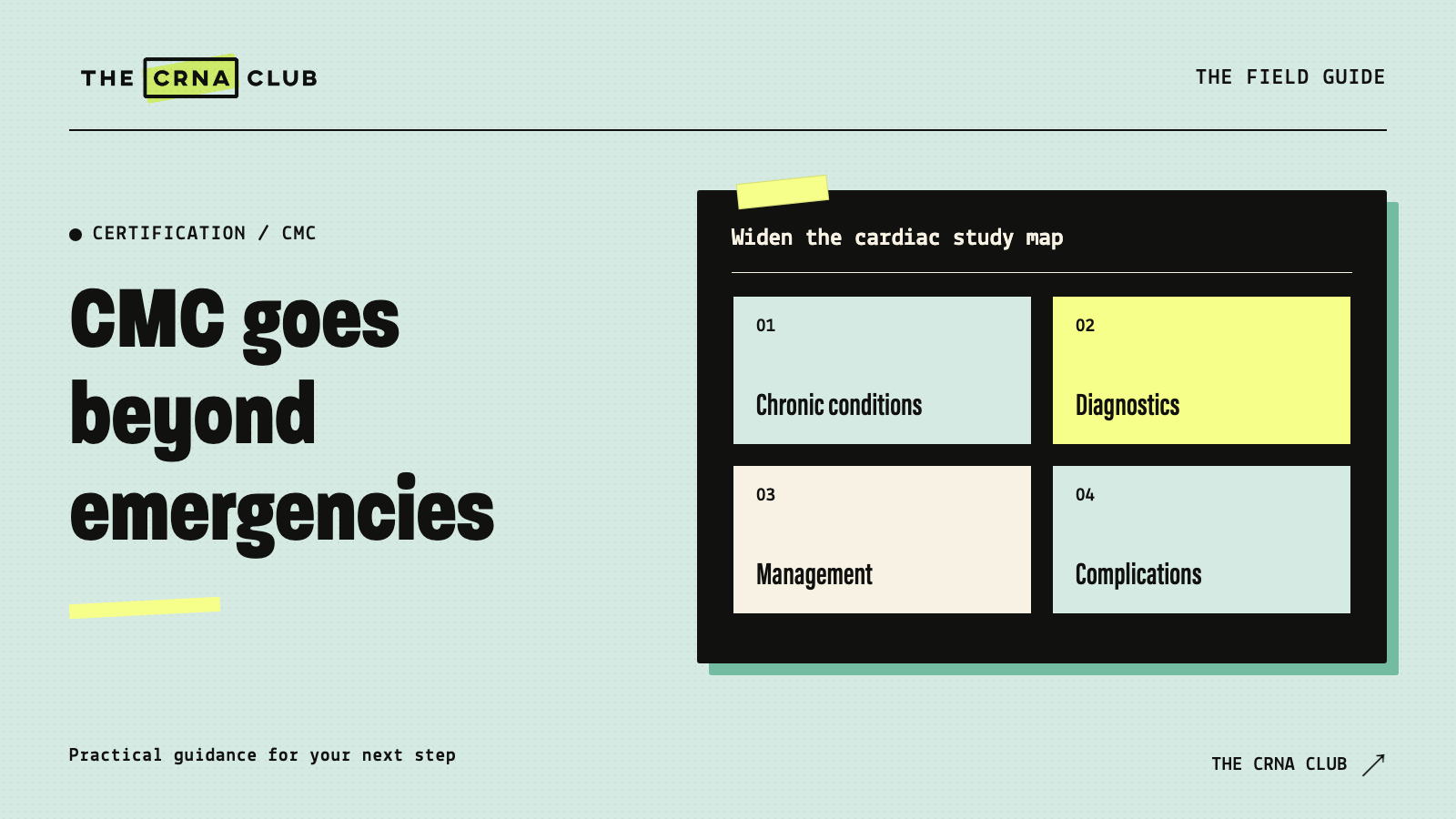
Why does CMC preparation include more than acute cardiac emergencies?
Sachi, CRNA
CRNA
In This Article (11 sections)
- What does the CMC outline actually include beyond cardiac conditions?
- Why doesn’t acute cardiac experience automatically cover that breadth?
- How should you connect noncardiac teaching with cardiac care?
- What would an integrated study case look like?
- How do you audit noncardiac coverage without getting lost?
- What if your old CCRN material explains the topic well?
- How much calendar time should noncardiac review receive?
- How do you use practice without drifting back to favorite topics?
- Where can fuller teaching help?
- Our Final Thoughts
- Take the Next Step
CMC preparation goes beyond acute cardiac emergencies because you’re caring for the whole cardiac patient. The plan includes noncardiovascular conditions, interventions and monitoring too. In the revised version effective November 19, 2026, noncardiovascular conditions account for 21%.
We suggest our CMC Review in CRNA Club membership for the subjects outside your usual cardiac cases. It includes lessons such as acute respiratory failure and stroke, alongside CMC questions and planning. Use the topic you don’t yet explain well to choose where to start.
It’s easy to keep opening familiar cardiac material because it makes sense. Let’s give the topics you’ve been skipping an actual place in your study week.
What does the CMC outline actually include beyond cardiac conditions?
Use the applicable official plan to identify its noncardiovascular scope and related nursing actions. The revised version includes a defined noncardiovascular domain alongside cardiac conditions, therapeutic interventions and monitoring. Read its topic details rather than translating the credential name into an assumption that only cardiac emergencies matter.
The official CMC test plan linked here applies on and after November 19, 2026. If your appointment is earlier, use the applicable earlier official plan.
In CMC review, connect the other condition with the cardiac patient’s care while learning its own findings. You still need to understand a respiratory or neurological problem rather than explain every new change as cardiac. Use the applicable AACN outline to choose which topics belong in that review.
Our certifications-beyond-CCRN guide gives broader credential context. Keep the exact study scope with AACN’s applicable document.
Why doesn’t acute cardiac experience automatically cover that breadth?
You see some problems far more often than others. Check the familiar explanations too, then compare them with the outline. Which topics do you rarely encounter? Which ones do you keep skipping? Those are useful places to choose the next lesson.
Say you explain familiar acute cardiac cases confidently but struggle when the question adds a respiratory or neurological problem. Your cardiac experience still helps. Now you need the explanation for that other condition and how it affects this patient. Choose that lesson instead of returning to another comfortable cardiac set.
Another nurse sees broader comorbidity but needs deeper monitoring explanations. The shared credential goal doesn’t make their starting points identical.
Give each gap a specific task. A label such as “noncardiac” covers too much to organize one session. Name the condition, relationship or interpretation you need to explain before selecting a source.
How should you connect noncardiac teaching with cardiac care?
Identify the noncardiac problem, understand its own findings and then examine the relevant interaction with the patient’s wider condition. Don’t force every new finding into a cardiac explanation simply because the certification focuses on cardiac medicine. Let the case details guide the reasoning you need to study.
Say a cardiac patient develops a change in breathing. What do you know about oxygenation? What do you know about ventilation or acid-base status? Separate those questions before choosing the explanation. Having a cardiac history doesn’t make every respiratory finding mean the same thing.
Our respiratory teaching separates oxygenation from ventilation. The AARC blood-gas guideline supports using the relevant measurements to evaluate those different aspects. They aren’t interchangeable questions simply because the same sample supplies information about them.
In study, explain which information addresses which problem. If you cannot make that distinction, review it before treating another long set of cardiac questions as the solution.
What would an integrated study case look like?
Use a short case to check which information answers which question. Keep the cardiac background, add the breathing change and explain what you still need to know. You don’t need to invent a fixed treatment sequence to practice interpreting the findings.
For an original study example, a cardiac patient receiving supplemental oxygen has an SpO2 of 97%, while an arterial sample shows PaCO2 of 60 mmHg. Does the saturation tell you carbon dioxide removal is adequate? No. The two measurements describe different information. Before interpreting the acid-base problem, ask for the pH, bicarbonate, trend and clinical context. The isolated pair doesn’t establish the cause or a treatment.
The case doesn’t establish a particular diagnosis merely by naming a cardiac history. Don’t assume every respiratory change has the same cause or that one isolated result settles it.
Now change the example. Keep the cardiac background but change the respiratory information. Explain why you need to revisit the interpretation rather than repeat a memorized response from the first version.
This approach gives the noncardiac topic its own explanation while connecting it to the broader patient picture.
How do you audit noncardiac coverage without getting lost?
Use the official topic list and a short worksheet separating exposure, explanation and next task. Start with a manageable section, then study it. A whole-outline check catches omissions, while the detailed worksheet helps choose what belongs in the next focused block.
A personal review sheet might look like this:
-
Acute respiratory failure: If exposure is frequent but oxygenation versus ventilation remains unclear, compare what each measurement tells you.
-
Stroke: If exposure is limited and you recognize the term but need mechanism review, use focused teaching before practice.
-
Acute kidney injury: If you have some exposure and know the definition but interpretation is unclear, work through the relevant explanation.
-
Thyroid disorders: If your exposure is unclear and you haven’t assessed the topic, schedule a practice check or teaching block.
Use the exact official topics in your version. Don’t invent a much larger syllabus because a textbook contains additional chapters.
The question “where does my explanation stop?” keeps the audit useful. A heading found in a book doesn’t prove the learning need is covered.
What if your old CCRN material explains the topic well?
Use accurate foundation teaching, then check whether it addresses the CMC scope and your actual gap. A resource doesn’t need a new credential label to explain a concept usefully. You still need independent retrieval and appropriate application rather than assuming the earlier pass completes the new review.
For example, your existing material might explain a basic respiratory measurement clearly. Keep it. Add focused teaching if the relevant interpretation or interaction remains unclear in a cardiac-medicine case.
The CMC examination bibliography for the revised plan helps locate targeted references. It doesn’t require purchasing every listed book.
Our CCRN overview provides general foundation context. Use the applicable CMC outline as the destination for the new crosswalk rather than treating every broad review chapter as equally relevant.
How much calendar time should noncardiac review receive?
Put noncardiac review into real blocks, then adjust for the topics you need to learn. The revised percentage helps you notice the domain, but your study hours also depend on your starting knowledge. If several concepts are unfamiliar, give them enough teaching time rather than copying a percentage and hoping it fits.
A hypothetical week includes a focused noncardiac lesson, a later independent explanation and unfamiliar application. It also preserves other CMC areas, so repairing one gap doesn’t remove the rest of the plan.
Use the month-to-week approach: mark work and available study days first, then assign the specific topic. “Noncardiac review sometime” is easy to postpone because it never becomes an appointment with a defined task.
If the work repeatedly takes longer than expected, change the timeline or task estimate. Don’t pretend a larger learning need fits simply because the calendar already has a test date.
How do you use practice without drifting back to favorite topics?
Choose some practice deliberately around the gaps identified, and include unfamiliar mixed application later. Record what the session sampled. A bank’s default setting or your own selection doesn’t automatically give every part of the outline appropriate attention.
Review correct guesses and uncertain explanations too. A topic sometimes looks stronger on the dashboard than it sounds when you explain it without choices.
If the same noncardiac concept keeps appearing in your notes, change the repair activity. Use a clearer source, a smaller foundational step or a focused discussion rather than repeating the same unanswered question.
Compare resources and automated plans with the applicable official version. Don’t assume every product setting already reflects the November revision merely because its name includes CMC.
Where can fuller teaching help?
Use our CMC lessons when the short rationale doesn’t explain the mechanism or interaction. Start with acute respiratory failure or stroke if that is where you’re stuck, then explain the main idea without the lesson open. Try a different practice example later and note which part still needs work.
Try those CMC lessons, questions and planner through the seven-day membership trial. Bring one topic you usually skip and put it in your first study block. Use the trial to learn that explanation and practice it, rather than watch more content you already understand.
Don’t turn study scope into an eligibility shortcut. Learning a topic doesn’t create qualifying clinical hours, and certification eligibility doesn’t decide whether a CRNA program accepts your experience.
Our Final Thoughts
Keep the cardiac focus and give the rest of the published scope real attention. A focused breadth audit, a connected explanation and a later unfamiliar example will tell you more than repeatedly choosing the topics you already enjoy. Put the next unfamiliar concept on the calendar.
Take the Next Step
Use the seven-day membership trial for CMC teaching and practice across the topics you need. If you want to start by scheduling your existing materials, the free certification planner includes one lifetime free plan. Compare coverage with the AACN outline for your date.