After Your First CRNA Shadow Day, What Should You Observe Next?
Sachi, CRNA
CRNA
In This Article (11 sections)
- What did you learn on the first day?
- Which parts of the role should you try to see?
- Should you observe a different setting next?
- What should you ask about decision-making?
- How can a second visit clarify the working life?
- How should you plan your next shadow day?
- How should you document another visit?
- Do more hours always make the application stronger?
- How do you use the learning in an essay or interview?
- Our Final Thoughts
- Take the Next Step
After your first CRNA shadow day, choose the next observation around a question you still have about the role. You might need a different practice setting, another phase of care or a clearer view of clinical decision-making. Meet your target programs’ documentation requirements, then use additional time to deepen understanding rather than collect hours without a learning purpose.
You’ve seen an induction, watched the monitor and followed the CRNA through part of the day. Now you’re deciding whether to go back, ask for a different setting or focus on another application task.
We recommend logging what you saw in our shadowing tracker, then choosing one question the day left unanswered. Our shadowing lessons help you prepare questions about the whole role, beyond the procedures. Explore the lessons and tracker with the seven-day trial as you decide what you want to see next.
What did you learn on the first day?
Write what you saw, what the CRNA explained and what you still don’t understand. Keep those separate. If you assumed the schedule was typical but never asked, that’s a question for next time.
Use a worksheet like this:
| Part of the day | What I directly observed | What I still need to understand |
|---|---|---|
| Before the procedure | Assessment, preparation or patient conversation | How findings changed the plan |
| During anesthesia | Monitoring and adjustments I could follow | What the clinician was anticipating |
| Recovery and handoff | Transition and communication | How readiness and next needs were assessed |
| Working life | Schedule or teamwork discussed | What varies in other settings |
Keep the reflection free of patient identifiers. You need the learning, not a detailed clinical narrative.
A useful question could be, “I saw the CRNA change the plan after assessing the patient, but I didn’t understand which finding drove the choice.” That’s a better starting point than requesting another day simply because the last one was interesting.
Which parts of the role should you try to see?
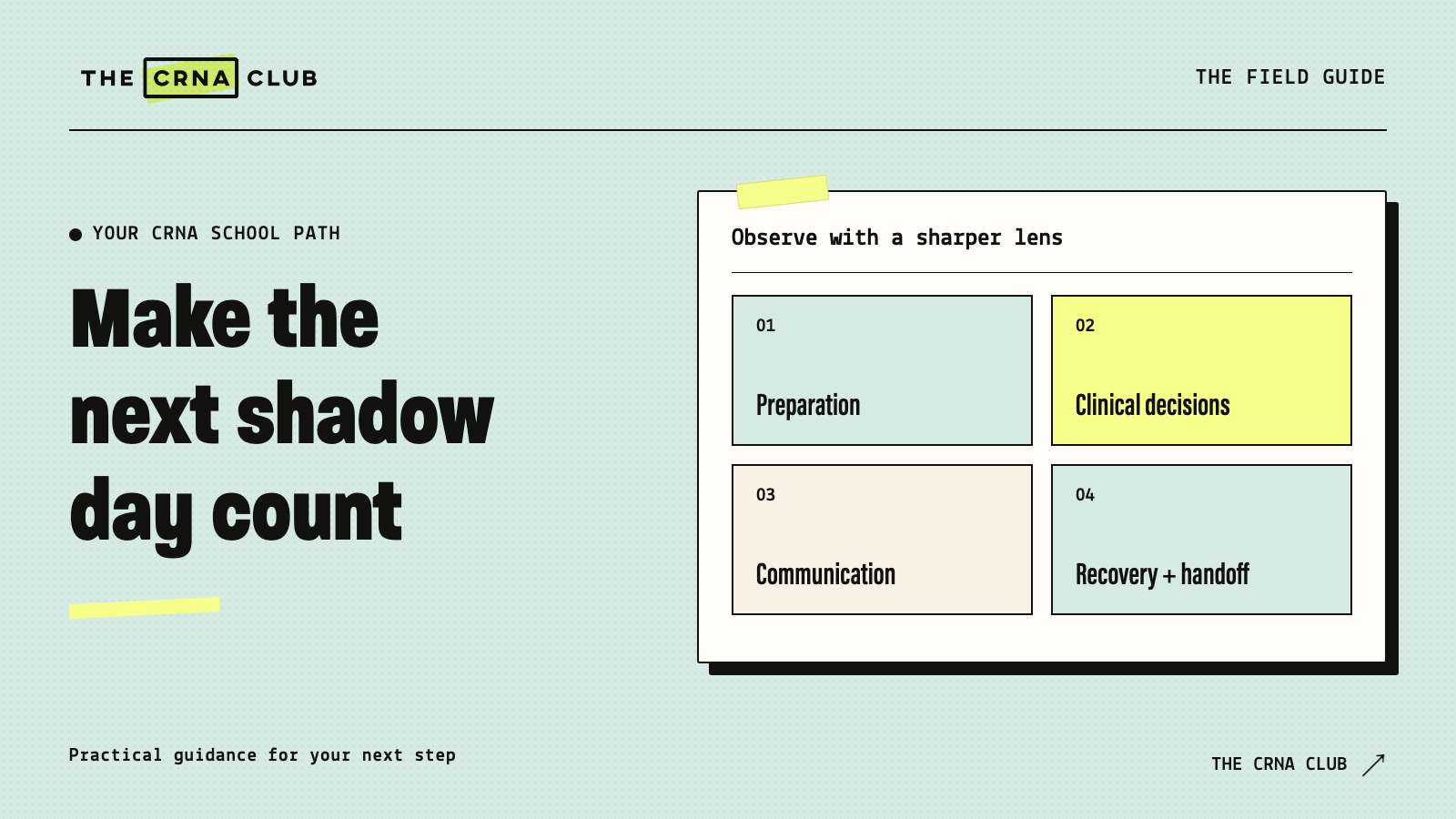
Look across assessment, planning, anesthesia care and the transition afterward. A procedure can be memorable, but the role includes decisions and communication throughout the patient’s experience. If your first visit showed only one phase, ask whether an approved future visit could help you understand the parts you missed.
The AANA’s current practice-standards guide for RNs includes assessment, planning, communication, equipment and patient management. Those topics give you a more complete view than asking only whether you saw an intubation.
A University of the Incarnate Word shadow-verification form also describes observation across phases of anesthesia care. It’s one program’s documentation example, not a universal form, but it shows why the whole day matters.
Our shadow-day question guide helps you prepare questions within those phases.
Should you observe a different setting next?
A different setting is useful when it answers a specific question about the work. You could compare inpatient and outpatient practice, a different patient population or a setting with another teamwork structure. Don’t assume a setting is better merely because its cases sound more complex. Ask what you want to understand there.
For example, your first day might have been a scheduled outpatient list. You learned about preparation, continuity and recovery, but you’re curious about how hospital practice handles unscheduled work and different support resources.
Or you began at a large hospital and want to understand a smaller practice. Ask about how the team organizes care, what resources are available and how the clinician’s day is structured. You don’t need to claim one setting has more “real” anesthesia than the other.
A change in setting can broaden your view. It doesn’t guarantee you’ll see every technique, schedule or challenge during one visit.
What should you ask about decision-making?
Ask the CRNA to explain a choice when patient care allows time for teaching. Focus on what information mattered, what alternatives were considered and what response they were watching. You’re learning how the clinician thinks, not testing them or asking for a complete anesthesia lecture during a busy case.
Useful questions include:
- “Which part of the assessment most affected the plan today?”
- “What are you watching for as the case progresses?”
- “What would make you reconsider this approach?”
- “How do you prepare for a problem before it happens?”
Let the clinician choose an appropriate time and level of detail. If the patient needs attention, stop the conversation. Write down a broad learning question afterward and review it through an educational source.
Our OR terminology guide can make the next visit easier to follow. You don’t need to master every mechanism first, but understanding the terms frees you to listen to the reasoning.
How can a second visit clarify the working life?
Ask about a representative schedule, call, teamwork, learning and the less visible responsibilities of the role. Keep the answer attached to that clinician and setting. One CRNA’s work arrangement is useful insight, but it doesn’t establish what every future job will require or what you personally will prefer after training.
A thoughtful conversation can include what the clinician enjoys, what is difficult and what they wish they had understood before school. Ask how the work differs from the ICU nursing you know.
You can also ask what changes across practice settings. Rather than “Do CRNAs have a good lifestyle?” ask, “How does the call arrangement affect your week, and what would be different in another position you’ve held?”
Don’t turn a shadow day into salary negotiation or a request for a future job. Your immediate goal is informed career exploration.
How should you plan your next shadow day?
Choose a question, identify the experience most likely to help and prepare a few observations to compare. Keep the request realistic and follow the facility’s approval process. A clear learning purpose makes the plan more useful, even if the available cases differ from what you expected.
Consider hypothetical applicant Eva.
Eva’s first visit showed a CRNA managing scheduled outpatient procedures. She can describe the continuous assessment, but she still sees the role mostly through medications and airway skills. Her next learning question is how preoperative findings shape a plan and how that plan changes when the clinical picture changes.
She asks whether a future approved visit could include more of the preoperative workflow. She prepares a few questions and watches how the clinician communicates the plan. Afterward, Eva adds the experience and observed skills to her shadowing tracker. She compares her notes from both visits and chooses one new question to review. That’s how we suggest using the log to learn from each visit.
She doesn’t need a dramatic emergency to learn something meaningful. A routine change in planning can deepen her understanding when she pays attention to the reasoning.
How should you document another visit?
Check each school’s required hours, observer relationship, setting and verification process before the visit. Bring the requested form when appropriate and confirm whether the host can complete it. Keep the formal attendance record separate from your personal reflection so neither one is mistaken for the other.
Keep the school’s signed form when it requires one. Use your own notes and tracker to remember what you learned and what you want to ask next.
Our shadowing form and log guide helps organize the paperwork. Don’t assume a clinician can sign for hours they didn’t observe or that an informal conversation counts as a clinical shadow day.
If you’re returning to the same institution, check whether repeat observation is allowed. A prior approval doesn’t create unlimited access.
Do more hours always make the application stronger?
More time is useful when it meets an actual requirement or adds meaningful understanding. There isn’t a universal hour total that proves competitiveness. Once you have met the target school’s rule, compare the learning gained from another visit with the other preparation needs you’ve identified.
Maybe your next useful step is a different setting. Maybe it’s completing an approved prerequisite, reviewing a clinical gap or practicing how you explain your motivation. A schedule filled with repeat shadow days can still leave those tasks unfinished.
Use the shadow-hour requirements guide to check the rule, then give the next experience a reason. You can value shadowing without treating every additional hour as an admissions point.
How do you use the learning in an essay or interview?
Describe what the experience taught you about responsibility, assessment, decision-making or communication, then connect it to your actual goals. Avoid reciting every case you saw. The reader or interviewer needs to understand how the observation changed your understanding, not how many unfamiliar procedures you can name.
For example, a fictional reflection could explain that you first focused on induction, then recognized how much planning and reassessment happened before and after it. The useful part is the change in understanding and what you did to explore it further.
Keep the account truthful and private. Don’t turn a clinician’s personal story into your own experience or use a patient’s identifiable circumstances to make the opening more dramatic.
Our Final Thoughts
Write one question the first visit left unanswered. Use that question to choose the next setting or part of the day you want to observe, then confirm the host’s process for another visit.
Take the Next Step
Log your first visit and write one question for the next one. We recommend our shadowing lessons and tracker to help you prepare, record the experience and follow up with the CRNA. Explore them with the seven-day trial.