How Do You Find CRNA Shadowing If Your Hospital Does Not Have CRNAs?
Sachi, CRNA
CRNA
In This Article (11 sections)
- Where should you start when your own hospital has no CRNAs?
- Does every facility want you to contact a CRNA directly?
- How do you organize the search without sending duplicate requests?
- What should the first inquiry say?
- Can a professional connection help?
- What onboarding information should you expect to clarify?
- How do you make sure the visit meets your school’s requirement?
- What if the facility declines or doesn’t respond?
- What should you do once you secure a visit?
- Our Final Thoughts
- Take the Next Step
If your hospital has no CRNAs, look for an approved shadowing route at another hospital, an anesthesia department or an outpatient setting. Start with the facility’s official observer instructions. Some places require a central request, while others require a sponsoring clinician. A CRNA’s willingness to host you is helpful, but it doesn’t replace facility approval.
Not knowing a CRNA at work doesn’t mean you’re stuck. We recommend our shadowing lessons to help you plan the request and prepare for the day. Our shadowing and CRNA contact tracker gives you a place to keep contacts and follow-up as you build those connections. Explore both with the seven-day trial.
Start by finding the facility’s request process. Then send the short inquiry below through the right route.
Where should you start when your own hospital has no CRNAs?
Create a short list of nearby facilities where CRNAs practice, then find each facility’s observer or anesthesia-department instructions. Include hospitals outside your system and appropriate outpatient settings. Confirm whether they accept external observers and how requests are initiated. Don’t assume a facility hosts shadowing simply because it provides anesthesia services.
Search the official site for terms such as “CRNA shadowing,” “anesthesia observation” and “observer program.” If you find only a general education page, look for the department’s designated contact rather than guessing a clinician’s email.
Your list can include a hospital anesthesia department, ambulatory surgery center or other setting where you can observe a CRNA’s actual work. Check your target school’s requirements before choosing an unusual setting or a different type of anesthesia professional.
Our general shadowing guide covers finding opportunities. This article focuses on the routing problem when you’re an external nurse without a contact inside the facility.
Does every facility want you to contact a CRNA directly?
No. Read the official process before reaching out. Some departments coordinate all requests centrally and ask applicants not to schedule directly with clinicians. Others require a host to sponsor the observer request. Following the correct route matters more than collecting a long list of personal contacts.
For example, the University of Maryland’s CRNA shadow-day page directs requests through its official form and asks applicants not to arrange shadowing directly with individual CRNAs.
UC San Diego Health’s observer program describes a different process in which a host department initiates the observer request. That difference explains why a general “email the chief CRNA” rule won’t fit every facility.
Check whether the facility currently accepts external RN observers before requesting a date.
How do you organize the search without sending duplicate requests?
Keep one row per facility with its route, eligibility information, contact or form, dates requested and response. This prevents you from submitting a central form and then separately messaging several staff members about the same visit. It also shows whether you’re waiting, missing paperwork or looking at a facility that doesn’t accept external observers.
A practical search sheet could look like this:
| Facility | Official route | External nurse eligible? | Current status | Next action |
|---|---|---|---|---|
| Hospital A, hypothetical | Central CRNA request form | Confirmed | Submitted | Follow stated response instructions |
| Hospital B, hypothetical | Host-sponsored observer request | Unclear | Not started | Ask department about eligibility |
| Surgery center C, hypothetical | Administrator coordinates requests | Not yet confirmed | Inquiry sent | Wait for response |
| Hospital D, hypothetical | External observation unavailable | No | Closed option | Remove from active follow-up |
Use the dates you actually have available. If you work rotating shifts, give several options rather than asking the host to solve your whole schedule.
A short list of well-researched requests is easier to manage than dozens of messages you can’t track.
What should the first inquiry say?
Use the first inquiry to find the correct process. Include:
- Who you are, including external-RN status when it affects eligibility.
- What you want to learn from observing a CRNA.
- A question about the approved request or sponsor route.
- Available dates only when the instructions request them.
Keep private documents out of the first message unless the official application asks for them through that channel.
A fictional inquiry might read:
Dear Anesthesia Education Team,
I’m an ICU RN at another health system and am exploring nurse anesthesia. My hospital does not have CRNAs, so I’m looking for an approved opportunity to observe the role. Does your department accept external RN observers, and is there a specific application or sponsor process I should use? I’m happy to follow the required onboarding steps.
Thank you for your time,
Jordan Patel
If a central form is required, use it instead of sending that email. If the facility requires a host, tailor the request to the department’s instructions.
You don’t need a dramatic account of your career goals. A clear purpose and respect for the process are enough for an initial inquiry.
Can a professional connection help?
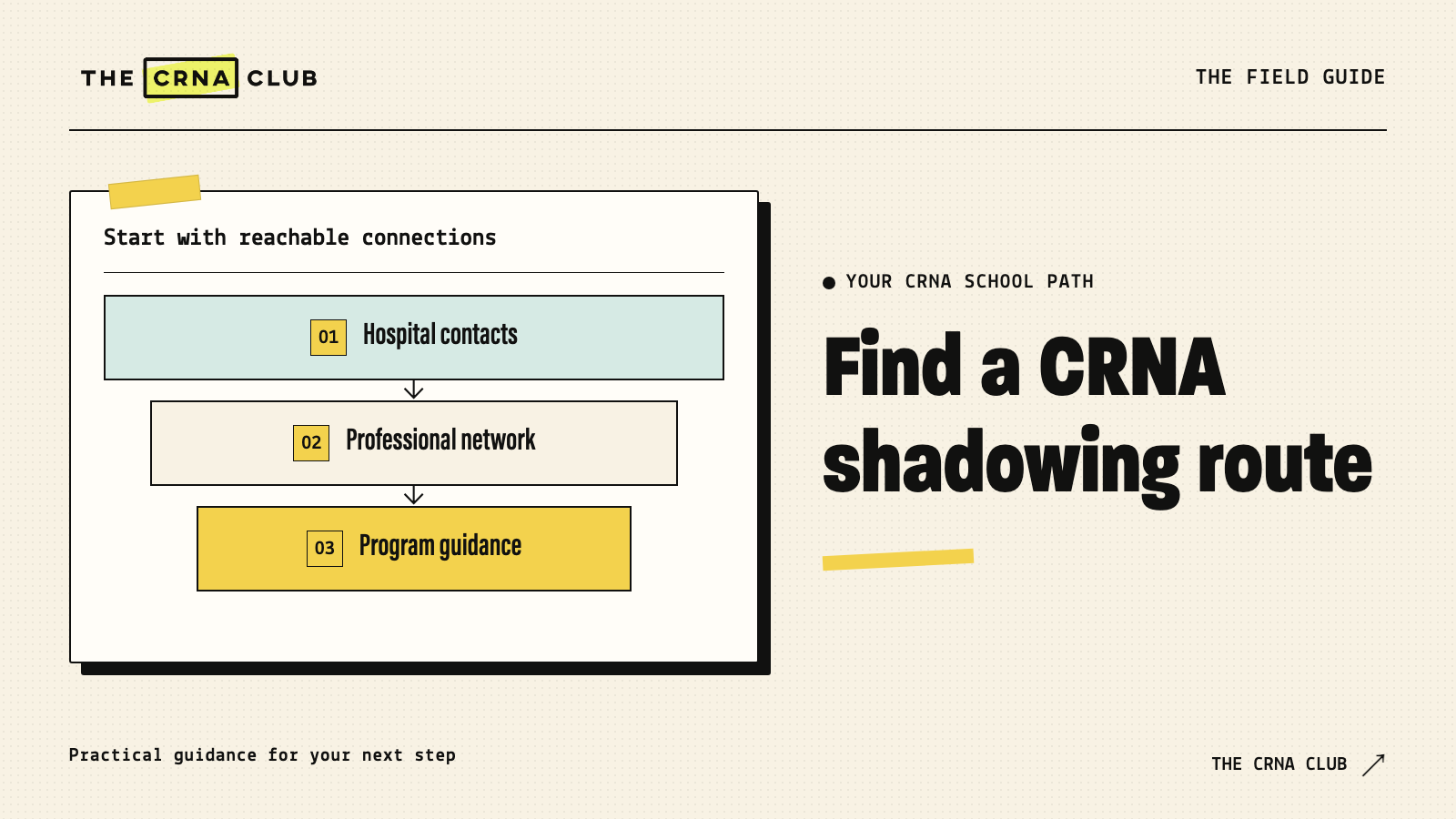
A connection can help you identify the correct route or a willing host, but it doesn’t override observer requirements. Ask whether the person knows the approved process at their institution. Professional meetings, local nursing contacts and education events can create opportunities for that conversation without turning it into a demand for access.
You might say, “My hospital doesn’t have CRNAs, and I’m trying to understand approved shadowing options in the area. Do you know which department or observer office I should contact?”
You’re asking for a useful introduction to the process. That’s easier to answer than “Can you arrange shadowing for me?”
When someone offers to host you, add the contact and agreed follow-up to our shadowing tracker. Thank them and ask what approval is still needed. A personal yes and an approved observation date are different stages. Keep both in the tracker so you don’t arrive before the facility has cleared the visit.
What onboarding information should you expect to clarify?
Ask what documents, training, identification and clearance the facility requires, and where to submit them. Confirm the allowed observer role, arrival instructions and any restrictions. Requirements differ, so use the official checklist rather than assuming an RN license or a badge from another employer gives you access.
A facility might need health documentation, confidentiality agreements or an observer badge. Don’t send sensitive material to an unverified personal email just because someone says they know a CRNA who can help.
Once approved, ask about clothing, parking, check-in, where to meet and what to bring. Our shadow-day preparation guide helps you prepare those practical questions.
Shadowing is observation. Follow the approved role even if you already know how to perform a task as an RN in your own workplace. Your employment elsewhere doesn’t create clinical privileges at the host facility.
How do you make sure the visit meets your school’s requirement?
Check the required observer relationship, setting, documentation and hours before the visit. Bring the school’s form when required and ask the host whether it can be completed. Don’t assume an institution will verify hours, provide a recommendation or allow repeated visits simply because it approved one observation.
Some schools require a CRNA specifically, while others accept another anesthesia professional. Use the actual rule for the application you intend to submit.
The shadowing form and log guide helps you organize the record. Keep observation time distinct from paid clinical work or online education. If the host cannot provide the documentation your school requires, ask admissions how to proceed before treating the requirement as complete.
What if the facility declines or doesn’t respond?
Respect a decline and follow any stated response timeline. If no timeline is given, one concise follow-up through the same appropriate channel can clarify whether the request was received. Then continue with other eligible options. Repeated personal messages won’t create clinical capacity or an observer program where one isn’t available.
A useful follow-up says, “I’m checking whether my external RN observation inquiry from June 3 reached the correct office. If your department is not accepting observers, I understand and appreciate the clarification.”
Don’t frame a no as evidence the profession doesn’t welcome you. The facility can have limited space, restricted eligibility or other operational reasons. You only know what it tells you.
If your geographic search is very limited, ask whether a target program has a formal shadowing resource. It might, but don’t assume it can place every applicant.
What should you do once you secure a visit?
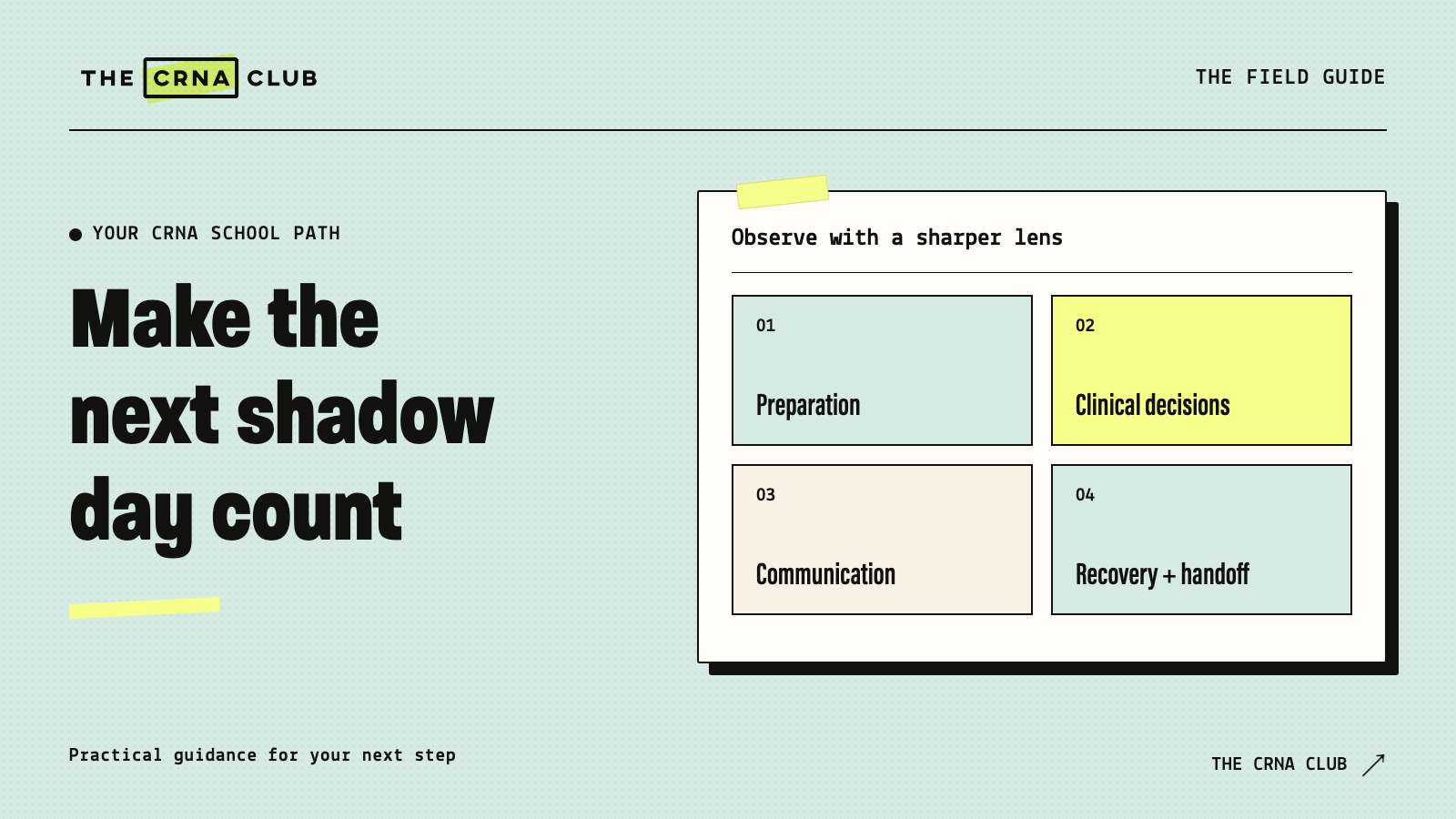
Prepare a few questions about the role, understand the expected conduct and think about what you want to learn across the day. The time becomes more useful when you observe assessment, planning, monitoring and handoff rather than watching only the most visible procedure. Ask questions when the clinician has space to answer.
Our questions-to-ask guide helps you choose questions that fit your stage. Keep your notes free of patient identifiers and record the learning, not private clinical details.
Our Final Thoughts
A coordinator’s answer that external observation is unavailable lets you close that option and focus on facilities that accept your situation.
Take the Next Step
Choose one facility and find its external-observer instructions. We recommend our shadowing lessons for preparing your request and questions, and the contact tracker for keeping the follow-up straight. Try them with the seven-day trial.