Can You Take CRNA Prerequisites Online With Labs?
Sachi, CRNA
CRNA
In This Article (9 sections)
- Why does the exact program policy matter?
- What belongs in a course evidence packet?
- How should you describe an online lab?
- What should the approval email ask?
- How do you compare approval across several schools?
- How should you check workload before enrolling?
- What should you save after the course is approved?
- Our Final Thoughts
- Take the Next Step
Yes, you can take online prerequisites when your target CRNA schools accept the exact course and lab format. We suggest using our Transcript Analyzer to identify what you’ve already completed, then comparing what’s missing with your school list. The seven-day trial includes prerequisite lessons and school research tools to help you plan the course. Get the lab question answered before paying tuition.
Convenience matters when you’re working ICU shifts. But a flexible course only helps if it does the academic job you need. Don’t pay tuition based on a provider’s broad claim that its courses serve health-professions applicants.
Our prerequisite course hub helps you research options. Once you find one, collect the syllabus, credits and lab details. Let’s make the question specific enough for your school to answer, instead of asking whether it accepts online classes in general.
Why does the exact program policy matter?
Program policies differ on course subjects, labs, grades and format. A course accepted by one school isn’t automatically accepted by another, even when both use the same prerequisite name. Compare the actual rules for each target program and keep a separate decision for every course-school combination.
For example, Columbia’s nurse anesthesia prerequisite page states online and community-college courses are acceptable and that science labs aren’t required under its published policy. That doesn’t settle a program requiring a lab.
Keiser’s entry DNAP page accepts fully online coursework subject to its other requirements and lists a lab condition within its chemistry requirements. Use the actual chemistry and institution rules rather than transferring Columbia’s lab policy to Keiser.
These are examples of current published differences, not a complete list of schools accepting every online lab. Verify your own targets and proposed course. If the wording doesn’t explicitly settle the lab modality, ask before assuming.
Keep the date with the answer. A course approved for an earlier cycle or another applicant may have different details from the one you’re considering now.
What belongs in a course evidence packet?
We suggest sending a short course packet with the actual syllabus and lab description. Include the institution issuing the transcript, course number, credits and expected finish date. If the school has a formal course-review process, use it. The checklist below helps you gather the details without sending an entire catalog.
Use this checklist:
- Awarding institution: The college or university issuing the transcript.
- Course identity: Exact title, prefix and number.
- Academic level: Undergraduate or graduate classification.
- Credits: Semester, quarter or other stated unit.
- Lecture content: Current description and syllabus.
- Lab: Separate or integrated, its credits and actual modality.
- Grading: Letter grade, pass/fail or other format.
- Assessments: Proctoring or attendance information if the school requests it.
- Timing: Start, finish and expected transcript-posting dates.
The awarding institution matters when a course is advertised through another platform. Ask who provides the official academic record and retain the exact course link. Don’t assume the website selling enrollment is the institution appearing on the transcript.
You don’t need to send an enormous catalog. A few clearly labeled documents and links make the review easier. The packet should answer the specific policy questions without requiring admissions to search through unrelated course options.
How should you describe an online lab?
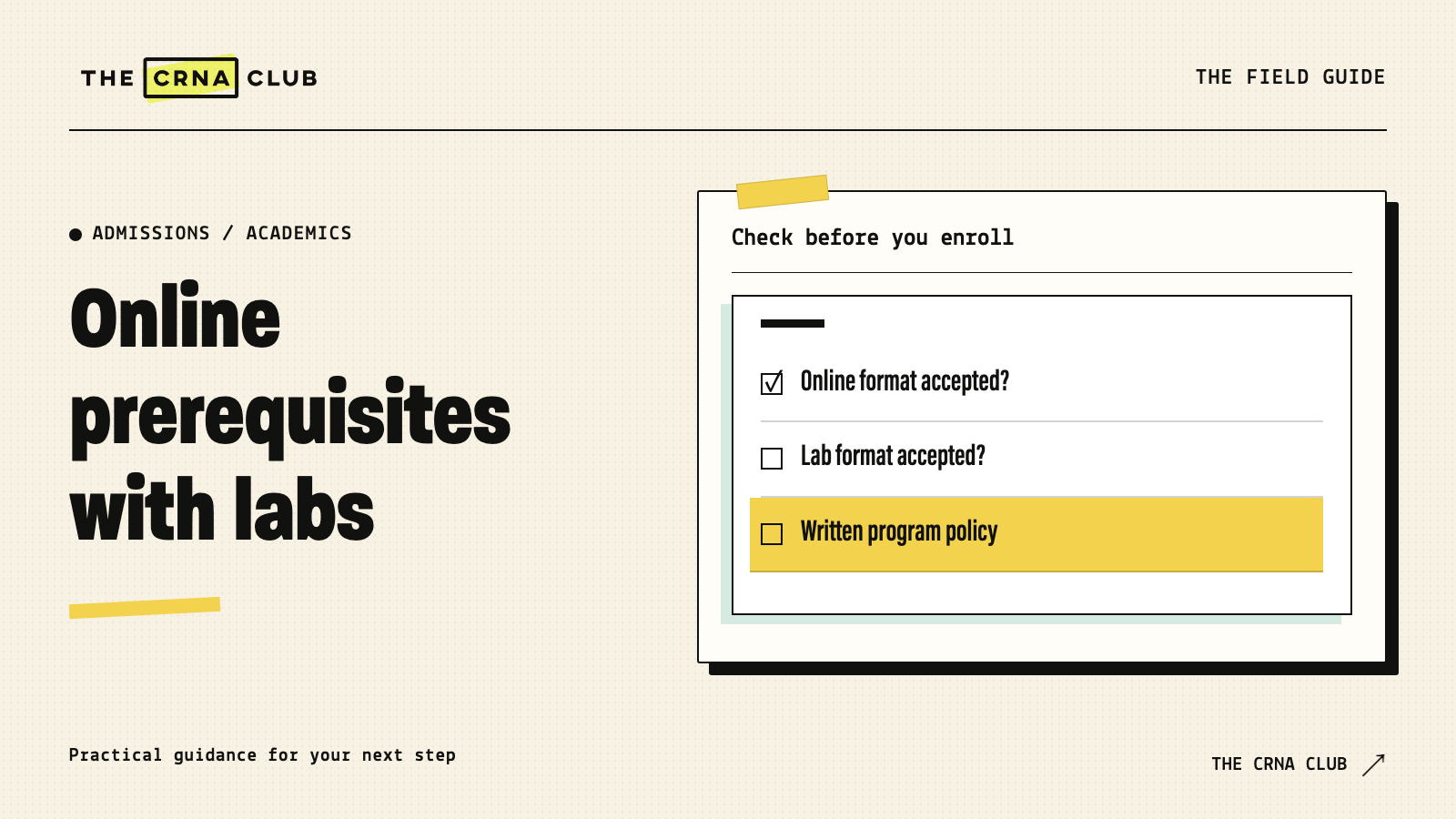
What does online lab mean for this course? A simulation? A kit you use at home? A live remote session? Ask the provider and get the current description. Then send that format to your school. Acceptance of an online lecture doesn’t automatically answer the lab question.
Johns Hopkins’ prerequisite course page offers online courses and warns that virtual labs aren’t accepted everywhere. A provider’s own acceptance policy doesn’t establish acceptance at every receiving nurse anesthesia program.
Write the format in plain language: “The lab uses ___, carries ___ credits and appears on the transcript as ___.” If the provider doesn’t answer one of those questions, leave it unresolved and follow up.
Also check whether the lecture and lab are separate registrations. A course title containing “with lab” isn’t enough if your registration only covers the lecture. Verify the final transcript record for the option you’re buying.
If a program requires an in-person component, a flexible online lecture might still be part of a workable plan, but confirm the combined arrangement. Don’t assemble two courses from different institutions and assume they satisfy one requirement without review.
What should the approval email ask?
Ask whether the exact course and lab meet the named prerequisite for the intended application cycle. Include the packet and separate acceptance, grade, recency and timing questions. Avoid asking whether an online class “looks bad,” because that wording doesn’t identify a policy decision admissions can answer clearly.
A focused request might read:
I’m planning prerequisite coursework for the upcoming nurse anesthesia application. Would the attached course satisfy your ___ requirement? It is offered by ___, carries ___ semester or quarter credits, and uses this lab format: ___. The syllabus, grading and expected completion date are included. Please let me know whether the course is accepted or whether you require a formal equivalency review.
If needed, add one timing question: “Must the final grade be available at application, interview or matriculation?” Ask the program rather than deciding from another school’s timeline.
Keep the response with the packet. If the school accepts the course subject to a grade or date, retain those conditions too. A partial yes isn’t an unconditional approval.
Follow any official review process. A general email about online coursework may not establish equivalence for a specific course, so make sure the answer addresses the actual course number and lab you intend to take.
How do you compare approval across several schools?
Put each target school in its own row and record its answer about the same course. Does it accept the lecture and lab? Is there a grade or date condition? We suggest keeping that with your school research so one yes doesn’t turn into an assumption about your whole list.
| School | Published rule or answer | Course and lab status | Condition to track |
|---|---|---|---|
| School A | Accepts the specific packet | Confirmed for stated purpose | Minimum grade and completion date |
| School B | Requires a different lab format | Not accepted as proposed | Investigate another option |
| School C | Review requested | Unresolved | Submit formal equivalency materials |
These are hypothetical labels, not named-school decisions. Use the actual answer you receive. Wait for the school’s answer before marking that course confirmed.
A course accepted by more targets may simplify the plan, but keep cost and workload in view. You don’t need to take the most expensive option for maximum theoretical flexibility if it doesn’t fit the schools you would actually attend.
Our where-to-take prerequisites guide covers the broader search. Use this packet worksheet to verify the specific option you choose from that search.
How should you check workload before enrolling?
Review the real assignment, lab and exam schedule alongside ICU shifts and application deadlines. Self-paced doesn’t necessarily mean no fixed completion conditions, immediate grading or unlimited flexibility. Confirm the provider’s rules and leave time for the final grade and transcript process needed by your target programs.
Ask about instructor response time, assessment windows, lab shipping if applicable and the latest date for completion. Check whether earlier coursework is required for enrollment. A course you are allowed to buy may still be difficult to complete without its expected foundation.
Build a sample week before registering. Put in your work shifts, protected sleep, lecture study, lab tasks and exams. If all the lab work lands immediately after shifts, reconsider the course timing or overall load.
The GPA + Prerequisites lessons help connect course choices and schedules with the actual application plan. Explore the seven-day membership trial while checking which class solves your academic gap and when it realistically fits.
What should you save after the course is approved?
Save the syllabus you sent and the school’s reply together. If you switch course numbers or the provider changes the lab, ask whether the approval still applies. After the course, check that the transcript shows the title, credits and grade you expected before sending it through the application process.
After completion, follow the application’s instructions for reporting the course and sending its original transcript.
Our Final Thoughts
An online course can fit a working nurse’s schedule well when its academic details match the requirement. Verify the actual course and lab before paying, then protect enough time to do the work well.
A clear packet makes the question easier for everyone. You know what you’re asking the course to accomplish, and the program has the information needed to review it.
Take the Next Step
Start with the free Transcript Analyzer, which includes one lifetime free analysis, to review the prerequisites you already have. Try our seven-day membership trial for prerequisite lessons and school research tools. Choose the missing course, build the short packet above, and get the exact lecture-and-lab arrangement confirmed before enrolling.