CRNA School Requirements Data: GRE, CCRN and Prerequisite Policies
It gets confusing when two schools both say you don’t need a test, then give you different instructions about submitting scores. When you compare CRNA school requirements, read past the yes-or-no checkbox. Rush accepts optional GRE scores. USC doesn’t consider them. Neither requires the test, but that doesn’t give you the same plan for both schools.
Sachi, CRNA
CRNA
In This Article (7 sections)
We compared eight policies from five programs to show where the wording changes what you need to do. Start your list in the CRNA Club School Database, then check the program’s own policy before paying for a test or another class. The seven-day platform trial adds the broader application-planning tools and learning library.
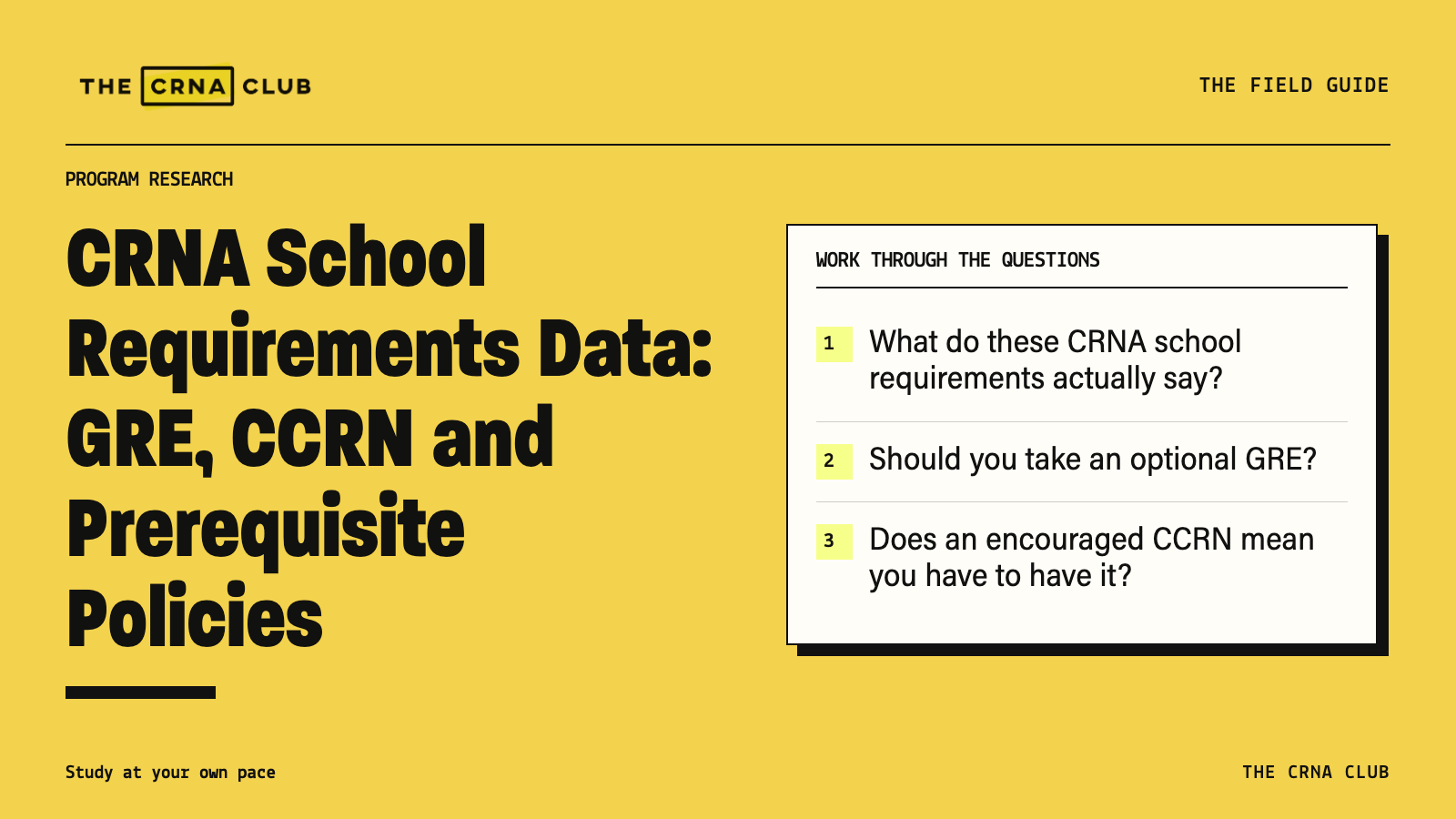
What do these CRNA school requirements actually say?
The examples below cover the GRE, CCRN, course age, labs and shadowing. We checked the linked school pages on November 21, 2026. A few programs appear more than once because we’re comparing different requirements at the same school.
We chose examples with different rules. Eight policy examples from five programs won’t tell you what percentage of all CRNA schools requires a test. They will show you why a simple checkbox sometimes leaves you with the wrong next step.
| Program and measure | Published policy | What the wording means |
|---|---|---|
| USC: GRE | The GRE is neither required nor considered, effective January 1, 2024. | Not considered |
| Rush: GRE | Scores are not required. Applicants are invited to submit them if they believe the scores strengthen the application. | Optional submission |
| Samford: CCRN | Certification is encouraged but not required. | Encouraged |
| TCU: CCRN | CCRN is required. The FAQ does not accept CEN or RN-C as substitutes. | Required |
| Columbia: Course recency | No prerequisite expiration. A refresher is recommended for science or statistics taken over five years ago. | Refresher recommendation |
| USC: Course recency | Anatomy, physiology, general chemistry and biochemistry or organic chemistry older than ten years must be retaken. | Required retake for named courses |
| Columbia: Science labs | Labs are not required for science prerequisites. | Not required |
| USC: Shadowing documentation | A quality shadow experience has no minimum hours. A quality CRNA interview is an allowed substitute using the amended form. | Alternative permitted |
Look at the GRE rows. If scores are optional, you have a decision to make. If the program won’t consider them, studying for that test won’t add anything it has agreed to review. Now look at the older-course rows. A recommendation to refresh your knowledge and a required retake give you different things to put on your calendar.
Keep the school’s wording beside your notes in the School Database. Our data methodology explains how we keep source links and verification evidence with program information.
Should you take an optional GRE?
Well, start with your school list. Rush invites you to submit scores if you believe they strengthen your application. USC says it doesn’t require or consider them.
Say you need chemistry and you’re also thinking about GRE prep. If every school on your list excludes GRE scores, put that time toward something those schools will review. If a school accepts optional scores, ask how it uses them before deciding where to spend your study time.
An optional score doesn’t come with a promise to offset a low GPA. Find out what the program says, then decide whether the test addresses a weakness in your application. Our GRE guide walks through that decision in more detail.
Does an encouraged CCRN mean you have to have it?
No. Samford encourages CCRN certification without requiring it. TCU requires the CCRN and says CEN and RN-C don’t substitute for it.
You might decide to earn your CCRN for the preparation even when a school doesn’t require it. Keep that decision separate from the school’s application rule. And check when it needs proof. Having it by enrollment is a different timeline from having it when you apply.
There is also a current testing problem to plan around. In its November 19, 2026 notice, AACN suspended testing until further notice. If that affects your deadline, contact the CRNA program with your exam documentation and ask what it will accept. A canceled exam doesn’t change the school’s rule by itself. Save the program’s answer.
Do you need to retake an older prerequisite?
Look at the exact course and the date the school uses. Columbia doesn’t expire prerequisites, but recommends refreshers for older science and statistics courses. USC requires retakes of named sciences older than ten years and gives a deadline tied to enrollment.
All right, say you took chemistry nine years ago. You’re within ten years now. Will you still be within ten years when you start the program? Work from the date the school actually uses before deciding the class is done.
Before registering for a replacement, check:
- Does the subject and course level match? Include the credits.
- Is a lab required, and does the school accept the course format?
- What’s the minimum grade, and how old is the course allowed to be?
- Do you need it finished before applying or before enrolling?
Our prerequisite-expiration guide helps you work through those questions. Even if your course hasn’t expired, look at the rest of your recent science work. Meeting the prerequisite answers whether the class counts. Your grades and recent coursework help you decide whether more academic preparation would be useful.
What if two official pages give you different answers?
Ask the program which rule applies to your entry class. Read the nurse anesthesia instructions first; a general graduate-school page might describe another program. And if a requirement isn’t mentioned, don’t assume it’s waived.
You could send:
I’m preparing an application for the [entry cohort]. The nurse anesthesia page says [policy], but [other official page] says [different policy]. Which rule applies to this cohort, and when do I need to submit the documentation?
Include both links. Save the reply with its date and who answered, so you know which application it covers. Then update your own checklist.
Our Final Thoughts
If your school list has left you with more questions than answers, start with the requirement that changes your next decision. Do you need to book a test, retake a course or ask the program for clarification? Get that one answer before adding another task to your calendar.
Turn the requirements into your next steps
We suggest using the School Database to compare your programs, then checking the linked policies for your entry class. For more application-planning tools and educational content as you prepare, try The CRNA Club free for seven days.