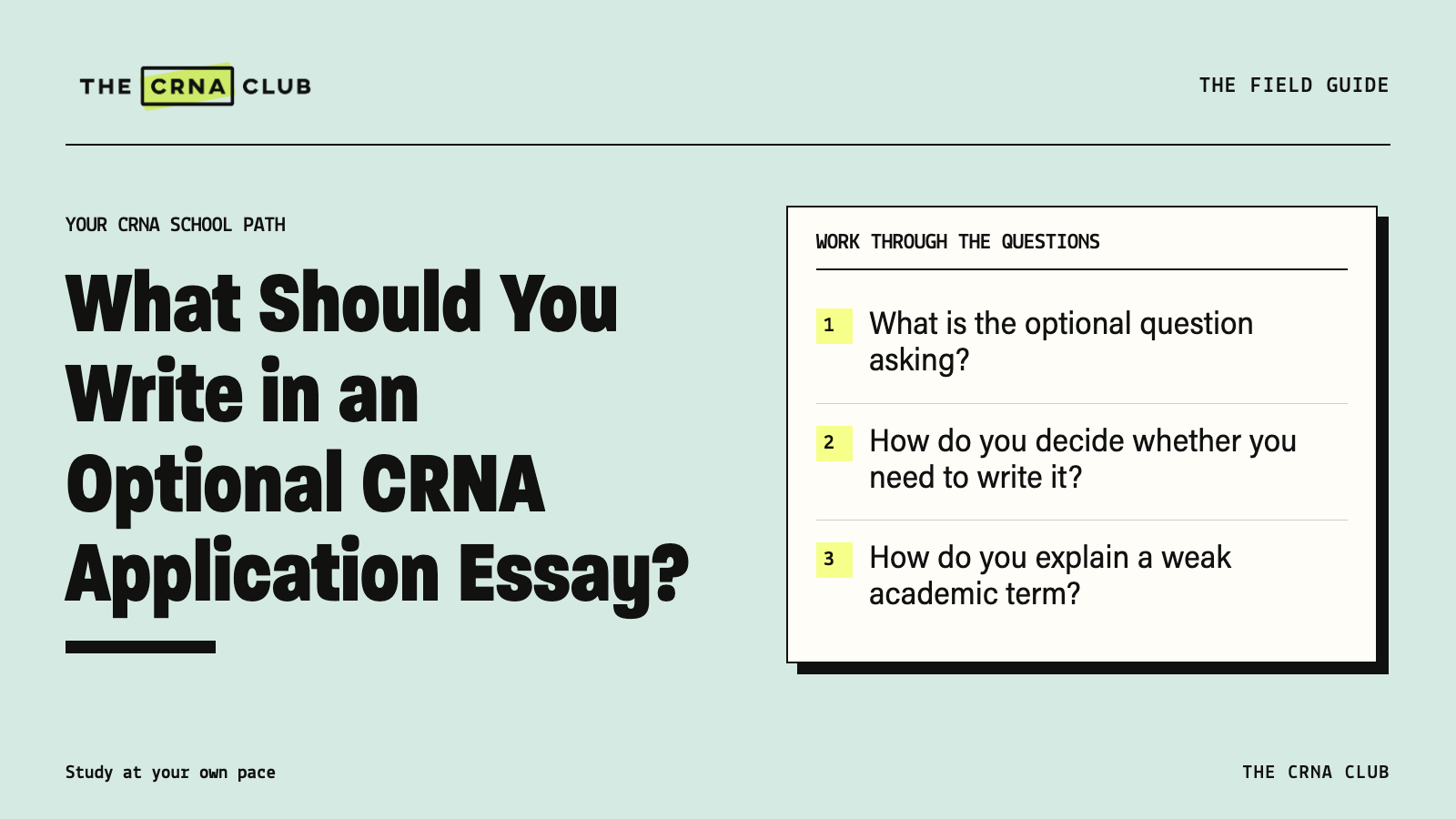
What Should You Write in an Optional CRNA Application Essay?
It’s easy to look at an empty box and wonder whether leaving it blank looks bad. Write an optional CRNA essay when the prompt applies to you or the committee needs relevant information the rest of your application leaves unclear. If you’d only repeat your personal statement, leave it blank. An empty optional box doesn’t mean you need to invent another reason you’re a strong applicant.
Sachi, CRNA
CRNA
In This Article (7 sections)
Draft with the school’s actual question beside you. Where its AI policy permits feedback, use Essay Critique to check the focus and structure. The seven-day platform trial adds essay lessons and the wider application tools.
What is the optional question asking?
Before choosing a story, let’s look at the prompt. An academic-explanation box asks for different information from an optional diversity statement. “Additional information” might give you more room to decide, but you still need something relevant to add.
Underline the action words. Does the school want you to explain a gap, describe an experience or add an update? Answer that question. If it’s asking why your grades fell in one term, another paragraph about loving pharmacology won’t help the reader understand those grades.
Our personal statement guide covers the main essay. Read the optional response beside it so you don’t tell the same story twice without adding anything.
How do you decide whether you need to write it?
Finish this sentence: “Without this response, the reader wouldn’t understand…”
Maybe it’s a difficult academic term, a nontraditional degree path or a significant update the form invites. Check whether another section already asks you to explain it. If you can’t name what the optional response adds, don’t fill it with repeated credentials.
The essay-planning lessons in the trial help you organize the answer. But make the content decision first. You don’t need to use every character simply because the portal gives you room.
How do you explain a weak academic term?
Give enough context to understand what happened, then show what you did about it. If you changed your schedule or study habits, what work have you completed since? What does that newer work show?
Use this hypothetical outline with your own facts:
- During [term], [specific disruption] affected [limited academic consequence].
- Before returning, you changed [workload, study method or support arrangement].
- You later completed [actual coursework] with [actual results].
- You now use [specific sustainable practice] to manage the same risk.
Don’t fill in grades you haven’t earned. And don’t ask the committee to disregard the transcript. Give it newer evidence of how you work now.
What does a useful opening sound like?
See the difference in these invented openings:
“I am a passionate, hardworking applicant who will make an excellent student.”
“My transcript includes a withdrawal from physiology in [term]. I returned after adjusting my work schedule and completed the course in [term].”
The first repeats a claim without helping the reader. The second names the part of the record you’re explaining and starts showing what changed. Finish with your actual evidence and reflection.
Keep private family or medical details limited to what the question needs. You don’t have to make the account more emotional to make it useful. Cut generic thanks, blame and any credential you’ve already explained elsewhere.
How should you check the finished response?
Put it beside the prompt and main essay. Does it answer the optional question? Does it add information? Check that the dates agree with your transcript and resume, then check the word or character limit in the portal.
If you’re using Essay Critique, give it the real prompt and follow the school’s AI rules. Feedback is useful only within the assistance that school permits. The writing and the experience still need to be yours.
Our Final Thoughts
Give yourself permission to make this a content decision before it becomes another writing task. Put the optional question beside your finished materials and name what the reader still needs to understand. If there’s a useful gap to explain, write to that gap. If you’d only repeat yourself, leave the optional space blank.
Check whether your response adds something
Where the school permits AI feedback, use Essay Critique with your draft and the actual prompt. You can also explore essay lessons in the seven-day platform trial.