Do You Need a New RN License Before Applying to CRNA School Out of State?
You don’t automatically need a new RN license before applying to an out-of-state CRNA program. Check the school’s application requirement, then separately record what it needs after acceptance and before clinical training. Your current license, compact privileges and any move all affect the next step.
Sachi, CRNA
CRNA
In This Article (7 sections)
- What license do you need when you apply?
- How are application, enrollment and clinical requirements different?
- Does a compact license cover every state where you might train?
- Should you get the extra license early to show commitment?
- What should you ask the program?
- Our Final Thoughts
- Keep the licensing steps with each school
We suggest using the CRNA School Database to build your shortlist, then recording the exact license requirement for each school. The seven-day trial adds target-program checklists so the licensing task stays beside that program’s other deadlines.
What license do you need when you apply?
Read the nurse anesthesia program’s instructions. Don’t assume the school’s location means you must already hold its state’s license to submit an application.
The University of Maryland’s nurse anesthesia FAQ says Maryland licensure isn’t required to complete its application. Applicants provide their valid current RN license from the state where they work. Its requirements after acceptance include Maryland licensure or qualifying compact status, plus a Washington, D.C. license.
That example shows why the timing matters. Buying one extra state license before applying wouldn’t necessarily finish every later requirement.
For your own list, copy the school’s exact wording into a note. If it says “eligible for licensure,” ask what documentation it wants and when. Don’t turn that into “license already issued.”
How are application, enrollment and clinical requirements different?
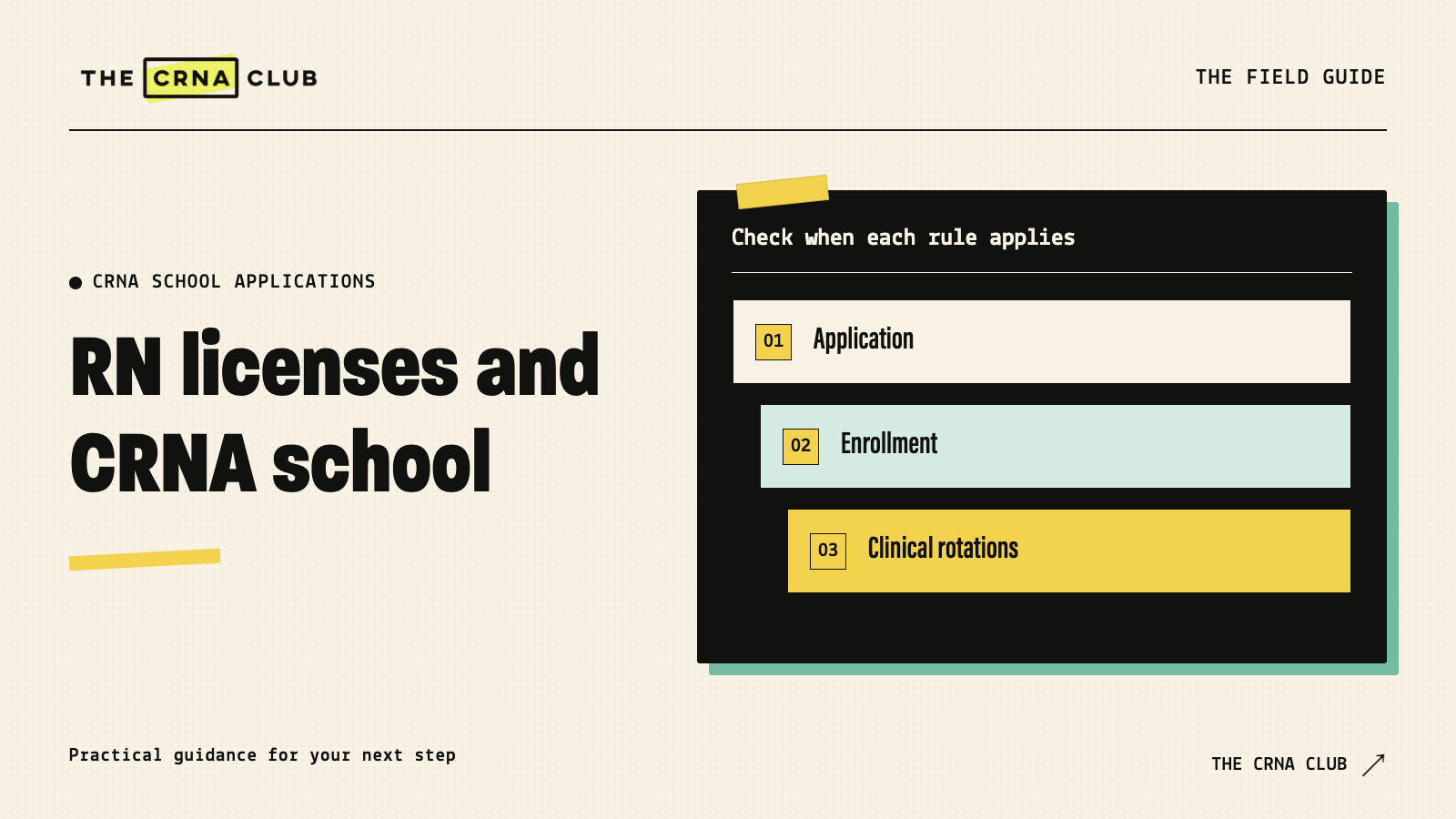
Treat them as separate checkpoints. At application, the program reviews your current eligibility. After acceptance, it might set additional conditions. Clinical placements introduce the jurisdictions where you’ll train.
Build a short checklist like this:
| Checkpoint | Question to answer | Evidence to save |
|---|---|---|
| Application | Which active RN license or privilege is required now? | Current program admissions instruction |
| Enrollment | Must another license be issued before classes start? | Admitted-student checklist and due date |
| Clinical | Which jurisdictions and documents apply to assigned sites? | Program clinical-licensure instructions |
| Relocation | Will changing your legal residence affect your compact license? | Guidance from the relevant board of nursing |
We recommend putting unresolved items in your target-program checklist rather than marking “RN license done” for the whole school list. “Current license uploaded” and “all future clinical licenses ready” are different completion statements.
Our offer-comparison guide helps you review the other conditions accompanying an acceptance.
Does a compact license cover every state where you might train?
Check your actual license status and each destination. A license issued by a compact state isn’t necessarily a multistate license, and a multistate privilege doesn’t cover noncompact jurisdictions.
The Nurse Licensure Compact website provides current participating-state information. Use it with the receiving board’s instructions and the program’s placement requirements. Don’t infer a nationwide privilege from the word “compact.”
Moving also deserves a separate check. NCSBN’s moving guidance explains how changing your primary state of residence affects licensure. A school address, temporary clinical stay and legal residence aren’t interchangeable descriptions.
If you’re unsure which applies, contact the board before selecting an endorsement application or changing your license. Give the actual move and residence details so it has an answerable question.
Should you get the extra license early to show commitment?
We wouldn’t spend the money for appearance alone. First determine whether the program needs it at application and whether an application started now fits your actual plans.
Consider a fictional applicant applying to three states. One school wants the current home-state RN license at application. Another requires a particular license before enrollment. The third hasn’t explained the timing. The next action is to clarify the third school’s rule and plan the second school’s deadline, rather than pay for three licenses to look enthusiastic.
Once you know a license is required, build in the board’s published processing steps, documents and any fingerprinting requirements. Avoid using another applicant’s processing time as a promise about your own file.
What should you ask the program?
Use a short request:
I’m applying to [program/cohort] and hold an active [state, single-state or multistate] RN license. Is that sufficient at application? If admitted, which licenses or privileges must be documented before enrollment and clinical placement, and by what dates? Please share the policy covering clinical sites outside the school’s state.
Then finish these follow-ups:
- Save the program’s reply with the entry cohort and date.
- Put the confirmed licensing deadlines in that school’s checklist.
- Ask the relevant board about legal residence and license endorsement.
- Recheck requirements when your actual clinical locations are assigned.
The program explains its requirements, while the board explains your license.
Our Final Thoughts
Find the deadline attached to the license requirement before you act. You’ll know what belongs on today’s application checklist and what needs its own plan after acceptance.
Keep the licensing steps with each school
Start in the CRNA School Database, then use the seven-day trial to organize target-program tasks and keep the confirmed requirements together.