Does a Graduate Certificate Improve a CRNA School Application?
Sachi, CRNA
CRNA
In This Article (8 sections)
- What problem would the certificate solve?
- How should you compare a certificate with targeted courses?
- What does a cost comparison look like?
- How will certificate grades affect your GPAs?
- Does a graduate certificate guarantee course transfer?
- What should you ask before enrolling?
- Our Final Thoughts
- Take the Next Step
A graduate certificate can add useful coursework, but we wouldn’t choose a whole credential before checking whether one or two courses solve the problem. Start with our Transcript Analyzer to review what needs attention. Our seven-day trial includes GPA + Prerequisites lessons, a manual GPA Calculator and school research tools to help you compare the academic benefit with the time and tuition.
If the problem is one weak science grade, a whole certificate may be more coursework than the problem needs. If you want the certificate for a separate professional goal too, the decision changes. Name both reasons rather than asking the credential title to explain the value for you.
Look at the classes inside the certificate. Which one would you take if there were no certificate attached? That’s a useful place to start. The graduate title doesn’t tell you whether the course meets a prerequisite or enters the GPA you need to change.
What problem would the certificate solve?
What do you need to fix? A missing prerequisite, old science work, or a weak subject? Or do you want the certificate for your professional work too? We suggest writing those reasons separately. Then you can see which classes help with each one instead of asking the credential to solve everything.
Write a sentence describing the problem without mentioning the certificate. For example, “My target programs need an updated physiology course,” or “I want structured graduate study in a subject relevant to my professional work.” Now compare the actual courses with that sentence.
If the certificate contains unrelated electives, decide whether they serve a goal you care about. Additional credits still take time and money even if the program packages them under an appealing title.
TCU’s nurse anesthesia FAQ discusses additional science coursework and comparable graduate options in its own guidance. It doesn’t make a whole certificate a universal admissions requirement. Read the current instructions for your actual school list.
Our GPA and prerequisite retake guide helps identify whether the need is a specific course. If it is, check that course first before expanding the plan into an entire credential.
How should you compare a certificate with targeted courses?
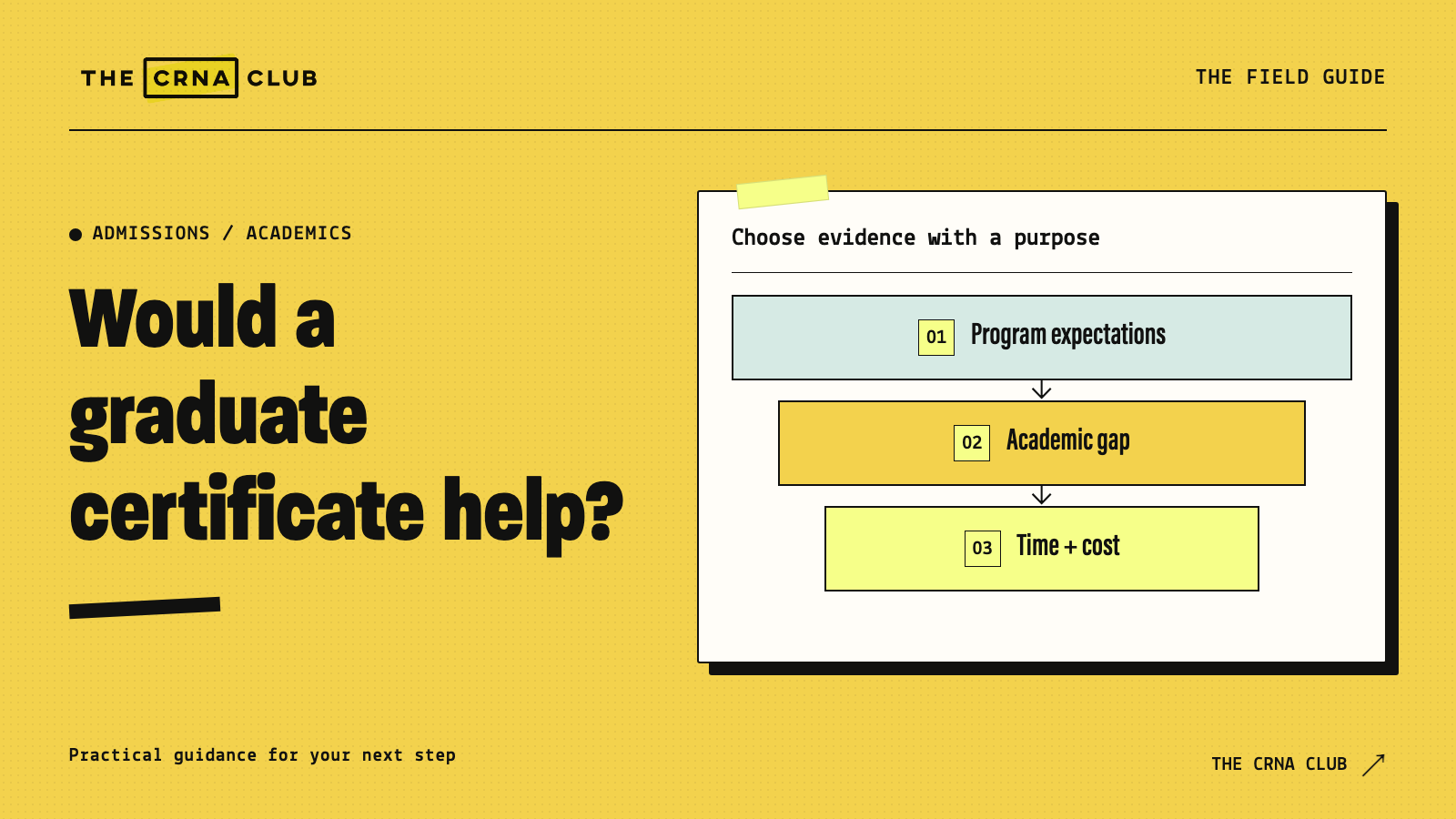
Compare the required courses, relevant outcomes, total cost and scheduling conditions rather than the credential names alone. Include which requirements remain unmet afterward. A smaller course plan may address the specific gap efficiently, while a certificate may make sense when its full curriculum serves a clear additional purpose.
Use this worksheet:
| Decision item | Graduate certificate | Targeted courses |
|---|---|---|
| Courses required | List every course, including electives | List the exact courses needed |
| Verified application purpose | Which published requirement or guidance does each address? | Which published requirement or guidance does each address? |
| Additional personal value | Does the credential support another real goal? | Does the learning support that goal without the credential? |
| Cost | Tuition, fees, materials and prerequisites | Tuition, fees, materials and prerequisites |
| Timing | Sequence, term availability and final grades | Available registration and completion dates |
| Remaining gap | What remains unresolved after completion? | What remains unresolved after completion? |
Don’t count a possible transfer-credit benefit as confirmed. Ask the receiving program separately and read its policy. Admission value and transfer credit are different decisions.
Check what record you’ll get. Does the provider issue academic credits and grades on a transcript, or a certificate showing you completed continuing education? Those aren’t the same. If you’re trying to change a GPA, you need to know the course level, graded credits and how your target school treats them.
Ask what happens if you stop before finishing the certificate: will completed courses still appear as graded academic credits, and what withdrawal or enrollment rules apply? Also check whether you can enroll in individual courses without joining the certificate. Non-degree access, prerequisites and registration priority vary. A course appearing in a catalog doesn’t establish that it will be available to you in the term you need.
What does a cost comparison look like?
Calculate the full cost using actual current information when available, and label hypothetical estimates clearly. Compare the same categories for both options. Include prerequisite courses, fees and the cost of delaying other work, rather than focusing only on the tuition figure printed beside the certificate title.
Consider this hypothetical comparison, using made-up prices for arithmetic only:
| Item | Four-course certificate | Two targeted courses |
|---|---|---|
| Credits | 12 | 6 |
| Assumed tuition per credit | $750 | $750 |
| Tuition | $9,000 | $4,500 |
| Assumed fees | $400 | $250 |
| Illustrated total | $9,400 | $4,750 |
That’s $4,650 more in this made-up example. What would you get for the extra cost? If the other two classes serve another goal you care about, include that. If they don’t, we suggest looking hard at the smaller course plan before paying for the whole certificate.
Replace every assumed price with current figures before deciding. Ask about required materials and whether any course has another prerequisite. Check whether employer assistance applies and whether it carries repayment or service conditions. Read the actual benefit terms rather than assuming a general tuition program covers the particular certificate.
Time belongs beside cost. If the certificate requires sequential courses across several terms, its grades may arrive after your intended application cycle. A shorter plan may be more useful for the deadline even if both options interest you academically.
How will certificate grades affect your GPAs?
The effect depends on whether the courses are graduate or undergraduate, how they are classified and which calculation the program uses. A graduate certificate’s title doesn’t determine every GPA category. Verify the coursework level and model the relevant groups separately before assuming the grades will raise an undergraduate minimum.
NursingCAS’s GPA guidance distinguishes cumulative undergraduate and overall calculations, with graduate coursework treated in its stated categories. Use the actual course classification and current instructions.
Imagine a hypothetical applicant hoping to raise a cumulative undergraduate number. If the certificate’s courses belong to graduate work, they may produce a separate graduate result without changing that undergraduate figure. The applicant needs to understand the published eligibility rule before paying tuition for the wrong numerical goal.
Our science GPA calculation article addresses another group that may have different course-selection rules. Keep program science definitions separate from the label on the certificate.
Strong academic work remains visible even when a particular number doesn’t change. But avoid promising how much a committee will weigh it. The precise claim you can make is what coursework you completed and what grades you earned.
Does a graduate certificate guarantee course transfer?
A graduate certificate doesn’t guarantee transfer into a future nurse anesthesia program. Transfer decisions depend on the receiving program’s policy and course review. Ask about equivalence, timing and other conditions separately from whether the course is acceptable academic preparation. Don’t build a financial plan around unconfirmed credit transfer.
Marian University’s DNP-CRNA FAQ gives a useful example: transfer requests receive individual evaluation after admission and require course documentation. It also states transferring courses doesn’t reduce its flat-rate total tuition or program length. That is Marian’s policy, not a rule for every school.
For your own targets, ask what a transfer would actually change. Would it affect course load, tuition, sequence or none of those? A course waived from one term doesn’t automatically shorten a tightly sequenced program.
Keep the answer in your cost worksheet. If transfer remains uncertain, calculate the decision without assuming savings. If the certificate still serves a worthwhile goal, you can evaluate it on that basis rather than a benefit nobody has confirmed.
What should you ask before enrolling?
Before enrolling:
- Ask your target school about the exact class. Attach the syllabus and credits. “Would this satisfy your physiology requirement?” is easier to answer than “Would this certificate look good?”
- Ask the course provider about individual enrollment. Can you take that class without joining the certificate?
- Confirm when you can enroll. Check that timing before building the course into your application plan.
A focused message might read:
I’m considering the attached graduate certificate or two individual science courses before applying. My academic question is ___. Would these specific courses satisfy your ___ requirement, or would they be additional coursework? I understand transfer credit is a separate review and would appreciate your current instructions for that process.
Then ask the course provider about enrollment access, prerequisites, grading and term sequence. These are separate organizations answering different questions. Approval from the provider doesn’t establish acceptance by the nurse anesthesia program.
The GPA + Prerequisites lessons help you connect the transcript problem with a course plan. Explore the seven-day membership trial while comparing the options against your own requirements and calendar.
Our Final Thoughts
A certificate should have a purpose beyond sounding more advanced. Compare the courses, expected learning, real cost and policy fit with the smaller plan you could take instead.
If two targeted courses solve the problem, you don’t need to add a credential for reassurance. If the whole certificate serves a meaningful goal, choose it with the full commitment in view.
Take the Next Step
Use the free Transcript Analyzer, which includes one lifetime free analysis, to review the grades and courses you already have. Then try our seven-day membership trial for GPA lessons, the manual calculator and school research. Compare the certificate with the smallest course plan that would meet your actual need.