From Overwhelmed to Focused: How to Choose the Right CRNA Program
Ashley, CRNA
CRNA

In This Article (12 sections)
- Where Do You Actually Start? (Pull Your Transcripts First)
- Is Your University Regionally Accredited? (Check This Before You Build a List)
- What Location Factors Matter When Choosing a CRNA Program?
- Which Is Better for You: Front-Loaded or Integrated CRNA Program?
- DNP or DNAP: Does the Degree Type Matter?
- What Should You Know About CRNA Clinical Sites?
- Who’s Actually Teaching You? (Faculty, Sim Labs, and Cadaver Labs)
- What Happens When You Bomb a Test? (Student Support)
- Class Size, Attrition, and NCE Pass Rates: The Numbers to Ask For
- What Grade Do You Need to Pass? (Don’t Get Blindsided)
- How Important Is the Cost When Choosing a CRNA Program?
- Our Final Thoughts
Choosing the right CRNA program involves considering factors like location, program structure, clinical sites, faculty, and student support to find the best fit for your goals and lifestyle. And whatever you do, don’t judge a program by its website. Talk to actual people. If you're just starting out and want the full roadmap, our How to Become a CRNA guide breaks down every step.
When I first started my CRNA journey, I was completely overwhelmed with all of the different programs across the US! I am from California originally, but I was open to attending school in a different state, so long as the program was a good fit. While each person’s situation is highly unique, here are the factors I looked at when narrowing down the list of programs I wanted to apply to and questions to ask yourself (and the program) as you are doing your research. If you're wondering what CRNA schools are actually looking for in an applicant, we actually talked about this on the podcast (Ep 1: "What CRNA Schools are REALLY looking for in an applicant" on Apple Podcasts).
Quick Answer
With 154 CRNA programs tracked in The CRNA Club's school database, narrowing your list starts with three filters: location and willingness to relocate, program structure (front-loaded vs. integrated), and clinical site variety. Rank these by personal priority, then eliminate programs that fail your top two criteria. Before you finalize the list, pull your transcripts, confirm your university's accreditation is accepted, and compare the numbers that programs don't advertise: class size, attrition, and NCE pass rate.
Where Do You Actually Start? (Pull Your Transcripts First)
Before you fall in love with a program, you need to know what you’re working with. Request official transcripts from every college you’ve attended. Yes, including that one awful, energy-drink semester you’d rather forget. It still counts.
- Every program slices your GPA differently. Some want cumulative, some want science GPA only, some look at just the last 60 credits (bless them)
- Knowing your real numbers means you can target schools that fit your academic story instead of guessing. Maybe those C’s from your first degree won’t even count at the right program
- Spot the weak spots you can still fix. Retaking science courses you got a B or lower in can genuinely move the needle
- The average minimum GPA across the 151 programs that publish one is 3.04. So the bar is often lower than the 3.5 everyone panics about
We get into this (and everything we’d do differently) in Ep 9: "3 Resume boosters for your CRNA School application". Once you have your numbers, use our free Timeline Generator to keep deadlines straight.
Watch the explanation
How should you compare CRNA programs?
In this video:Compare total costs, attrition and board outcomes alongside clinical rotations, faculty access and daily logistics. Sachi walks through questions about housing, travel and student support so you can build a program comparison that reflects your own constraints.
10:38 · Watch on YouTube

Is Your University Regionally Accredited? (Check This Before You Build a List)
This is the technicality that quietly wrecks application seasons. Some CRNA programs require your nursing degree to come from a regionally accredited university, not a nationally accredited one. Of the 154 programs in our database, 47 explicitly require regional accreditation. We’ve seen people get all the way to interviews and then get cut over this. Nightmare.
There are six regional accrediting bodies in the US. If your university is accredited by any of these, you’re in the clear:
- Middle States Commission on Higher Education (MSCHE)
- New England Commission of Higher Education (NECHE)
- North Central Association of Colleges and Schools (NCA)
- Northwest Commission on Colleges and Universities (NWCCU)
- Southern Association of Colleges and Schools (SACS)
- Western Association of Schools and Colleges (WASC)
You can verify your school on the U.S. Department of Education’s accreditation database. And if your school isn’t on that list, breathe. Most programs don’t require regional accreditation, but you have to check each one individually.
Your nursing program accreditation is much simpler. It’s a yes-or-no question. Most CRNA programs want to see ACEN or CCNE accreditation, and if your BSN program has one of those, you’re usually good. Still, always check. Some programs get weirdly specific. Our CRNA School Requirements guide and the Free School Database are built for exactly this.
What Location Factors Matter When Choosing a CRNA Program?
- Decide if you want to stay close to home or are able explore/relocate to a new city and/or state
- Consider how being away from home might affect you (e.g., housing, support system)
- Think about cost of living, not just tuition. Ramen budget or can you splurge on sushi?
Here’s the part nobody tells you: where you go to school lowkey determines where you might work. We thought we’d move anywhere post-grad, and then laughed at that at our first job interview. Programs build relationships with hospitals in their region, and a lot of graduates get hired through clinical site connections made during school. If you already know you want to end up in a certain area, favor programs with strong hospital ties there.
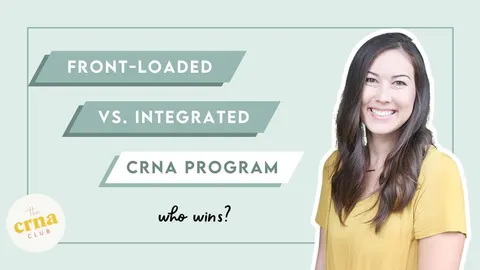
Which Is Better for You: Front-Loaded or Integrated CRNA Program?
- Front-loaded: Academics first, clinicals later
- Integrated: Academics and clinicals mixed throughout the program
- Think about what learning style suits you best. Do you need a lot of hands-on work to tie concepts together? Or are you the type who needs to know all the details before trying to do something?
- Note: not all integrated programs are seamless in the sense that what you are currently going over in didactic may not match up with what you are doing in clinical practice
- Online vs. in-person: Is the program primarily one or the other? How do you fare with online classes, are you able to stay self-motivated? Determine if you learn better in a classroom or prefer the flexibility of online courses. Consider how the format aligns with your lifestyle and responsibilities outside of school
Hybrid options are far more common than people realize. 127 of the 154 programs are at least partially online, usually delivering didactic content remotely while clinicals stay in person. That can mean better cash flow, less chaos with kids, and not having to move across the country.
Don’t sleep on the academic calendar either. Semester, trimester, and quarter systems hit very differently over the average 36-month program. Quarter systems compress patho, pharm, and clinicals into shorter windows and can feel relentless. Ask about breaks too. Will you actually see your family at Christmas, or just FaceTime them from the call room?
If you're still unsure which type of program fits your personality, check out our podcast episode on this exact topic (Ep 6: "5 signs CRNA school is right for YOU" on Apple Podcasts).
DNP or DNAP: Does the Degree Type Matter?
The alphabet soup is enough to make your eyes glaze over at 3am in the break room. All CRNA programs are doctorate-level now, and across the 154 programs, 117 award a DNP and 36 award a DNAP.
Short version: the DNP is tied to a nursing school. The DNAP is not. Both prepare you for the same National Certification Exam, and both lead to the same license, the same paycheck, and the same post-call exhaustion. If you think you might want to teach or move into academia later, the DNP may open more doors. Otherwise, pick the one that fits your future self and stop agonizing over it. We break this down fully in the Learning Library’s DNP vs. DNAP vs. PhD lesson.
What Should You Know About CRNA Clinical Sites?
- Independent practice sites as a major factor for me
- What is the volume like at the programs’ clinical sites? How do the programs’ clinical numbers match against the COA minimum requirements? Learn more about COA requirements.
- Does the program have specific sites for specialty rotations? (e.g., pediatrics, OB, cardiovascular, thoracic, etc). Or are these “specialty” cases sprinkled in into overall “general” rotations?
- Does the program have “away” clinical sites? If so, is housing included?
- Will you be competing for cases with SRNAs or MD anesthesia residents at your sites?
- How much exposure will you have to ultrasound and regional anesthesia? This is a HUGE sector of anesthesia today! Explore more about anesthesia practices.
Ask specifically about core clinical sites, not just the electives. Electives get shuffled at the last minute all the time, so the core sites are what your life will actually look like. We picked our clinicals basically blind. Some of us lucked out, others got stuck driving hours each way to random sites. Would not recommend.
- Do placements keep you local, or is it “congrats, you’re driving three hours in a snowstorm”?
- Does the program track or reimburse mileage? Gas money is not included in tuition, and some of us learned that the hard way
- Will you be living somewhere you hate, or paying double rent for an away rotation?
- Will you see a mix of practice models, or only one? Limiting your exposure now can limit your job options later
To see how different programs stack up in terms of clinical experiences and requirements, our Free School Database lets you compare details side by side.
Who’s Actually Teaching You? (Faculty, Sim Labs, and Cadaver Labs)
Most of us skim the faculty page and move on. Big mistake. Who teaches you matters a lot, and it’s one of the easiest things to research before you ever apply.
- Look up faculty on LinkedIn and look at what they’ve published. If you’re obsessed with cardiac and there’s a faculty member who lives and breathes cardiac, that’s huge
- Are they current ICU and OR practitioners, or purely academic? Both have value, but you want people who’ve been in the room
- Are they supportive, or totally MIA when you need them?
Also ask about labs. Not all programs have a SimLab or a cadaver lab, and some have both (actual goals). Our old program barely had a SimLab and honestly, regret. If you feel anxious about procedural skills, having somewhere to practice intubating before a real patient is on the table makes a real difference in your confidence.
What Happens When You Bomb a Test? (Student Support)
Student support can genuinely make or break you, and it’s the thing websites are worst at describing. Ask the uncomfortable questions:
- Is there legit mentoring, or just an “open door” policy nobody actually uses?
- Is there an actual advisor? Sometimes you need more than your group text for the meltdown moments
- What happens when you fail an exam? Is there a real remediation process, or are you on your own?
- Can you talk to upperclassmen? They’ll tell you which professors are great and which ones... aren’t
So, real talk: reach out. DM a current student on Instagram, show up at info sessions, get nosy. Marketing materials will never tell you what happens on your worst day. Current students will.
Class Size, Attrition, and NCE Pass Rates: The Numbers to Ask For
These three stats tell you more about a program than any brochure.
- Class size. Across the 131 programs that publish one, the median class size is 24, and they range from 10 students all the way up to 105. Small classes mean more faculty attention and less hiding. Bigger cohorts mean more people to swap call stories with, but more competition for cases
- Attrition rate. This is just how many students drop or fail out. The average across programs that report it is about 4%. If a program is losing more than 10%, start asking why. Sometimes it’s a weird year or a tiny class skewing the stats. Sometimes it isn’t
- NCE pass rate. You survive school to pass boards, so this is the stat that matters at the finish line. The average pass rate is about 90%, and programs have to stay above 80% to keep their accreditation. If you see a program with consistently sketchy pass rates, run. Look at the trend across several years, not one cherry-picked number
You can compare class sizes and other program details in our Free School Database instead of stalking Facebook groups like we did.
What Grade Do You Need to Pass? (Don’t Get Blindsided)
You think you’re a solid B+ student until you find out your program requires an 83% to pass. Every program sets its own minimum passing grade, and some are savage. This is rarely front and center in marketing materials, so ask directly before you commit. Your mental health will thank you. Our CRNA School Requirements guide and the Program Requirements lesson in the Learning Library cover what to look for.
How Important Is the Cost When Choosing a CRNA Program?
While important, don’t let cost hold you back. Tuition varies enormously between programs, so compare real numbers rather than assuming, and explore scholarships, loans, and financial aid options. Remember that the sticker price isn’t the whole cost. Factor in cost of living, away-rotation housing, and the commuting you’ll be doing to clinical sites. If you want to see what I wish I had done differently before applying, give a listen to Ep 2: "3 things I would have done differently BEFORE applying to CRNA school" (Apple Podcasts).
For more information on CRNA programs, visit CRNA School Requirements. If you're curious about the best schools, check out Free School Database. To understand the differences between DNP and DNAP, our Learning Library has a full lesson on this called DNP vs. DNAP vs. PhD.
Additionally, use our School Comparison Tool and Application Planning Timeline to aid your decision-making process. If you're looking for a deep dive into what programs require, the Program Requirements lesson is a great place to start.
For more information, check these trusted resources: Council on Accreditation (COA), NBCRNA.
Our Final Thoughts
Choosing the right CRNA program is a personal journey that depends on your learning style, clinical preferences, and life situation. Take your time researching and reflecting on these factors to find the best fit for you. Ask the questions you think are dumb. 1000% guarantee someone else is wondering the same thing. And don’t make the decision off a website. talk to the humans who are actually living it. Remember, The CRNA Club is here to support you every step of the way.