Graduate Science Course or Undergraduate Retake for CRNA School?
Sachi, CRNA
CRNA
In This Article (9 sections)
- What should you check before comparing course levels?
- When does an undergraduate retake make more sense?
- When might a graduate science course be useful?
- How do you compare the two choices in one worksheet?
- How would three applicants make different choices?
- What should you send a program before enrolling?
- How should workload and cost affect the final decision?
- Our Final Thoughts
- Take the Next Step
We suggest retaking the undergraduate course when it solves a required subject, grade or recency problem. Consider graduate science when those requirements are met and you have a clear reason for more advanced work. Start with our Transcript Analyzer to review the record, then use the GPA + Prerequisites lessons and school tools in the seven-day trial to compare the options.
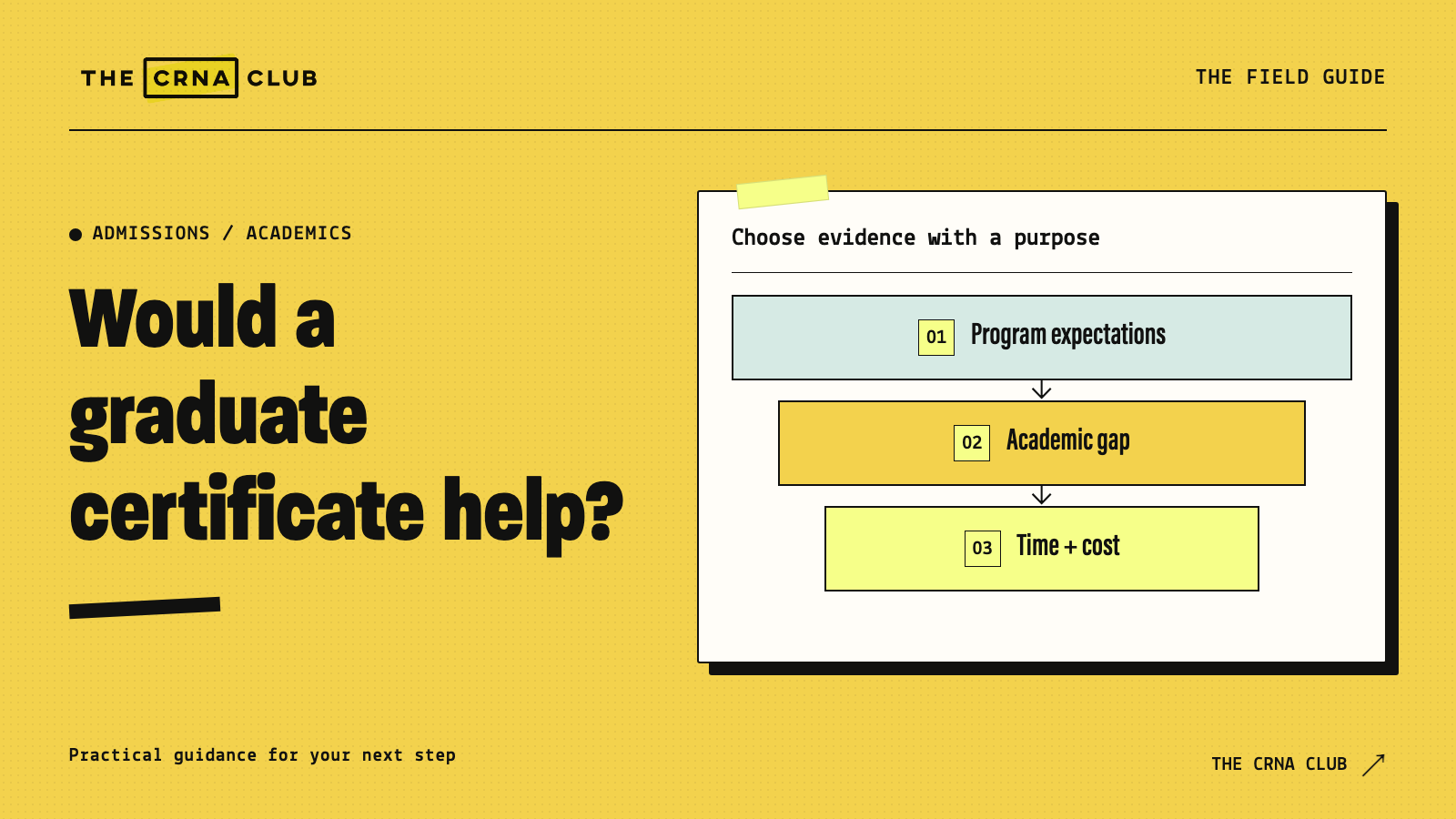
Start with the problem you’re trying to solve. Is chemistry missing? Is the old course expired under a target school’s rule? Do you need a higher grade in a required course? Or are you considering additional academic work after those requirements are met? Those are different decisions.
A graduate course isn’t automatically the better choice. If your school still needs chemistry, advanced physiology leaves chemistry unfinished. If your requirements are met and physiology is the weak area, advanced physiology may have a much clearer purpose. Let’s separate those two situations.
What should you check before comparing course levels?
What do you need the class to do? Meet a prerequisite, improve a specific GPA, or show stronger recent science work? We suggest choosing that purpose first. Then check the course against your schools’ requirements, including credits, grade, lab and recency. One class may help with one purpose and leave another untouched.
Use a school-by-school worksheet. You might find a course accepted at one program while another requires a different subject or sequence. Don’t enroll based on a general recommendation until the proposed course fits your actual list.
For example, TCU’s nurse anesthesia FAQ discusses comparable retakes and graduate coursework as options in its own academic guidance. That is useful program-specific information. It doesn’t establish a substitution rule for every school.
Keiser’s entry DNAP page gives a different chemistry example: its stated general chemistry requirements aren’t satisfied by several other chemistry course types, including organic chemistry and biochemistry. Follow the current wording for the school you’re considering.
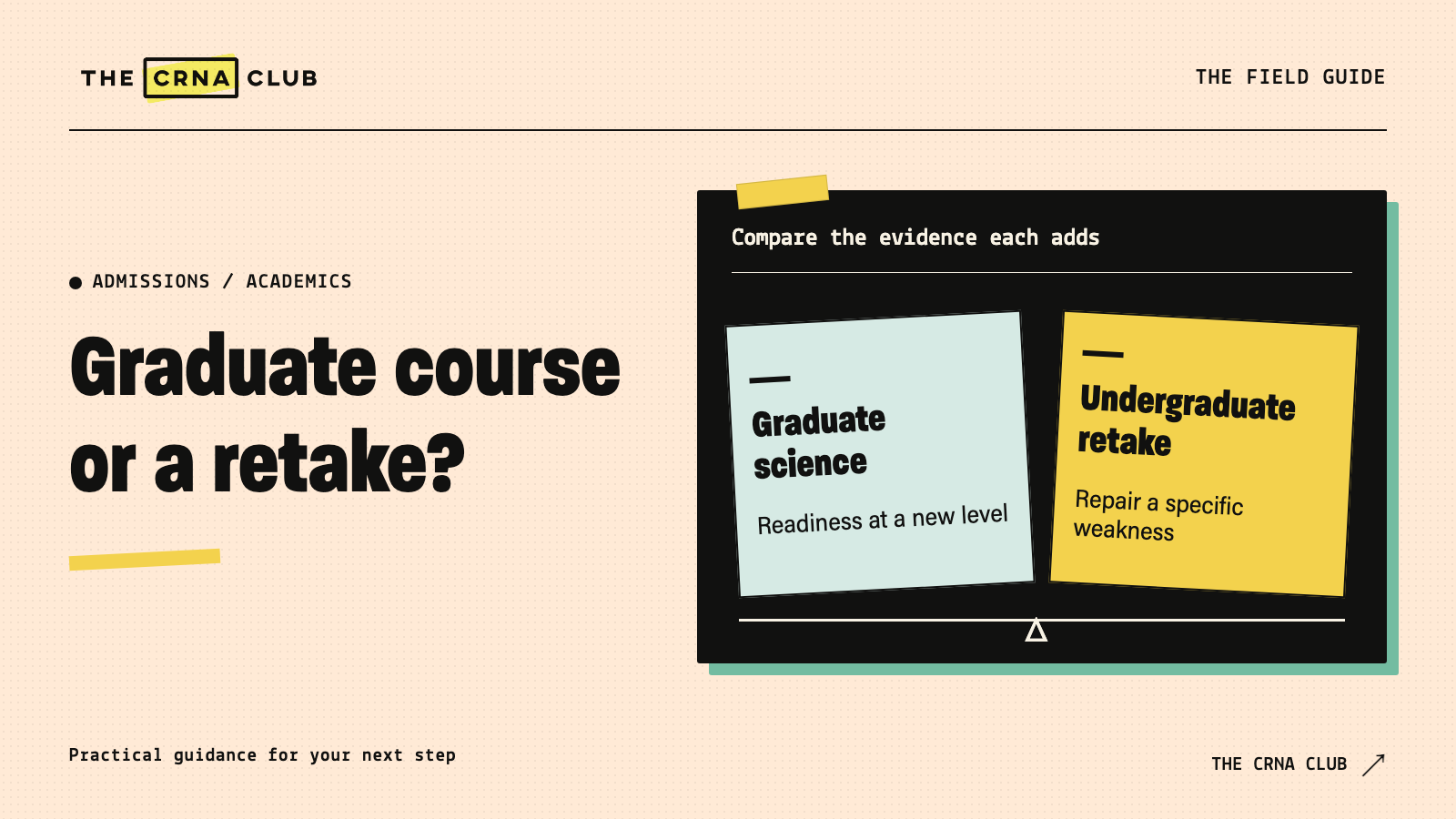
The comparison shows why “take the harder class” is incomplete advice. The first question is whether the class does the job your application requires.
When does an undergraduate retake make more sense?
Choose the retake when you need that course to meet the school’s rule. That might be a grade below the minimum, an old prerequisite, or missing lab content. Confirm the proposed class is accepted, then protect enough study time to do well. Taking it again still means doing the work.
Imagine a hypothetical applicant whose target school requires a particular chemistry course and lab. Her prior attempt doesn’t meet the grade requirement. An unrelated graduate physiology course would add new work while leaving the chemistry issue unresolved.
Her next task is checking an acceptable chemistry option. She needs the course description, credits, lab details, grade format and completion date. She also needs to understand how the repeat will appear in the relevant GPA calculations.
Our GPA and prerequisite retake guide explains the broader retake decision. Keep the exact course acceptance question beside it.
A retake is also a chance to address what made the original course difficult. Was the workload too high? Were study methods ineffective? Did the class conflict with another obligation? Build a changed plan before assuming a new enrollment will produce a different grade.
When might a graduate science course be useful?
A graduate course makes more sense when your prerequisites already qualify and the subject matches what you need to strengthen. We suggest looking at the weak subject first. If physiology is the issue, compare a relevant advanced physiology or pathophysiology option. Then check how your schools review it and whether you’re ready for the workload.
Consider a hypothetical nurse with accepted prerequisites and a clear interest in studying advanced physiology. She has the background needed for the course and enough time to do the work well. If the target program recommends relevant recent science, the graduate option may serve a specific purpose.
Now ask what the course won’t change. It doesn’t erase the original undergraduate record. It doesn’t automatically satisfy a distinct chemistry lab requirement. And it doesn’t promise the credits will transfer into a future nurse anesthesia program.
Read the course syllabus before deciding. The title “advanced” doesn’t tell you the assignments, exams, prerequisite knowledge or workload. A course that fits your learning goals but collides with application deadlines may belong later in the plan.
Keep the recommendation scoped. A useful choice for this hypothetical applicant isn’t a universal instruction for everyone with a lower GPA or an older transcript.
How do you compare the two choices in one worksheet?
Compare each option against the actual problem, the rule it satisfies and the cost of completing it. Include what remains unresolved afterward. This prevents a course from looking useful simply because it is challenging or inexpensive. The decision should end with a specific purpose you can verify before enrolling.
- A required course is missing: Find an accepted version of that prerequisite. Confirm subject, level, credits, lab and timing.
- Your grade is below the stated minimum: Investigate an approved retake or accepted alternative. Confirm the repeat policy and replacement.
- The course is outside the recency window: Find an updated course that meets the rule. Check whether the school measures age at application or matriculation.
- Prerequisites are met and recent rigor is the goal: Compare relevant undergraduate or graduate science. Check program guidance, workload and transcript treatment.
- Undergraduate GPA is below a hard minimum: Check the exact GPA rule and build a realistic academic plan. Verify whether the proposed course enters that GPA.
Don’t assume a graduate A fixes an undergraduate GPA minimum. NursingCAS distinguishes cumulative undergraduate and overall calculations in its official GPA guidance. The program’s specific rule still needs checking.
Write the outcome in plain language: “This course satisfies the required subject,” or “This provides additional learning after prerequisites are met.” If the sentence remains vague, keep researching before paying tuition.
How would three applicants make different choices?
Think about three applicants with different problems. These are made-up examples, but they show why we wouldn’t give everyone the same instruction to take the hardest available class.
Applicant A has an unmet chemistry prerequisite. She first verifies an accepted undergraduate course and lab. A graduate course in another subject would leave the requirement open, so she prioritizes the accepted chemistry course.
Applicant B has qualifying prerequisites but an older academic record. He compares the target programs’ current recency and additional-course guidance. If recent science is useful for his list, he chooses a course with relevant content and a workload he can complete well.
Applicant C has a low cumulative undergraduate GPA and wants a graduate certificate to “replace” it. She first calculates the actual undergraduate number and reads the eligibility rule. A graduate course may produce a separate graduate result without changing the undergraduate denominator. Her decision needs more information than the certificate’s marketing language.
All three applicants should also consider timing. A final grade available after the relevant deadline may not serve the intended application purpose. Check how the school handles completed and in-progress work before relying on a planned class.
What should you send a program before enrolling?
Send the exact course information and ask the specific acceptance question. Include institution, course title and number, level, credits, syllabus, lab format, grading and intended completion date. Request clarification about the requirement you want it to satisfy instead of asking the school whether the course will guarantee a stronger application.
A focused message might read:
I’m comparing an undergraduate retake with a graduate course for the upcoming application. My current course is ___, completed in ___ with a grade of ___. Would the attached proposed course satisfy your ___ requirement? If accepted, would it be treated as a prerequisite replacement or additional coursework? The syllabus, credits, lab details and completion date are attached for review.
Keep the answer with the course record. If the school requires a formal review process, follow it. An informal answer to a broad question may not establish equivalence for a specific course.
You don’t need to send every target school the same long explanation. Ask the question each policy leaves unresolved. Clear course details make it easier to receive an actionable answer.
How should workload and cost affect the final decision?
Choose a plan you can complete well while preserving the required application work and adequate recovery from shifts. Compare tuition, fees, prerequisite courses, registration conditions and the date the final grade will appear. A course’s potential academic purpose doesn’t make an unrealistic schedule sensible.
The GPA + Prerequisites lessons walk through how to connect academic records with next steps. Explore them through the seven-day membership trial while comparing the course choices and requirements in your own plan.
Before enrolling, write the weekly study blocks and major deadlines. If the plan depends on finishing every assignment immediately after a twelve-hour shift, reconsider the load. A carefully chosen single course may serve your goal better than several courses you cannot give enough time.
Our Final Thoughts
Choose the course that solves the actual academic problem. Sometimes that’s a direct undergraduate retake. Sometimes it’s relevant advanced work after the requirements are already met.
Get the acceptance answer, understand the GPA effect and give yourself a schedule supporting strong work. A clear purpose beats choosing from the course title alone.
Take the Next Step
Use the free Transcript Analyzer to review what you’ve already taken. It includes one lifetime free analysis. Then try our seven-day membership trial for GPA + Prerequisites lessons, the manual GPA Calculator and school research. Compare the course’s purpose, actual GPA effect and workload before choosing the next enrollment.