How Do You Apply for the CCRN and Verify Your Clinical Hours?
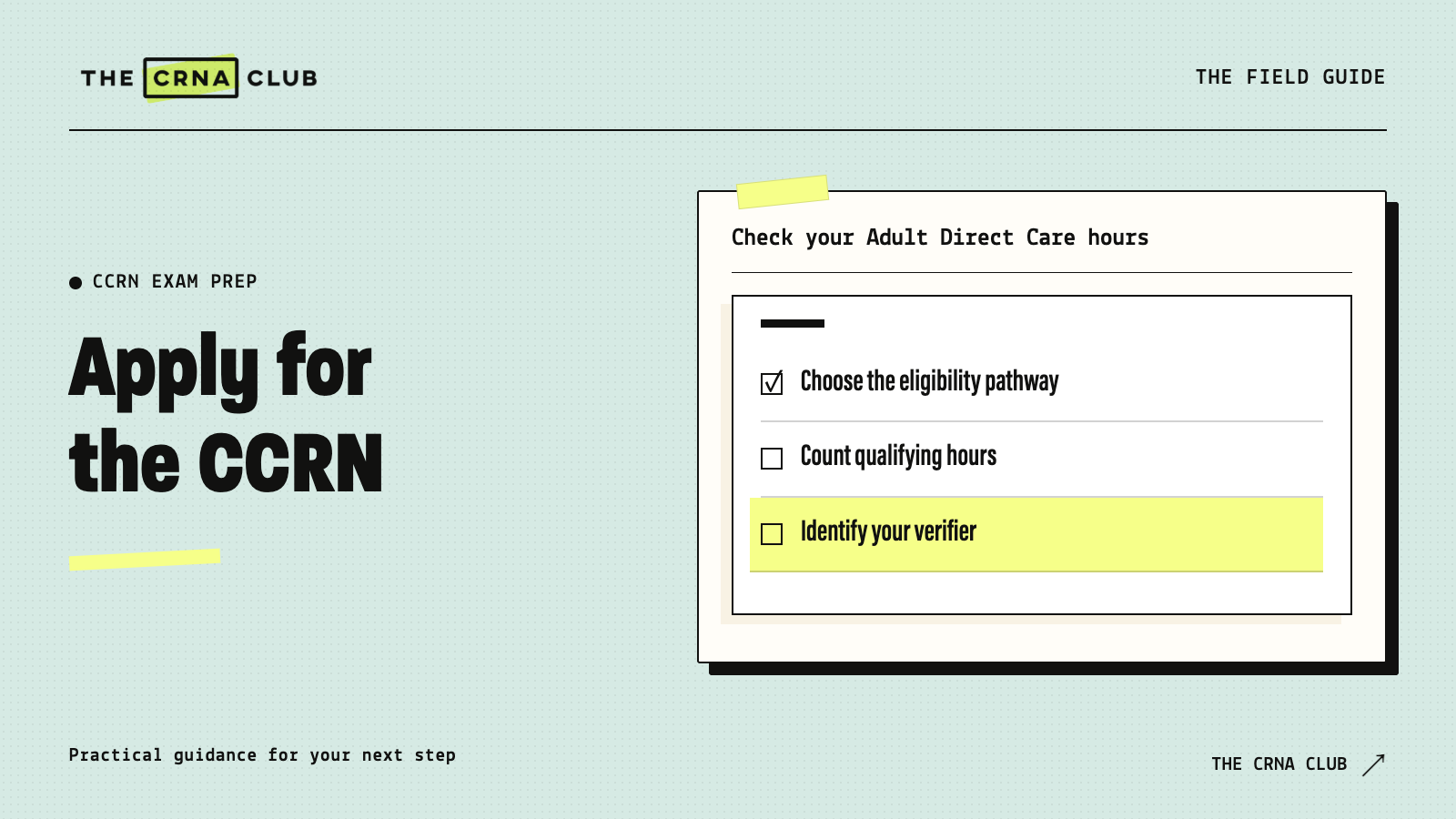
To apply for the adult CCRN through AACN’s Direct Care pathway, confirm your license and qualifying practice, check both the total and recent-hours requirements, and identify a professional associate who can verify your work. Then apply through AACN and use the eligibility dates in your confirmation email to schedule the exam.
Sachi, CRNA
CRNA
In This Article (9 sections)
- How many hours do you need for the adult CCRN?
- How should you organize the hours before applying?
- What does checking the two-year option look like?
- Do orientation and precepting hours count?
- Who should verify your CCRN hours?
- What happens after you submit the application?
- Does CCRN eligibility mean your experience counts for CRNA school?
- Our Final Thoughts
- Take the Next Step
Once you’ve checked eligibility, we suggest our CCRN Toolkit for video lessons, practice questions and a study planner around your selected workdays. For the broader applicant platform, try The CRNA Club free for seven days. The paid toolkit and full-platform trial are separate offers.
This guide focuses on adult Direct Care. If your patient population or role differs, start with our CCRN population and pathway guide and the corresponding AACN handbook.
How many hours do you need for the adult CCRN?
AACN’s adult Direct Care requirements give two options. You also need a current, unencumbered U.S. RN or APRN license.
| Option | Qualifying adult direct-care hours | Recent practice requirement |
|---|---|---|
| Two-year window | At least 1,750 during the preceding two years | At least 875 during the preceding year |
| Five-year window | At least 2,000 during the preceding five years | At least 144 during the preceding year |
Your total alone doesn’t settle eligibility. A majority of both your total qualifying hours and the hours in the most recent year must focus on critically ill patients. Check AACN’s full practice criteria for your actual work before applying.
Build your study calendar after checking that record. Our free certification planner includes one lifetime plan. Bring your workdays and intended exam timing so the plan fits what you have verified.
How should you organize the hours before applying?
We suggest a simple record you can explain to your verifier. Use your actual assignments and reliable employment records rather than multiplying every paid week by a standard shift total.
Record:
- Employer and unit, with the dates you worked there
- Patient population and the care you personally provided
- Qualifying hours within the relevant look-back period
- The subset falling in the most recent year
- The source you used to check the totals
- Your verifier’s current contact information
Keep education, leave and uncertain duties separate while you review them. If you’re unsure how a particular activity fits, ask AACN about that activity rather than assuming all time on a unit counts.
You don’t need identifiable patient details in a personal hours worksheet. Focus on your practice and the records supporting it.
What does checking the two-year option look like?
Consider these fictional records. They demonstrate the arithmetic, not a complete certification-eligibility decision.
| Applicant | Qualifying hours in the preceding two years | Hours within the most recent year | What the numbers show |
|---|---|---|---|
| Nurse A | 1,800 | 900 | Both numerical thresholds for the two-year option are met |
| Nurse B | 1,800 | 700 | The total is sufficient, but the recent-year threshold is not met |
Nurse B shouldn’t submit the same total and assume time on the unit resolves the difference. Review the actual dates and qualifying duties. The five-year option is a separate possibility only if the complete record satisfies its requirements.
If you change the application date, recalculate the look-back periods. Recent practice is tied to the period preceding application, so a worksheet you made months ago needs another check.
Do orientation and precepting hours count?
Your role in the assignment matters. The July 2026 Direct Care handbook distinguishes observing another nurse’s assignment from being the assigned nurse providing care. It also describes qualifying bedside supervision by preceptors and certain other roles.
Write down what you were actually doing during orientation or precepting. If the duty remains unclear after reading the handbook, send AACN a short description. Don’t replace that description with “all my orientation counted” or “none of it counted.”
Who should verify your CCRN hours?
AACN asks for a clinical supervisor or a professional colleague who is an RN or physician and works with you. Choose someone who knows the practice they may need to verify. This is verification of eligibility, not a recommendation letter about how strongly they support your CRNA application.
Ask before listing the person. For example:
“I’m preparing my adult CCRN Direct Care application. Would you be willing to serve as my practice verifier? I’ve organized my qualifying duties, dates and hours and would like to review them with you before I submit your contact information.”
That is a sample message to adapt. Give the person a chance to review the record and flag something you need to clarify. Keep the current contact details with your application materials.
What happens after you submit the application?
Start from AACN’s adult CCRN page and follow its application route. Have your license information, practice-verification contact details and payment method ready. Confirm the legal name matches the identification you’ll use for testing.
After approval, read the scheduling instructions and your actual eligibility dates. The July 2026 handbook describes a current 180-day window rather than the usual 90 days; your confirmation email gives the period for your application. Use your own confirmation dates instead of a remembered deadline or another nurse’s approval email.
Save the confirmation and schedule with enough preparation time. AACN recommends being ready to test before applying. Our CCRN Toolkit helps organize the learning; AACN determines certification eligibility.
Does CCRN eligibility mean your experience counts for CRNA school?
No. Your target program has its own admissions requirements. Keep those notes separate from the certification-hours calculation. Use our School Database to organize programs, then confirm the current policy with each school.
Our Final Thoughts
Do the hours check before you pay for an application or choose a test date. A record with the right dates and a verifier who understands your work makes the next steps much clearer. Resolve uncertain duties with AACN, then put your energy into preparing.
Take the Next Step
Use the CCRN Toolkit to connect lessons, practice questions and your study calendar. If you’re also organizing CRNA applications, try the full platform free for seven days.