How Do You Choose Between Two Plausible Answers on a CCRN Question?
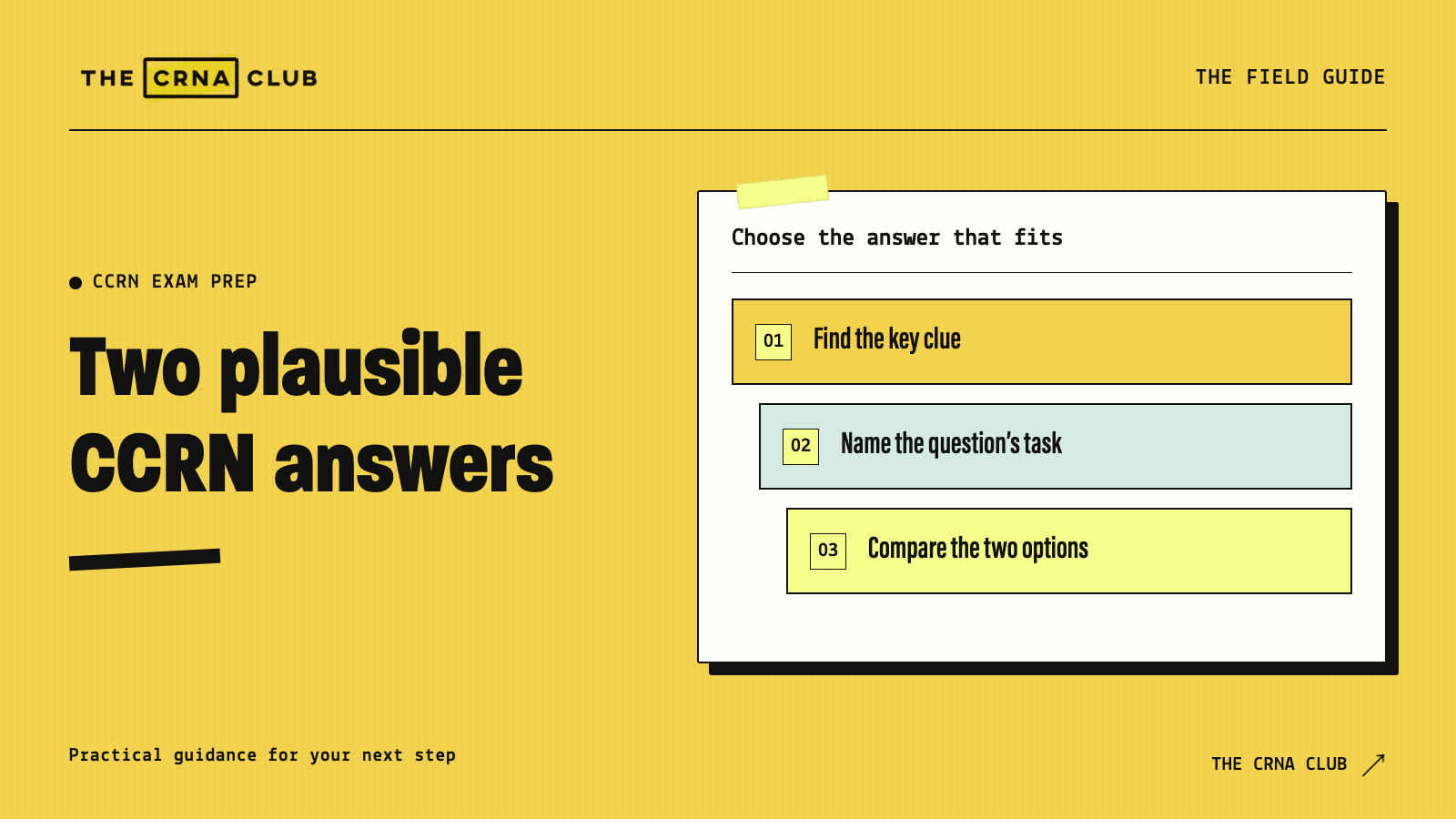
When two CCRN answers seem plausible, return to the exact task and identify the detail that separates the choices. Ask which answer is supported by this patient’s information, at this point in the question. Don’t choose a familiar intervention simply because you’ve seen it used at work.
Sachi, CRNA
CRNA
In This Article (8 sections)
- What should you do before comparing the last two choices?
- How do you compare two answers without talking yourself in circles?
- What does the decisive detail look like in a calculation?
- How does this work when both answers contain true facts?
- What if the question asks what to assess next?
- Should you change your first answer?
- Our Final Thoughts
- Take the Next Step
Our CCRN Toolkit brings the lessons and practice questions together so you can learn the missing connection and try it again. Try the full platform free for seven days if you also want the broader learning library and CRNA application tools.
Getting down to two choices tells you where to look next. It doesn’t tell you whether the remaining problem is knowledge, interpretation or a missed word in the prompt.
What should you do before comparing the last two choices?
Restate what the question asks in a short sentence. Is it asking for a mechanism, the next assessment, an interpretation, a calculation or a response? Those are different tasks, even when they use the same patient information.
Then point to the facts you actually have. Avoid adding the part you expect from a similar patient at work. A treatment fitting a different case doesn’t become the best answer because the medication name feels familiar.
We suggest writing this sentence during practice: “I chose ___ because the question asks ___ and gives me ___.” If the last blank stays empty, check whether you are making an assumption.
Use the relevant video in the CCRN Toolkit when the missing piece is content knowledge. A reading routine won’t replace physiology you haven’t understood yet.
How do you compare two answers without talking yourself in circles?
Use a short comparison:
- What would need to be true for choice A to fit?
- What would need to be true for choice B to fit?
- Which of those conditions is actually supplied or reasonably supported?
- Does either answer solve a different task from the one asked?
We suggest this comparison during practice. Read the whole question. “Assess first,” “choose the longest answer” and “never change your first choice” aren’t substitutes for understanding the case.
What does the decisive detail look like in a calculation?
Try this original practice item:
A fictional teaching solution contains 400 mg in 200 mL. The question asks for concentration in mg/mL. Two choices remaining are 2 mg/mL and 0.5 mg/mL. Which fits?
Answer: 2 mg/mL. Divide 400 mg by 200 mL. The 0.5 choice comes from reversing the division: 200 mL ÷ 400 mg = 0.5 mL/mg. That doesn’t answer a question asking for mg/mL.
The problem isn’t which number looks more familiar. The requested unit decides how to set up the calculation. For a quick check, multiply 2 mg/mL by 200 mL: you return to 400 mg.
If you keep making this error, practice a few new concentration problems with the units visible. Rewatching a pharmacology lecture from beginning to end won’t specifically address the inversion.
How does this work when both answers contain true facts?
Consider another original practice item:
Two hypothetical patients have the same oxygen saturation and cardiac output. One has substantially less hemoglobin. The question asks which difference most directly explains a lower hemoglobin-bound oxygen content. Your remaining choices are “hemoglobin concentration” and “cardiac output.”
Answer: hemoglobin concentration. The British Thoracic Society oxygen guideline distinguishes oxygen saturation from low oxygen content associated with anemia. Cardiac output matters to oxygen delivery, but it is held equal in this question. The requested quantity is oxygen content, and the supplied difference is hemoglobin.
Both topics matter clinically. Only one answers the specific comparison given. Don’t turn the learning point into a claim that cardiac output is unimportant or that saturation alone establishes adequate oxygen delivery.
That distinction comes up throughout critical care study: a choice might describe a true relationship while answering a different question. Your job is to connect the relationship to the task and the supplied findings.
What if the question asks what to assess next?
Separate the request for information from a decision about treatment. If the case leaves the cause unclear, ask what finding would distinguish the possibilities. If the prompt already describes an emergency requiring action, don’t turn this into a blanket instruction to delay action for more assessment.
Try this original reasoning prompt without answer choices:
A practice case reports a new abnormal measurement but doesn’t describe the patient’s condition or whether the reading has been checked. What information do you need before treating that single number as proof of a cause?
Explain the patient’s condition, the trend, how the measurement was obtained and the findings relevant to your leading possibilities. In an urgent case, explain the immediate assessment and response.
Identify what information is missing and explain how it would change your decision. AACN’s testable nursing actions include assessment, prioritization and evaluation in the wider context of practice.
Should you change your first answer?
Change it when you identify a specific reason: a missed unit, a finding you overlooked or a mechanism you initially misunderstood. Don’t change it only because the other answer starts to feel familiar after another reread.
During practice, record the reason for the change before checking the explanation. Over several sessions, review whether your changes corrected a particular mistake or followed uncertainty without new evidence. That tells you what to work on.
Our missed-rationale review guide covers the follow-up log. Here, keep the comparison brief: why your choice fits and why the nearest alternative doesn’t.
Our Final Thoughts
Don’t argue with both choices indefinitely. Identify the task, compare the detail separating them and choose the answer your reasoning supports. When you review, learn the difference you missed so the next question tests understanding instead of memory for a letter.
Take the Next Step
Try a small set in the CCRN Toolkit. For each uncertain answer, explain why you chose it before opening the rationale. Use the relevant lesson to work through the gap, then return to a fresh example.