How Do You Compare Clinical Training at CRNA Schools?
Sachi, CRNA
CRNA
In This Article (10 sections)
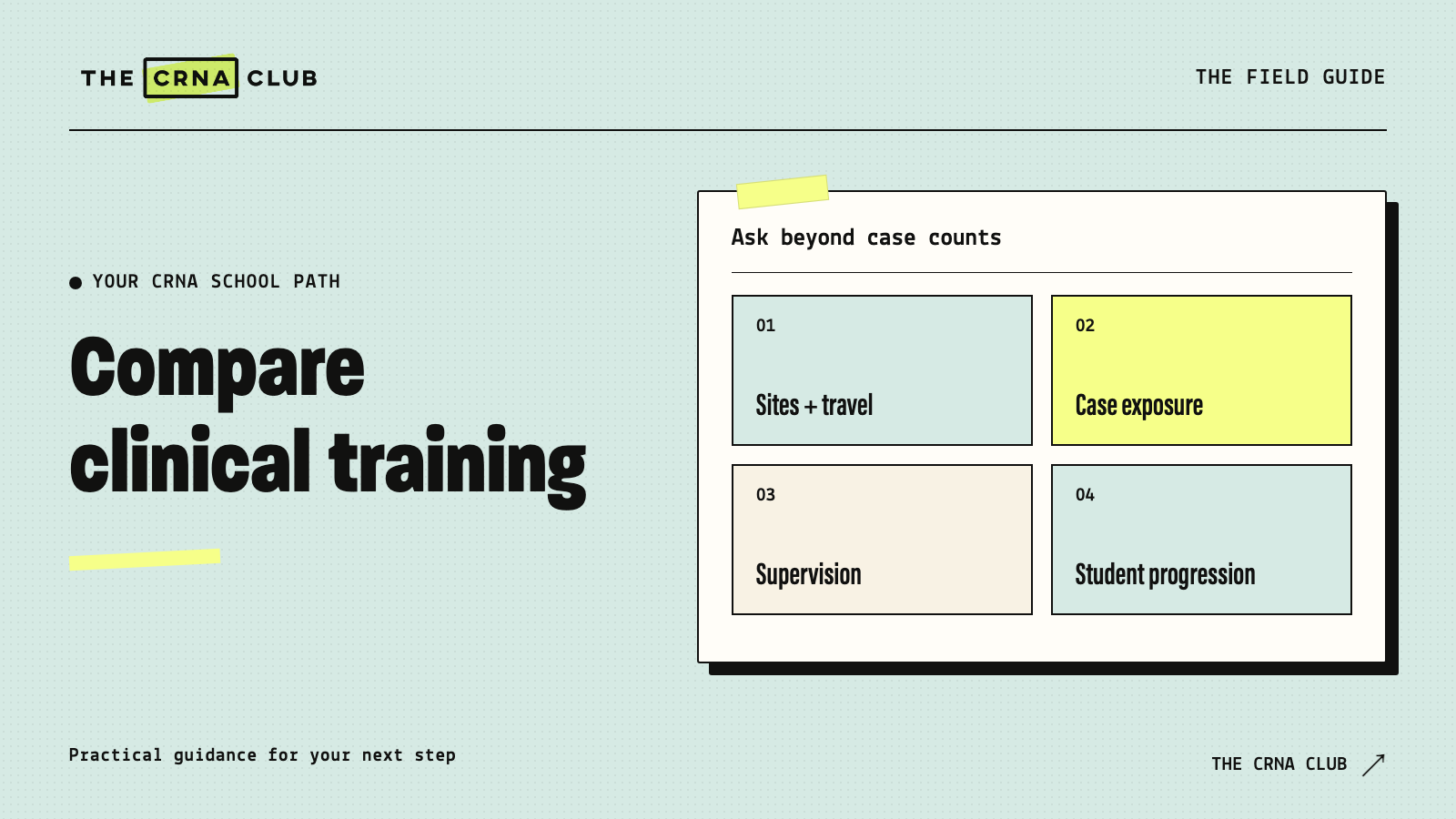
- What should you establish before comparing clinical details?
- What is the student’s role at each clinical site?
- How do you compare case variety without turning it into a numbers contest?
- What should you ask about supervision and feedback?
- How are clinical sites assigned, and can they change?
- What should you ask about learning alongside other trainees?
- How do simulation and classroom teaching connect to clinical work?
- What does a useful two-program comparison look like?
- Our Final Thoughts
- Take the Next Step
Compare CRNA clinical training by asking what students actually do, how their responsibilities grow and how the program identifies missing experience. Look at case variety, teaching, feedback and placement logistics together. A long hospital list or high overall case volume doesn’t tell you how an individual student learns across the program.
You can know the tuition, campus and program length and still have a blurry picture of clinical. “Great sites” sounds reassuring. But will you rotate through different practice settings? How will you receive feedback? What happens if you’re behind in one type of experience?
We suggest starting the comparison in our School Database, then keeping the clinical questions and answers with each saved program. Our program-planning lessons help you know what to ask beyond the hospital names. Explore them and the school tools with the seven-day trial, or begin with three saved programs in the free preview.
What should you establish before comparing clinical details?
Verify current program accreditation, then review the clinical curriculum and the cohort’s actual plan of study. Use the same questions for every school so your comparison is fair. Record what is confirmed, what depends on placement and what still needs clarification. Don’t treat an online comment as the program’s policy.
The COA standards effective January 2026 address clinical resources, site orientation, supervision and evaluation. They provide an official foundation for the questions you ask, while each program explains how it implements those responsibilities.
Our program research guide covers the broader investigation. Use this comparison to examine clinical training in more detail once you have a workable school list.
Under each saved school, note who answered your clinical question and when. If you heard “lots of regional experience” at an open house, write down what that means before you compare it with another school.
What is the student’s role at each clinical site?
Ask how students participate in assessment, planning, procedures, intraoperative management and postoperative care, and how those responsibilities change with progress. Find out how faculty assess readiness for additional responsibility. A site’s available services describe possibilities, but your actual learning depends on the role students have within that setting.
“Students rotate at a cardiac center” is the beginning of a question. Follow it with, “What does a student typically do during the rotation, how are cases assigned and how is progress evaluated?”
Be precise with terms such as observe, assist and perform. You don’t need a promise that you’ll personally perform every procedure in every case. You do need a clear explanation of participation and progression.
If a program discusses independent practice preparation, ask what that means educationally. What reasoning, planning and assessment skills will graduates demonstrate? How do faculty know a student has reached that level? A label doesn’t replace an explanation of the teaching process.
How do you compare case variety without turning it into a numbers contest?
Ask which patient populations, procedures and anesthesia techniques students encounter, then how the program monitors each individual’s experience. A total case count can hide uneven exposure. You need to understand whether students receive the required breadth and what happens when a particular area needs additional attention.
Questions to bring include:
- Where do students receive obstetric and pediatric experience?
- What regional anesthesia opportunities are part of the curriculum?
- How are difficult-airway and emergency experiences taught and assessed?
- Are there differences among sites that require additional rotations?
- Who reviews the case record, and how often?
Ask the program to explain its current expectations for your cohort. Published requirements can change. Ask which standards apply to your cohort and how the program tracks each student’s progress toward them.
Also distinguish minimum requirements from a program’s typical experience. A minimum is a completion threshold. A typical count needs a clear group and time period before you compare it with another school’s number.
What should you ask about supervision and feedback?
Find out who teaches students, how preceptors communicate expectations and how concerns reach program faculty. Ask how frequently students receive useful feedback and whether they have a chance to act on it. A student needs more than a final evaluation that arrives after the opportunity to improve has passed.
You can ask, “What does feedback look like during a routine rotation?” Then follow with, “If a student and preceptor disagree about expectations, who helps clarify them?”
A daily form is one tool. Ask how the program uses it. Does an advisor notice a repeated concern across several preceptors? Who checks whether the student’s improvement plan is working?
Consistency matters too. Some variation between clinicians is part of learning. Students still need a way to distinguish a reasonable preference from a safety concern or a program requirement. Ask how faculty help students understand those differences.
Ask for an example of how faculty handle conflicting preceptor feedback. You want to know who reviews the concern, what the student practices next and how improvement is assessed.
How are clinical sites assigned, and can they change?
Ask when students learn their placements, whether preferences are considered and which factors can change an assignment. Include the response plan for a canceled site or a missing learning opportunity. A placement preference isn’t a guarantee, and a current affiliate list doesn’t promise every student will train at every location.
Loma Linda’s current clinical FAQ explains that assignments reflect educational needs and that affiliations can change. That is one school’s published process, and a useful example of why you should ask about change rather than assuming a site list stays fixed.
For your programs, ask who coordinates an adjustment and how much notice students usually receive when possible. If you have a constraint affecting travel, discuss it before making a commitment.
Our clinical relocation cost guide helps you separate the educational opportunity from the practical costs of reaching it.
What should you ask about learning alongside other trainees?
Ask how clinical assignments and teaching opportunities are organized when several types of learners share a site. Avoid assuming the presence of residents or other students automatically improves or weakens your experience. The practical questions concern access, role expectations, supervision and how the program resolves an educational gap.
For example, “Are other trainees present?” produces a yes or no. “How are regional anesthesia learning opportunities allocated among trainees, and how do you track whether each student receives the experience they need?” produces more useful detail.
Don’t ask the program to criticize another profession or promise you priority over everyone. You’re asking how its educational responsibilities are met within a real clinical environment.
If current students describe a problem, treat it as a reason to ask a specific question rather than a confirmed judgment about the whole program. One rotation, preceptor or cohort doesn’t establish every student’s experience.
How do simulation and classroom teaching connect to clinical work?
Ask what students practice before entering clinical, how simulation addresses uncommon events and how classroom concepts are revisited during rotations. Look for feedback and progression rather than equipment alone. A simulation lab becomes useful through the teaching, practice and assessment that occur there.
You might ask, “How do you prepare students for their first clinical rotation?” or “When a student struggles with a clinical skill, how does faculty-directed practice fit into the improvement plan?”
If a school uses a front-loaded curriculum, find out how students maintain and apply earlier material once clinical begins. If it uses an integrated model, ask how concurrent coursework and clinical preparation fit together. Our front-loaded versus integrated overview explains that broader structure.
Neither model answers the teaching-quality question by itself. Your comparison needs the actual sequence and support.
What does a useful two-program comparison look like?
Compare concrete answers and the questions still unresolved. Avoid giving a school a higher score solely because it lists more hospitals or describes more cases. Put educational access, progress monitoring and logistics beside each other so a compelling feature doesn’t hide a practical limitation.
Consider these hypothetical responses:
| Question | Program A | Program B |
|---|---|---|
| Student role | Clear staged expectations by semester | Broad description, follow-up needed |
| Specialty experience | Assigned rotations with progress review | Several sites, allocation process still unclear |
| Feedback | Regular documented review and named faculty contact | Daily evaluations described, escalation contact unclear |
| Placement logistics | Distant rotations, student housing costs | Mainly regional sites, no guarantee of a particular assignment |
Program B isn’t automatically a poor choice. Its unanswered questions tell you what to ask next. Program A’s clear process also doesn’t erase the cost and travel requirements.
Say Sam, a fictional applicant, wants nearby support and a clear plan for regional and pediatric experience. Sam asks Program B to explain allocation and progress review before deciding. Sam keeps those two questions with Program B in My Programs until faculty answer them. We recommend doing the same with any clinical detail that could change your choice.
Our Final Thoughts
Ask both programs the same question about one experience you care about, such as regional anesthesia. Compare what you’d do, who would teach you and how the program would address a gap.
Take the Next Step
Choose two programs in our School Database preview and ask the same three clinical questions of both. Save what you learn with each school. Try the seven-day trial for the broader school-planning tools and lessons as you narrow the list.