How Do You Make CCRN Flashcards That Test Understanding?
Make CCRN flashcards from the facts and explanations you keep forgetting. Give each card one clear question, answer it before turning it over and verify the explanation against a reliable source. Then test the same concept in a different question so recognizing the card isn’t your only measure of progress.
Sachi, CRNA
CRNA
In This Article (9 sections)
- Should you use Anki or paper flashcards?
- What should go on a CCRN flashcard?
- What do useful cards look like?
- How do you fix a card that is too vague or too large?
- How should you use cards made from missed questions?
- What should you check in shared or AI-generated decks?
- How do you keep flashcards from taking over your study plan?
- Our Final Thoughts
- Take the Next Step
We suggest using the CCRN Toolkit for the teaching and practice around your cards. Review the concept in a video lesson, write a small prompt and use fresh questions to check your understanding. Try the broader platform free for seven days to explore the learning library and applicant tools.
You don’t need to turn every paragraph into a flashcard. The deck should help you remember what you’re studying, not become the reason you never get to practice.
Should you use Anki or paper flashcards?
Use the format you’ll return to consistently. Anki offers scheduled reviews and different card types. Paper cards work too when you keep a way to revisit difficult prompts.
If you use Anki, learn the basic question-and-answer workflow first. Its official getting-started guide explains notes, fields and cards. You don’t need an elaborate set of decks and add-ons before writing your first useful prompt.
Start with a short set from one study session. If you already understand most of a chapter, don’t copy it all into cards just because it’s there.
What should go on a CCRN flashcard?
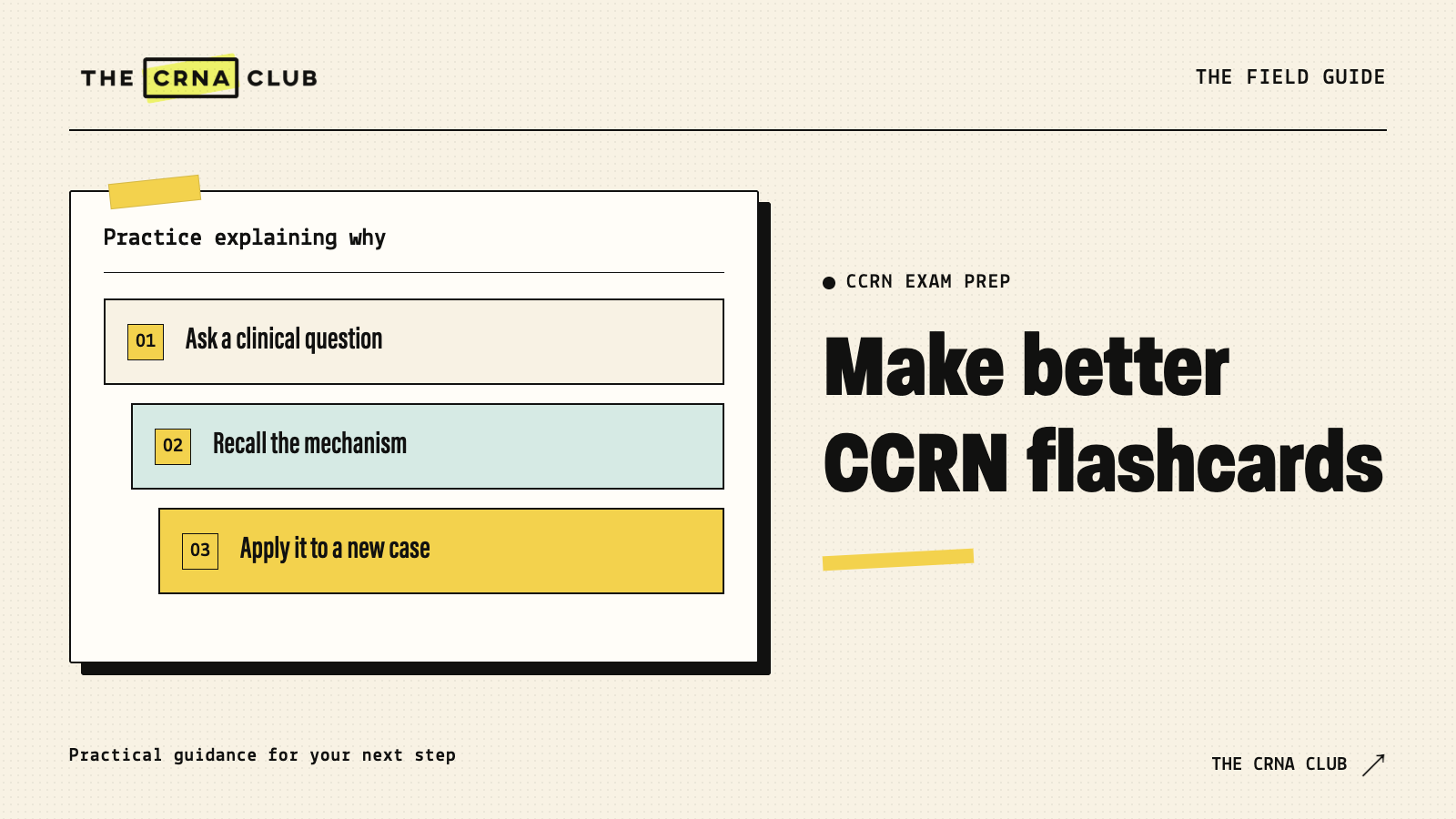
Choose the smallest prompt that still tests the connection you need. We suggest using a mix:
- Recall: Name a definition, variable or mechanism you need to remember.
- Explanation: Explain why one finding follows from a mechanism.
- Comparison: Identify the feature separating two similar concepts.
- Application: Explain what changes when one part of a fictional case changes.
Our CCRN Toolkit helps when the missing piece is the explanation. Watch the relevant teaching before writing the card. A short answer you don’t understand is still something you don’t understand.
What do useful cards look like?
These are original teaching examples. They aren’t copied from an exam or question bank.
| Card front | What belongs on the back | What it tests |
|---|---|---|
| “What does oxygen saturation describe?” | The proportion of hemoglobin binding sites occupied by oxygen; distinguish it from the amount of hemoglobin present | A definition |
| “Why doesn’t a normal oxygen saturation settle oxygen delivery?” | Oxygen content also depends heavily on hemoglobin, and delivery also depends on cardiac output | A causal connection |
| “What information would you need to compare oxygen delivery in two patients with the same saturation?” | Their hemoglobin and cardiac output, plus the context needed to interpret the measurements | Application |
Keep a source location on the back: the relevant lesson section or reference chapter. You should know where the explanation came from when you revisit it later.
The British Thoracic Society oxygen guideline explains why a normal pulse-oximetry reading does not rule out low oxygen content from anemia. For this example, saturation describes a proportion. It doesn’t tell you how much hemoglobin is carrying oxygen or how much blood reaches the tissues each minute. Use the card to distinguish saturation, oxygen content and oxygen delivery.
How do you fix a card that is too vague or too large?
Try answering it without seeing the back. If you don’t know what would count as a complete answer, rewrite the prompt.
Too vague: “Hemodynamics.”
More useful: “Which variables do you need to calculate cardiac output?”
Too much at once: “Explain every form of shock, its hemodynamics and treatment.”
More useful: Choose one relationship you misunderstood, verify it and ask about that relationship. Keep the larger topic for a lesson or a case discussion.
The point isn’t to make every answer one word. A mechanism needs a short explanation. Keep the question focused enough that you know whether you supplied the explanation or only recognized a familiar phrase.
How should you use cards made from missed questions?
Write the concept in your own words and respect the resource’s terms. You usually don’t need to copy a protected question and its choices to remember what you misunderstood.
Use this sequence:
- Read the rationale and identify the exact gap.
- Review the teaching until the missing step makes sense.
- Write a fresh question that asks for that step.
- Answer without looking, then compare with your checked explanation.
- Return later and try a different example.
Our guide to reviewing missed CCRN rationales covers the larger error-review process. A flashcard is one possible follow-up, not an obligation after every mistake.
What should you check in shared or AI-generated decks?
Verify unfamiliar claims before repeatedly studying them. Look for the source, the population the material covers and the date on any exam-policy card.
Be especially careful with medication explanations, practice thresholds and statements such as “always assess first.” A sentence stripped from its clinical context might become misleading. If you can’t explain why the answer fits, review the original teaching before keeping the card.
You also don’t need a large deck simply because someone else used one. Keep the cards addressing your own gaps. AACN’s current preparation guidance is the place to check the exam outline; a shared deck doesn’t establish coverage.
How do you keep flashcards from taking over your study plan?
Before starting, decide what the session needs: learning, recall or application. A deck helps with retrieval. It doesn’t replace the explanation you haven’t learned or the unfamiliar case you haven’t tried.
For a fictional 30-minute block, spend 10 minutes retrieving a small set, 10 minutes checking the weak explanations and 10 minutes applying one concept to a different question. Change the split when the explanation needs more time.
Our Final Thoughts
Build a deck you understand and will actually revisit. One clear card about a connection you missed is more useful than a screen full of copied paragraphs. Keep teaching and fresh practice beside the deck so you’re checking more than familiarity.
Take the Next Step
Use the CCRN Toolkit to connect your flashcards to lessons, questions and a workable calendar. Start with one topic you keep missing and make a small set you can explain.