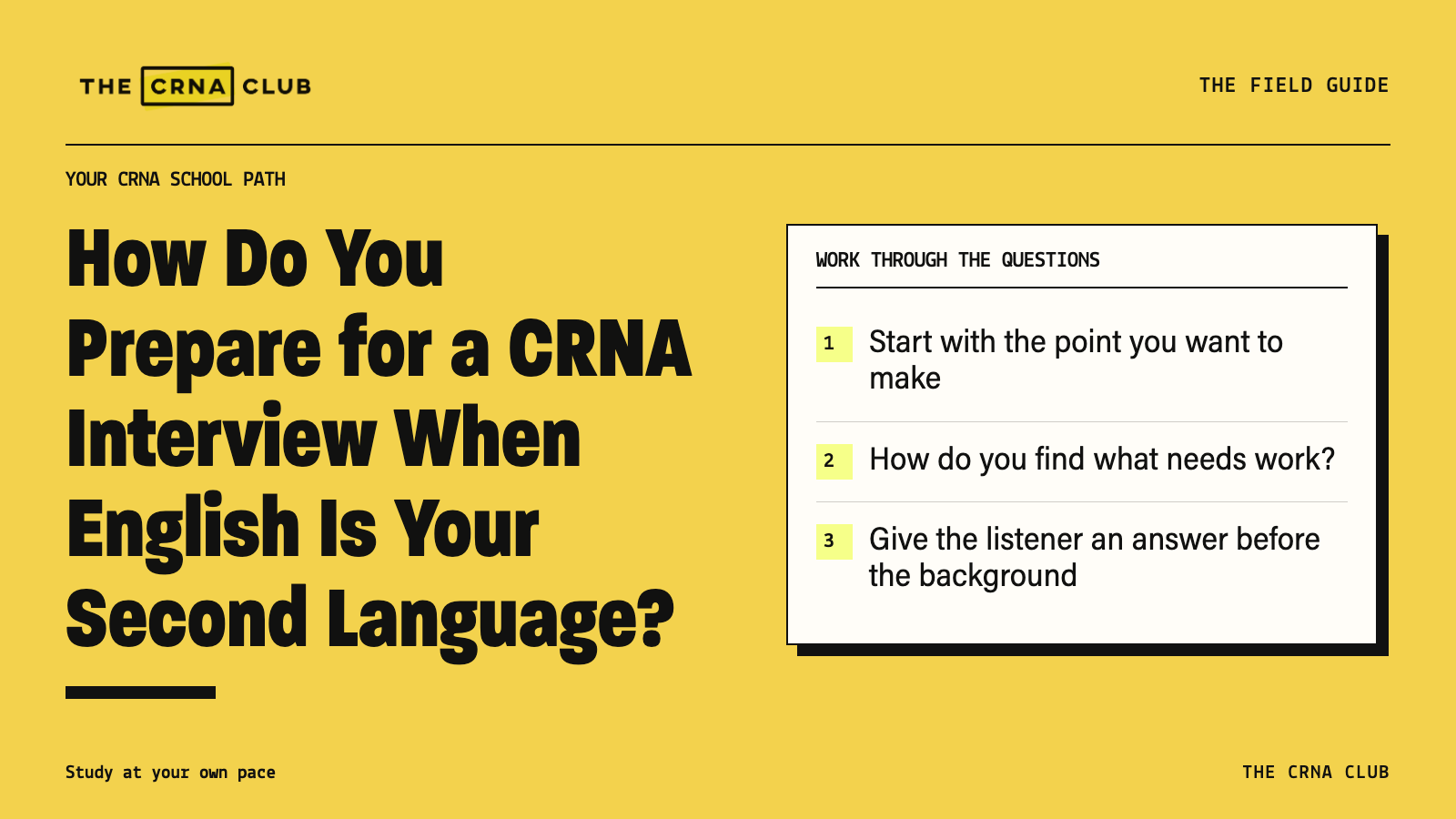
How Do You Prepare for a CRNA Interview When English Is Your Second Language?
If English is your second language, prepare for your CRNA interview by practicing how you’ll explain your experience and clinical reasoning out loud. Pay attention to where a listener loses your meaning, which terms are hard to say and where you rush. You don’t need to erase your accent to work on those things.
Sachi, CRNA
CRNA
In This Article (7 sections)
Preparing in another language adds something real to the work. Keep the practice focused on helping someone follow what you know, rather than trying to make every sentence sound like someone else’s.
The Mock Interview Lab gives you a place to practice spoken answers. Pair it with a trusted person who can tell you what they understood. The seven-day platform trial includes interview teaching and ongoing practice.
Start with the point you want to make
It can feel safer to write a complete answer and memorize every word. But what happens when the interviewer asks the question a different way? Now you’re trying to find your place in a script while also deciding whether it answers the question.
Let’s give you something easier to adapt. Try writing a few notes instead: your answer, one true example and what you learned. Say it aloud without reading a paragraph. Then answer a slightly different version of the question. You’re practicing explaining something you know in words you can actually use.
We talked about practicing aloud, knowing why you’re telling a story and thinking on your feet in Tangible Interviewing Tips from Communications Coach Michelle Miller. Those ideas give you something specific to practice beyond simply repeating an answer.
For clinical questions, keep the accurate medical term and explain it briefly. If a term you use in patient care is difficult to pronounce, practice that term. Replacing it with a vague word can make your clinical explanation harder to understand.
How do you find what needs work?
Pick one question and record yourself answering without reading. Listen once for meaning: did you answer the question, and could someone follow how the example supports your answer? Then listen for the places you rushed or lost the connection between ideas.
Ask a trusted listener to tell you your main point in their own words. If they describe something different from what you intended, you’ve found something useful to work on. Maybe your answer was there, but it came after so much background that they missed it.
A practice session could look like this:
- Choose one question.
- Outline your answer and one true example.
- Record the answer without reading.
- Listen for unclear meaning or rushed transitions.
- Ask someone to summarize what they heard.
- Try again with a different follow-up question.
Work on one problem in the next attempt. You don’t have to change every part of your delivery at once. Use the Mock Interview Lab as another practice setting, while remembering that its feedback doesn’t certify language proficiency or predict an admissions decision.
Give the listener an answer before the background
Listen to the difference in these fictional examples:
“There were several things and before I explain the thing I need to say the whole history…”
“I changed how I organized handoff after feedback from my preceptor. I started with the current concern, then used the history to explain it.”
The second answer tells you what changed right away. Now the history has a purpose: it helps explain that change. You don’t need elaborate vocabulary to make the connection clear.
What if you need a moment?
You can pause and say, “I’d like a moment to organize that.” If the question is unclear, ask about the part you need clarified: “Are you asking about the clinical decision or how I communicated it?” That helps you answer the actual question instead of guessing.
If you didn’t hear a word, ask for it to be repeated. You don’t need to keep apologizing for your English. Also be honest about what you don’t know. If you’re unsure of the physiology itself, that’s a clinical knowledge gap to work on rather than something to explain away as a language issue.
Check formal requirements separately
Your interview preparation doesn’t replace a required English-language exam or degree evaluation. Check the school’s current instructions for your educational background. Our foreign nursing degree guide covers the broader eligibility questions.
Keep this practice focused on helping someone understand what you know and what you’ve actually done.
Our Final Thoughts
Keep the next practice session focused on something you can work on. Record one answer and ask a listener where they lost your meaning. Choose that part for the next attempt, keeping the experience and wording your own.
Practice an answer in your own words
Try the Mock Interview Lab as one place to speak the answer aloud, alongside feedback from a trusted listener. Explore the seven-day platform trial for interview teaching and ongoing practice.