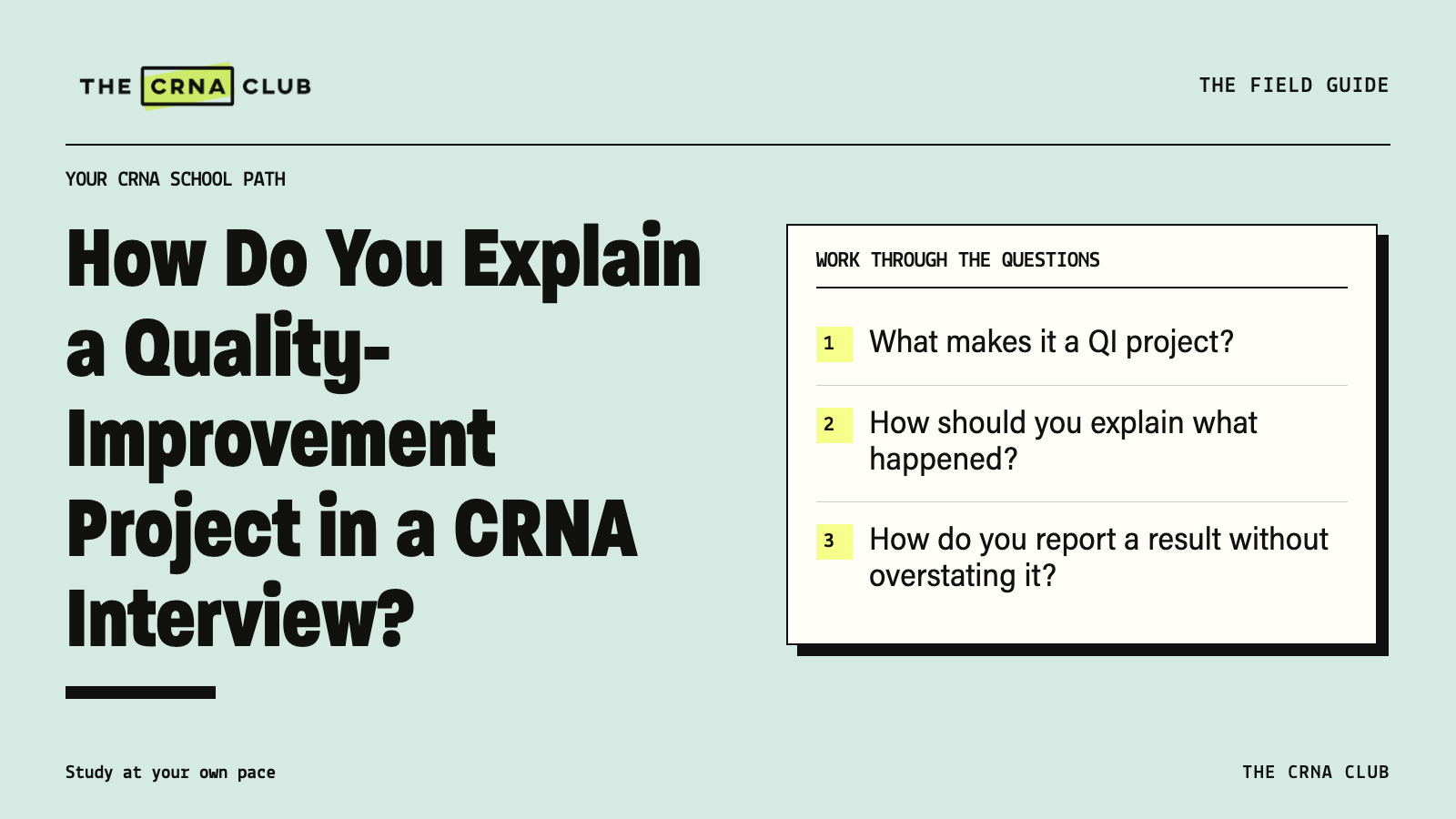
How Do You Explain a Quality-Improvement Project in a CRNA Interview?
For a CRNA interview answer about quality improvement, explain the problem your team worked on, what you did and how you checked the change. A committee name won’t tell the panel that. It needs to understand the work and the result you actually measured.
Sachi, CRNA
CRNA
In This Article (7 sections)
You may know the project well and still find it hard to explain in an interview. Start with the problem the team was trying to solve, then follow the piece of work you actually contributed.
Practice with the Mock Interview Lab. The seven-day platform trial adds interview and resume lessons while you connect the project with your application.
What makes it a QI project?
A quality-improvement project addresses a defined local problem and checks a change. A routine duty might be valuable without being a formal project. Teaching a new nurse, for example, doesn’t automatically become QI because you call it that.
Our resume lessons encourage unit initiatives and accurate descriptions of your contribution. Use the same care in an interview. If your job was collecting data, explain what you collected and how the team used it. Don’t imply you led the whole project.
How should you explain what happened?
Start with the local problem. What was the team trying to improve? Then name your responsibility and describe the change it tested.
Now explain the measurement. What did the team record before the change, and what did it check afterward? Finish with what you learned and what needed adjusting.
The Institute for Healthcare Improvement’s Model for Improvement connects the aim, measures and change to test. Its Plan-Do-Study-Act cycles use what the team learns to adjust the next test. Those questions help you explain the project beyond saying you attended the meetings.
Practice through the Mock Interview Lab, then ask whether the listener can tell which work was yours.
How do you report a result without overstating it?
Let’s look at what the result actually counted. Say a fictional documentation project started with 12 complete records out of 20 audited. After the change, 17 of 20 were complete.
That’s 60% compared with 85%, an increase of 25 percentage points. It tells you about the documentation you measured. It doesn’t show fewer complications, because the project didn’t measure complications.
If you’re still collecting follow-up data, say that. “We introduced the tool and are collecting follow-up data” explains the completed work. “The tool improved safety” claims a result you don’t yet have.
Use only aggregate or internal information you’re permitted to share. Keep patient identifiers and confidential workplace data out of the practice answer too.
What if the change didn’t meet the goal?
Well, what did you learn? Did staff find it difficult to use? Did the measurement reveal a different problem? What would the team test next?
For a fictional example:
“I assumed the reminder would fit the existing workflow, but staff feedback showed it appeared after the task was already complete. We changed its placement before the next test.”
That explains why the next test changed. Use what actually happened in your project. An honest adjustment gives you something useful to discuss even without the result you originally wanted.
Our unit project guide helps you find a suitable application example without turning participation into a larger role.
What follow-ups should you prepare for?
Know the starting measure and why the team chose it. Be ready to describe who helped and what else might have affected the result. If someone else analyzed the data, say so and explain what you understood from their analysis.
You don’t need to describe every meeting or spreadsheet. Choose the details that let the interviewer follow the change, your contribution and what you’d improve next.
Our Final Thoughts
Give a modest project the same care you’d give a larger one when you explain it. Choose a project you understand and explain the change, your contribution and what the team measured. If the work is unfinished or the result fell short, include that honestly and say what you’d check next.
Make your project explanation clear aloud
Use the Mock Interview Lab to practice describing the work in your own words. You can review interview and resume teaching through the seven-day platform trial.