Should You Choose a CRNA School Near Home or a Lower-Cost School Far Away?
Sachi, CRNA
CRNA
In This Article (10 sections)
- What should you compare before discussing money?
- Which costs change because you choose one school over the other?
- How can you calculate whether the lower tuition survives the move?
- What is the monthly break-even point?
- How should you account for family support?
- What about partner income and two households?
- Which clinical expenses deserve their own line?
- What still needs professional financial guidance?
- Our Final Thoughts
- Take the Next Step
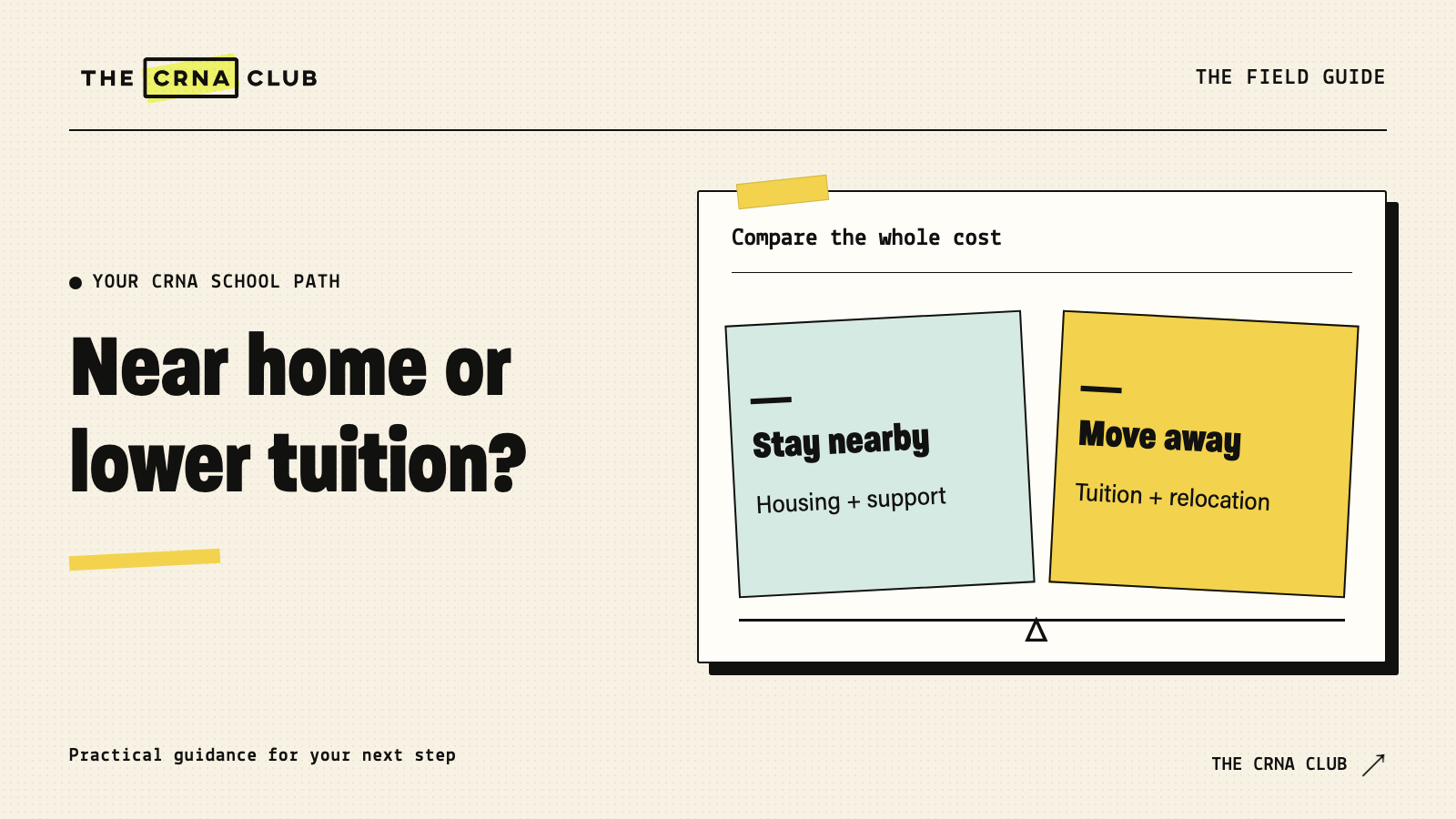
Choose between a nearby CRNA school and a lower-tuition school farther away by comparing the full costs and the support you would keep or lose. Calculate the expenses that change because of the move, then check whether the program’s clinical travel fits your life. A tuition discount matters, but it isn’t the complete price of attending.
You might look at two offers and see a clear tuition difference. One is close to family. The other looks cheaper and would require a move. Then childcare, partner income and clinical housing enter the conversation, and the easy answer gets less obvious.
We recommend comparing the schools in our School Database and working through the expenses with our financial-planning resources. Keep the travel and housing questions with each saved school so the budget and your school research stay connected. You can explore those resources and the school tools with the seven-day trial.
What should you compare before discussing money?
Confirm that both offers are workable academically and practically. Review admission conditions, attendance requirements, clinical locations and the program’s current accreditation. A cheaper offer you cannot attend through the whole curriculum is a different situation from two feasible options with different costs. Settle that distinction before choosing based on the tuition line.
A nearby campus might still require distant rotations. The University of Tulsa’s nurse anesthesia FAQ identifies a required rotation involving overnight accommodation and notes housing arrangements at distance sites. Those details can change a comparison even when a campus is local.
Ursuline’s nurse anesthesia FAQ describes required travel beyond the clinical hub and states that housing is not provided. Policies differ, so check the actual programs you’re comparing.
Use our offer comparison guide to review the conditions attached to each offer before adding the financial model.
Which costs change because you choose one school over the other?
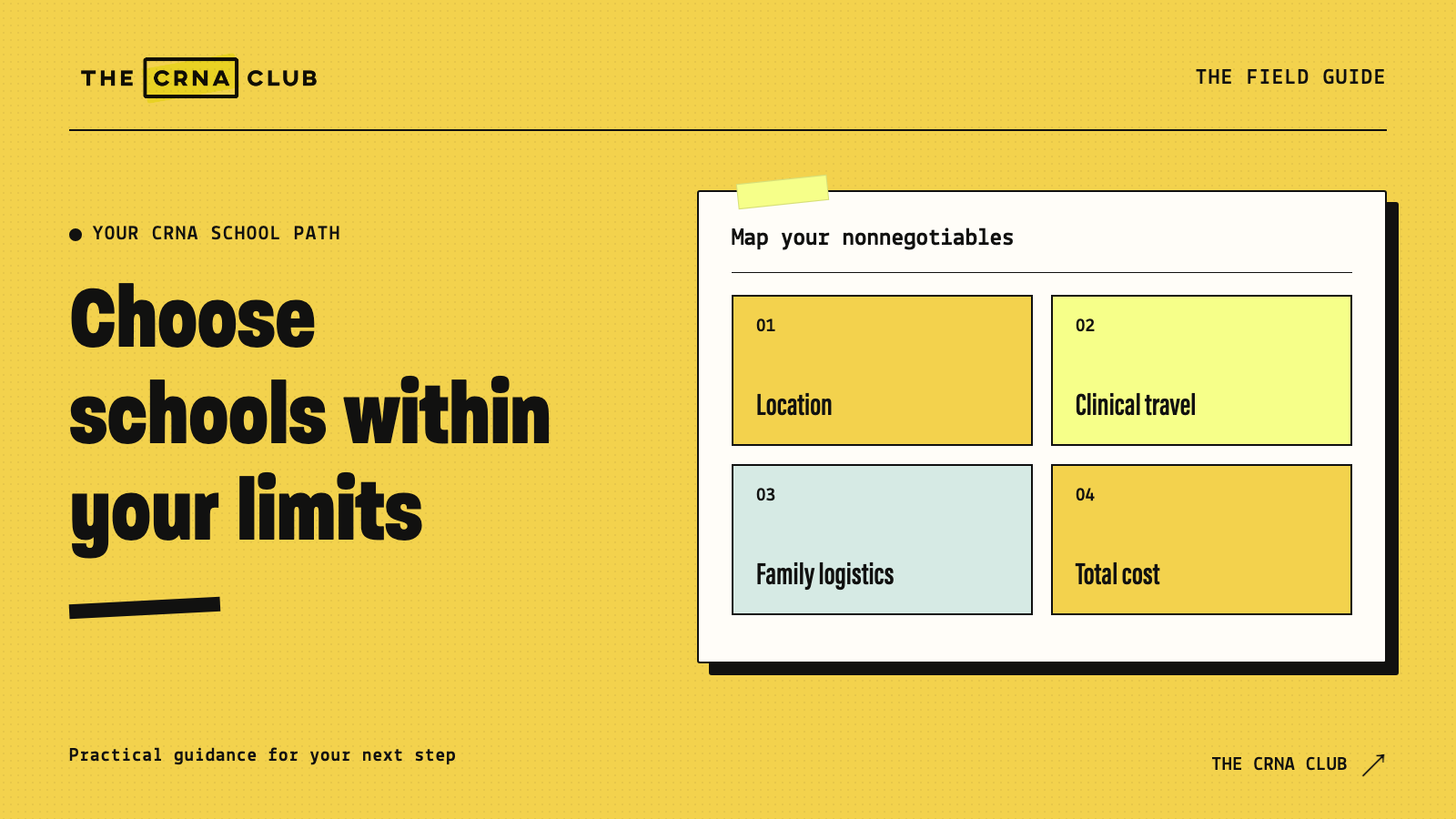
Separate expenses you would pay in either location from expenses created or changed by the move. Compare tuition and required fees on the same basis, then add relocation, housing differences, childcare, clinical travel and other decision-dependent costs. You’ll see whether the move creates a second rent payment or changes a cost you already pay.
For example, if you will pay for groceries in both cities, only the difference belongs in a comparison of changing costs. But if moving means paying rent near school while keeping a family home elsewhere, the additional household is a real cost to examine.
A useful worksheet has these fields:
| Category | Nearby school | Distant school | How you checked it |
|---|---|---|---|
| Tuition and required fees | Whole-program estimate | Same scope and entry year | Official program information |
| Housing | Existing or new arrangement | New arrangement and any second household | Actual available options |
| Childcare | Hours and cost | Hours and cost | Care-provider availability |
| Clinical travel | Required locations and housing | Same categories | Program’s placement information |
| Relocation | Any necessary move | Moving and setup costs | Written estimates where possible |
Keep a separate full budget for affordability. A table of differences helps choose between options, but it doesn’t replace knowing how you’ll cover the expenses both options share.
How can you calculate whether the lower tuition survives the move?
Subtract the extra costs of attending the distant school from its tuition-and-fee advantage. Use the actual program length and realistic monthly differences, then add one-time and rotation-specific expenses separately. Label assumptions so you can change them. A clear calculation is more useful than a single total with no explanation.
Consider this entirely hypothetical comparison over 36 months:
| Changing cost | Nearby School A | Distant School B |
|---|---|---|
| Tuition and required fees | $90,000 | $60,000 |
| Additional monthly housing cost relative to staying | $0 | $600 × 36 = $21,600 |
| Additional monthly childcare cost | $0 | $400 × 36 = $14,400 |
| Relocation and setup | $0 | $4,000 |
| Additional clinical travel | $0 | $2,000 |
| Total of these compared costs | $90,000 | $102,000 |
School B begins with a $30,000 tuition advantage. The changing expenses in this example add $42,000, making these compared costs $12,000 higher than School A.
Both schools still have living expenses. This fictional table leaves out the costs shared by both options so you can see what changes. Use your own prices and aid information before making the decision.
If your actual relocation costs are lower or housing is provided, the result changes. That’s why you want editable assumptions rather than advice based on someone else’s budget.
What is the monthly break-even point?
Take the distant school’s tuition advantage, subtract one-time and separate travel costs, then divide the remaining amount by the months over which recurring costs differ. The result tells you how much additional monthly expense would use up that advantage under your assumptions. It’s a comparison tool, not a prediction of all future spending.
Using the example above:
- Tuition-and-fee advantage: $30,000.
- Subtract $4,000 relocation and $2,000 additional clinical travel. That leaves $24,000.
- Divide $24,000 by 36 months: about $667 per month.
School B’s additional housing and childcare total $1,000 per month, which exceeds that $667 break-even amount. Under these assumptions, its tuition advantage disappears.
Now change the additional monthly costs to $300. Over 36 months, that adds $10,800. Combined with the $6,000 one-time and travel costs, the extra expense is $16,800, leaving $13,200 of the original tuition advantage.
Now you know which number to check next. If the childcare estimate changes the winner, get an actual quote and confirm availability before relying on it.
How should you account for family support?
Describe what the support actually provides and what would replace it if you moved. Free or low-cost childcare, transportation help and dependable backup care can affect spending and daily feasibility. Emotional support matters too, even when you don’t assign it a price. Keep those benefits visible rather than pretending they don’t count because they aren’t tuition.
Ask the person providing help about their capacity. “My sister lives nearby” doesn’t tell you whether she can cover a 5 a.m. departure or a week when your child is sick.
Write down the specific arrangement you can reasonably rely on, then add a backup plan. If the support is uncertain, model a scenario without it rather than assuming it will always be available.
Our partner and support-system guide can help begin that conversation. Your financial comparison should reflect what people can actually do, not what you hope they’ll be able to absorb.
What about partner income and two households?
Discuss whether the move changes a partner’s employment, commute or benefits, and whether the family would move together. Put those consequences in a separate household scenario so you can see them clearly. Don’t assume a job transfer, replacement income or free housing will be available before confirming the arrangement.
If your partner stays behind, compare the added housing and travel with the support you would lose day to day. If the family relocates, compare the actual work and care options in the new location.
A hypothetical applicant, Ben, initially plans to attend the cheaper school alone while his family stays home. Once he adds rent near campus and travel for visits, the plan looks different. He also needs to think about whether studying and clinical demands make the expected travel realistic.
We suggest saving those unanswered housing and travel questions under each target program, then updating your comparison after the school answers. That keeps an old budget assumption from surviving a change in the clinical plan.
Which clinical expenses deserve their own line?
Separate required rotation travel, temporary housing, transportation and any overlapping rent. Ask whether housing is guaranteed, provided at selected sites or simply suggested. Also ask when placements are known and whether assignments can change. The answer affects how much uncertainty belongs in your budget.
Don’t count “housing available” as “housing free” unless the program confirms that meaning. And don’t assume you can avoid a distant rotation because you prefer a local site.
Our clinical relocation budgeting guide explains the categories to check. Use the program’s current instructions to replace placeholder numbers with the best available estimates.
What still needs professional financial guidance?
Use your comparison to identify questions for the school’s financial-aid office and, when appropriate, a qualified financial professional. Actual aid eligibility, borrowing terms and repayment consequences require current information about your situation. A hypothetical cost table should help you prepare that conversation rather than substitute for it.
Also ask each school what its official cost-of-attendance estimate includes. The tuition versus cost-of-attendance guide helps you compare the scope of those figures.
Keep uncertainty visible. You can use a base case and a higher-cost case for an unconfirmed expense. If one assumption completely reverses your decision, investigate that assumption before treating the comparison as settled.
Our Final Thoughts
Find the assumption that changes your decision, such as childcare or a second rent payment. Get a current quote or a clear program answer before treating the lower tuition as a saving.
Take the Next Step
Choose two schools in our School Database preview and replace the fictional table with your own costs. We recommend our financial-planning resources for working through those scenarios, alongside the notes for your saved schools. Explore them with the seven-day trial.