Understanding Your “Why” in CRNA School
Nali, SRNA
SRNA

In This Article (4 sections)
Understanding your “why” in CRNA school is essential for maintaining focus and resilience throughout the rigorous journey of obtaining your nurse anesthesia degree. Knowing your purpose helps you stay disciplined and motivated, especially during difficult times.
Committing yourself to CRNA school is an investment in yourself and your future to an extent that is hard to conceptualize until you’re in it. Through your application you’ll have to be able to convey being a CRNA as something you’ve always wanted. And when interview time comes it will be your job to display that passion to your interviewers, so they understand that being a part of their program is something you’ve thoroughly thought about.
When it comes to pursuing nurse anesthesia, you will often hear that if you do not have a “why” getting through those three long years is going to feel impossible. I can attest that when you know and understand your “why” you have a better sense of direction and making it through those challenging moments during school. The importance of knowing your “why” was popularized by Simon Sinek’s book Start With Why where he emphasizes that successful individuals and organizations operate with a clear understanding of their purpose, which inspires others and sustains their success. If you’re considering this path, you might also want to review our step-by-step guide on How to Become a CRNA.
Why is having a “why” essential for CRNA school success?
Quick Answer
Understanding your "why" in CRNA school is important for maintaining focus and resilience. The CRNA Club emphasizes that having a clear purpose can significantly strengthen your success through the hardest stretches of the program. We actually talked about this on the podcast (Ep 61: "The boxes to check with your personal statement") and shared practical strategies for identifying your core motivation.
- Provides clarity and focus during your application and interview process
- Gives you the driving force to stay disciplined not just motivated
- Staying resilient during challenges and transitions in school
Watch the explanation
Understand the CRNA Role Before Applying
A state opt-out removes the specified federal physician-supervision requirement for CRNAs. Actual practice also depends on state law, facility policy and credentialing, so opt-out status does not by itself define every CRNA’s scope or employment model.Source
How can you identify your “why” for CRNA school?
So let’s figure out how to identify yours:
- WINS: What moments in your career felt the most fulfilling? What part of healthcare would you like to impact most, critical care vs. primary care?
- PASSIONS: Clarify how you want to impact the healthcare field. What is your passion or sector? What are you passionate about? What drives you the most?
- LONG TERM GOALS: Your “why” is often tied to your values. Are you going back to school seeking growth? For the progression of your family? For your kids to be able to live a better life? For financial freedom?
- STRUGGLES: Consider the challenges you’ve overcome in your career. What did you learn from these experiences that you could apply to your CRNA school journey?
- GRIT: Was there a challenging moment in your life that you overcame with grit and tenacity? Think of the qualities needed to pursue through graduate education and how you can relate this to your goal of becoming a CRNA.
Being sure of yourself and what you want in the long and short term in pursuing CRNA school will give you better direction in your application, interview, and matriculation process. Understanding your “why” is going to help get you through those long study days and the highs and lows of school. Finding the grit that you need to get to the finish line, especially when the going gets tough will be your driver.
At some point motivation ends and discipline will drive those 16 hour days of clinical, studying and boards prep. You must know with 100% certainty that the CRNA profession is something you want for yourself. If you want extra help with this process, our Learning Library has a full lesson on CRNA School Essay Basics that can help clarify your motivation and story.
- Nali A., RRNA
Need help with your CRNA personal statement?
We’ve got templates and how-to videos inside of our Membership! For more insights on CRNA programs, visit our CRNA School Requirements page. If you're preparing for interviews, check out our CRNA Interview Questions guide.
To craft a compelling personal statement, see our Personal Statement Guide. Use our School Comparison Tool to evaluate different programs. Plan your application timeline with our Application Planning Tool.
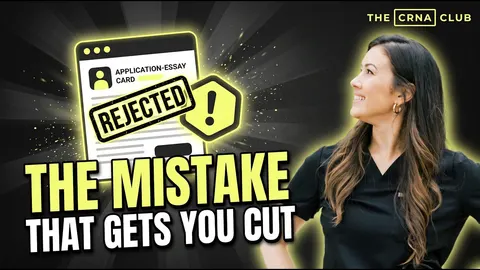
We also shared advice on writing your essay in Ep 21: "3 key things to do (and not do) when writing your CRNA school essay" and gave additional personal statement tips in Ep 42: "Tips for writing a personal statement that is well, personal.". If you want to go deeper, check out our Learning Library lessons like Essay Writing Tips w/ CRNA School Faculty and Storytelling Basics for more step-by-step guidance.
For more information, check these trusted resources: NursingCAS, AANA.
Our Final Thoughts
Understanding your “why” is not just a motivational tool but a important compass that guides you through the demanding path of CRNA school. With clear purpose and grit, you will work through challenges and celebrate your growth every step of the way. The CRNA Club is here to support you on this journey.