Can You Use AI to Write Your CRNA Personal Statement?
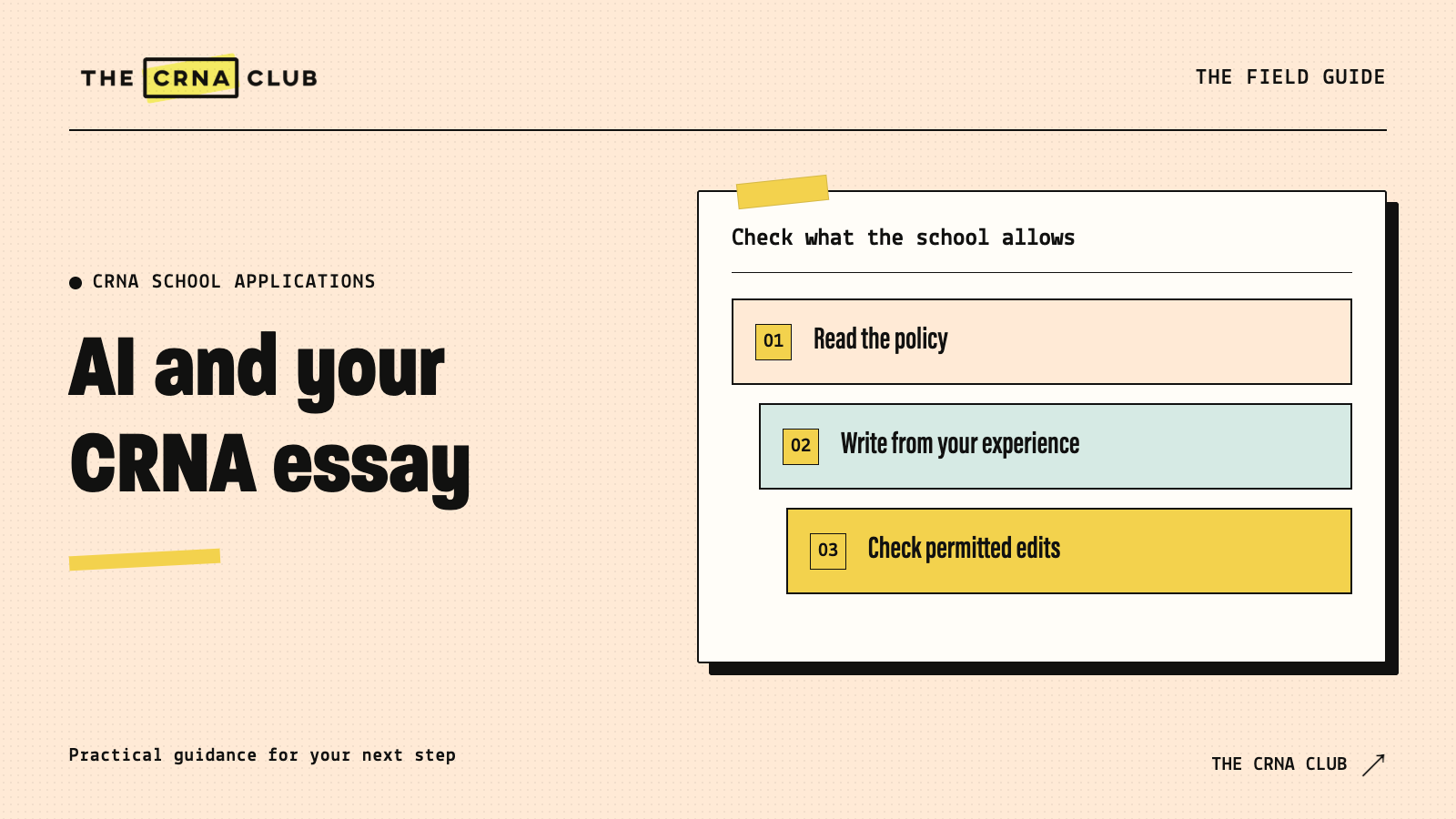
Follow each CRNA program’s AI policy before using a writing or feedback tool. Some programs permit limited editing while requiring your own content and voice. Others prohibit generative AI in essay responses. Your personal statement still needs to explain your experience and answer the actual prompt.
Sachi, CRNA
CRNA
In This Article (7 sections)
Our personal-statement lessons and planning resources help you organize that work. You can explore them with the seven-day trial. If your school permits the relevant AI feedback, our Essay Critique helps you review a draft against the prompt. Check the school’s rule before submitting your essay to an AI tool.
Are AI editing and AI-written essays treated the same way?
Read the specific policy. Northeastern’s DNP nurse anesthesia admissions page permits AI grammar checking and editing, while requiring the content, ideas and narrative to be yours.
The University of Minnesota’s DNP application instructions prohibit generative AI tools in preparing essay responses. Its instructions also include nurse-anesthesia-specific uploads, so don’t substitute a policy from another graduate program.
Those examples don’t create a national rule. If your instructions are unclear about critique, brainstorming or a particular editing feature, ask the program before using it. “The tool only gave feedback” doesn’t settle whether the school permits it.
What should you do before you ask for feedback?
Write the first version from your own notes. We suggest starting with the prompt and the evidence you have, rather than asking software to invent a compelling applicant.
- Split the prompt into its questions. Mark what each paragraph needs to answer.
- List your own evidence. Use real learning, work, shadowing and program research.
- Explain the connection. Say what the experience changed in your thinking or preparation.
- Draft in your own words. Read it out loud and revise sentences you’d never say.
- Check permitted assistance. Choose reviewers and tools within that school’s policy.
The personal-statement lessons teach prompt-focused planning and reflection. They give you a process to apply to your own experiences, including when AI assistance isn’t allowed.
The podcast “The boxes to check with your personal statement” walks through answering the prompt and telling a true story with a purpose. Listen on Spotify or Apple Podcasts.
What does helpful revision look like?
It makes your answer more specific without inventing what happened. Consider this fictional practice passage, written only to demonstrate revision:
First draft: I am a passionate and resilient nurse who wants to become a CRNA. My experience has prepared me for the challenge.
Those claims need evidence. A useful reviewer asks what you learned and what you did next, rather than adding more impressive adjectives.
For this fictional writer, assume the actual notes describe reviewing an unfamiliar ventilator problem with an educator and changing how they prepare for similar cases. A revision might read:
After struggling to explain a ventilator change, I reviewed the case with our educator and worked through the physiology before my next shift. I began keeping a short record of questions I couldn’t answer, then using those questions to direct my study. That habit made my preparation more deliberate and strengthened my interest in further education.
The revised passage works because it gives a specific action and reflection. Copying it into your essay would still make it someone else’s writing about an experience invented for this article. Close the example and work from your own notes.
Our annotated personal-statement examples show more revision choices. Use examples to study the writing process, not to supply your biography.
When would we suggest using Essay Critique?
Use it only when the program permits the assistance it provides. The Essay Critique tool reviews a draft with the school’s prompt and length limit, helping you identify missed questions, weak support or an unclear structure. It doesn’t decide whether a school allows AI assistance.
If permitted, bring the tool a draft you’ve already written. Choose one feedback item to investigate, then make the revision yourself. For example, if the feedback says your program-fit paragraph is generic, verify a real curriculum feature and explain why it connects with your goals. Don’t insert a faculty name or clinical-site claim without checking it.
If AI feedback isn’t permitted, use the same planning questions on paper. Ask a human reviewer only for the help the school allows. Membership access doesn’t override an admissions policy.
What if a revision sounds polished but doesn’t sound like you?
Read the paragraph aloud beside your original notes. Ask whether the new wording still expresses your actual reasoning and level of experience. If you can’t explain a sentence in an interview, rewrite it yourself.
Keep these checks beside the draft:
- Did you answer every question in the prompt?
- Does each major claim have a true example behind it?
- Are your clinical role and contribution accurate?
- Are program features verified for the pathway you’re applying to?
- Does the writing follow the school’s assistance and disclosure instructions?
Save your own drafts and feedback so you know how the essay changed. Don’t chase a detector percentage or rewrite toward an imagined algorithm. The assignment is to submit an honest response within the program’s rules.
Our Final Thoughts
Start with your own experiences and give yourself time to explain them. A useful writing process helps you say what happened, what you learned and why you’re pursuing nurse anesthesia without handing over authorship.
Get help with the next revision
Explore our essay-planning lessons through the seven-day trial. If your program permits AI critique, start with one lifetime free Essay Critique and use the feedback to choose a specific revision. If it doesn’t, keep your work within its permitted writing and review process.