Can You Use ChatGPT to Practice for a CRNA Interview?
Sachi, CRNA
CRNA
In This Article (9 sections)
- What should you ask ChatGPT to do during interview practice?
- What information should you provide before starting?
- How do you keep the answer sounding like you?
- How should you evaluate AI feedback?
- Can ChatGPT help with clinical interview questions?
- What would a useful 25-minute practice session look like?
- When should you move from AI practice to another person?
- Our Final Thoughts
- Take the Next Step
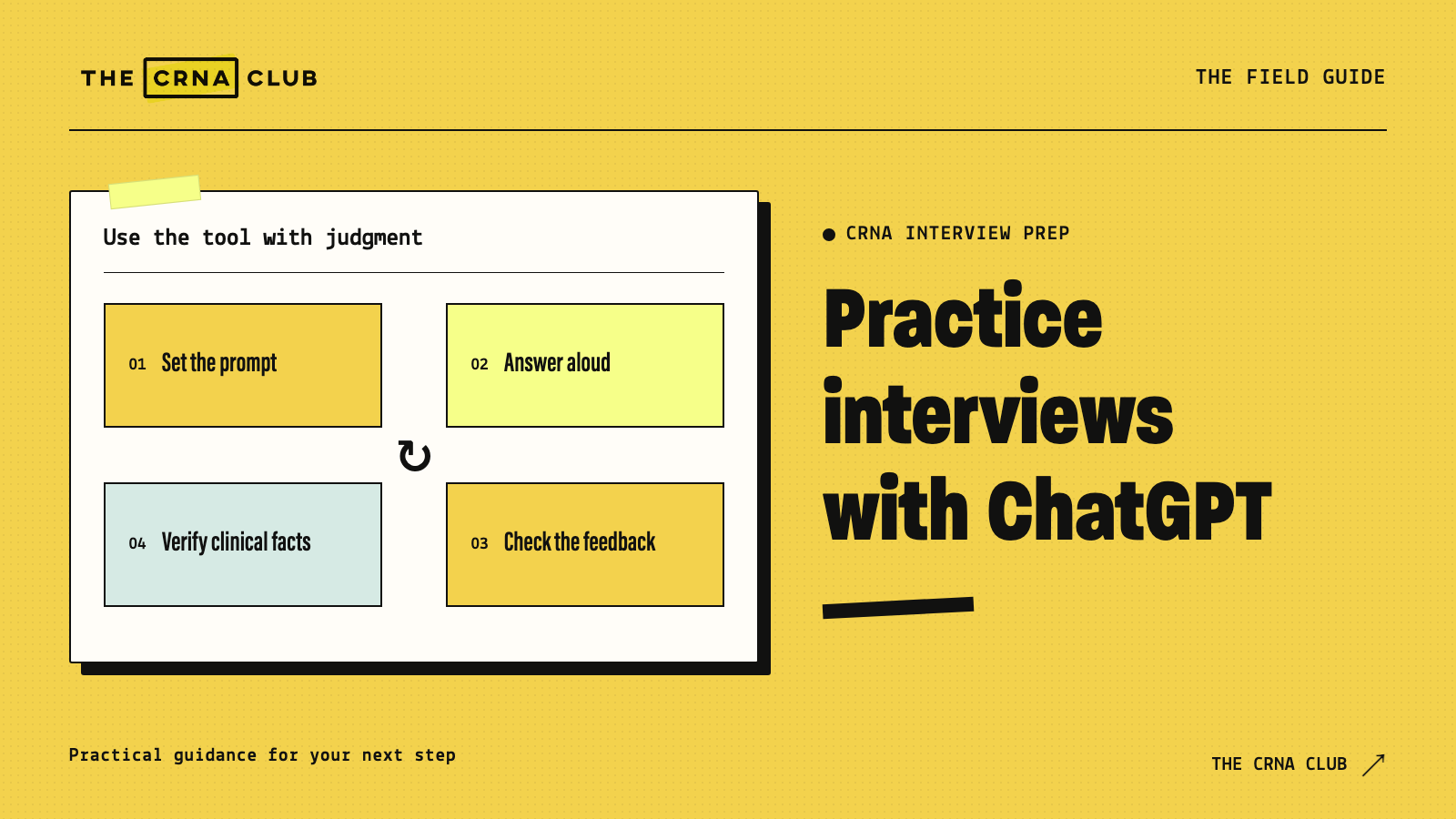
You can use ChatGPT to practice for a CRNA interview by asking one question at a time, answering out loud, and reviewing whether your answer addresses the question. Use it to generate practice opportunities and notice gaps. Check clinical facts separately, protect private information, and keep your examples and final answers your own.
That sounds straightforward until the chat starts giving you beautifully written answers. You read one and think, “Okay, that’s what I should say.” Now your practice session has turned into reading someone else’s explanation. You may recognize every word and still struggle when a person asks the question differently.
We recommend our Mock Interview Lab when you want spoken practice with feedback you can return to. It gives you question-level feedback you can use for another attempt. The seven-day trial adds the personalized study guide and interview lessons, so you can review weak topics between sessions. If you’re practicing in ChatGPT too, use the prompt below to keep the work focused on your answers.
What should you ask ChatGPT to do during interview practice?
Ask ChatGPT to give you one question, wait for your answer, and then comment on that answer. Include the type of practice you want and the boundaries it should follow. A focused session is easier to evaluate than a request for “everything I need to know for CRNA school.”
OpenAI’s guide to using ChatGPT recommends explaining your goal, the context that changes the answer, and the format you need. For interview practice, that means saying whether you’re working on behavioral examples, explaining your ICU experience, or handling follow-up questions.
Here’s an original starting prompt you can adapt:
Help me practice speaking about my own nursing experience for a CRNA school interview. Ask one behavioral question at a time and wait for my answer. Afterward, identify whether I answered the question, explained my own actions, and included a relevant reflection. Give me one improvement to work on. Don’t invent details, write a replacement answer, or predict my admission chances. Ask permission before changing the practice topic.
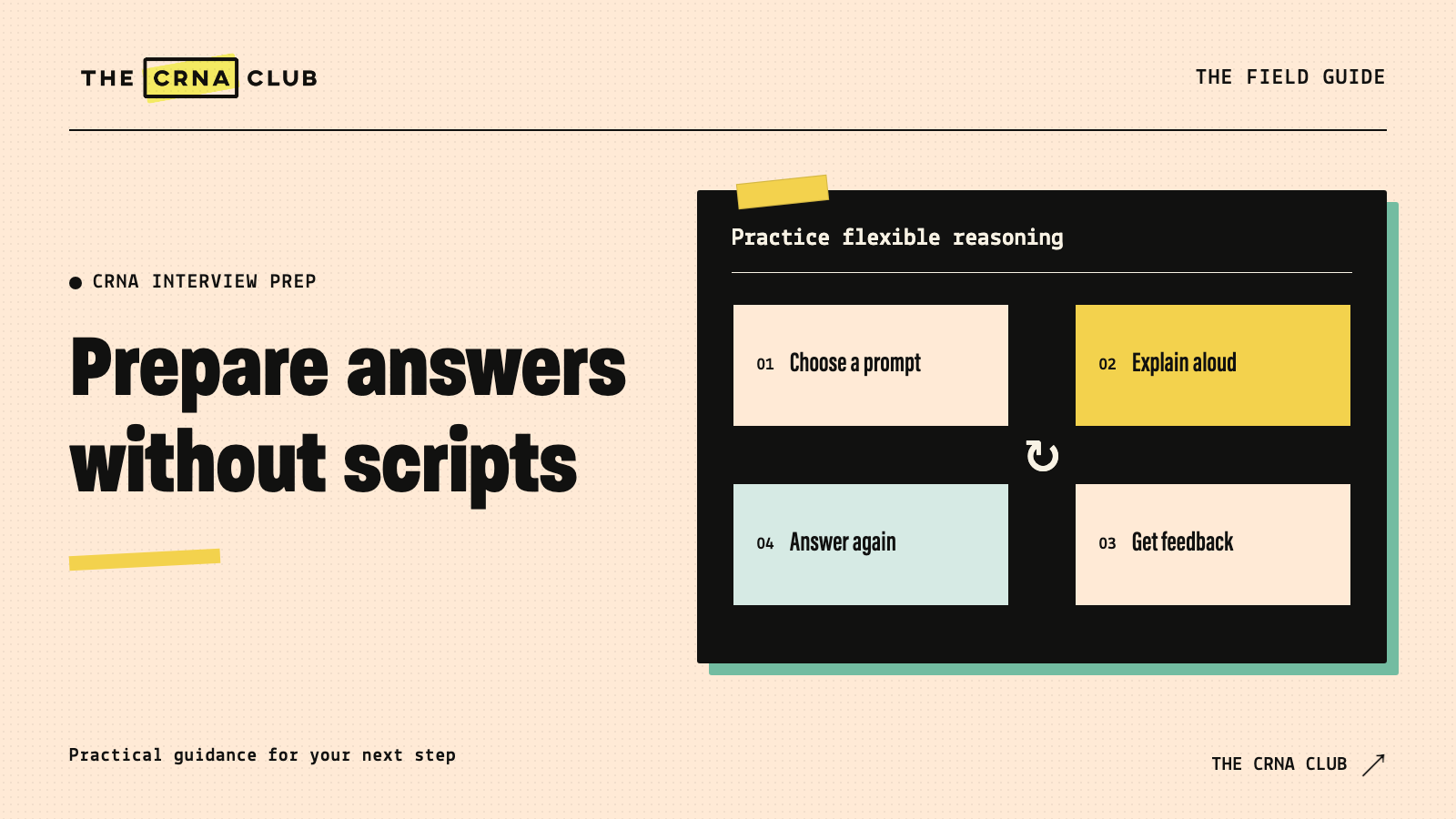
Your next job is to answer before reading any suggested response. Say it out loud. If you’re typing, speak first and then type a close summary. A tidy paragraph written over ten minutes doesn’t tell you how your explanation sounds when someone is waiting for you to finish.
What information should you provide before starting?
Provide the minimum background needed to make the questions useful. Your general ICU setting, a few responsibilities, and the skill you want to practice are usually enough. Leave out patient identifiers, private workplace records, recommendation letters, and information you don’t have permission to share.
For example, “I’m an adult ICU nurse practicing how to explain a precepting experience” gives the tool a useful direction. You don’t need to paste a chart, name your orientee, or upload a performance review to practice that conversation.
Use a fictional practice situation when you’re testing the tool itself. When you’re rehearsing your real experience, remove unnecessary details and follow your employer’s policies. Taking a name out of a story doesn’t automatically make every other detail appropriate to share.
OpenAI’s responsible-use guidance emphasizes checking workplace policies, keeping human judgment involved, and verifying important facts. Changing a chat setting doesn’t replace those responsibilities. This practice method doesn’t depend on uploading private documents or choosing a particular paid plan.
How do you keep the answer sounding like you?
Answer from a few factual notes, then use feedback to improve the explanation. Keep the event, your role, and your reflection intact. If the tool proposes a more impressive outcome than you can support, remove it. Better wording can’t make an invented detail appropriate.
Our Storytelling Basics lesson teaches a useful structure: explain what happened, how you responded, and why the experience matters. Start with the point so the listener knows where you’re going. You can review that approach in our guide to interview storytelling with What, How, and Why.
Imagine this fictional practice answer:
“I precepted a nurse who was having trouble organizing the beginning of the shift. We talked about what was getting missed, and I helped them create a first-hour checklist. We reviewed it after the next shift.”
A useful follow-up might be, “What did you learn about adjusting your teaching?” You can answer that from your own reflection. An unhelpful rewrite might add that you improved the unit’s retention rate. That outcome wasn’t in the example. Don’t accept it because it sounds stronger.
Beside each story, note what you did and what you actually observed afterward. If the result wasn’t measured, don’t turn it into a statistic. You’ll have a clearer answer when someone asks how you know the change helped.
How should you evaluate AI feedback?
Use AI feedback to choose what to practice. It isn’t an official interview score. Ask whether the comment points to something observable in your answer. “You didn’t explain your action” is something you can check. “A faculty panel would rate this nine out of ten” isn’t an admission judgment the tool can establish.
Use this small review sheet after each response:
| Check | What you can actually look for |
|---|---|
| Question answered | My opening addresses the question asked |
| Personal role | I distinguish my action from the team’s work |
| Relevant detail | The example explains the point without unrelated history |
| Reflection | I explain what I learned or changed |
| Fact to verify | Any clinical or program-specific claim has a trusted source |
Choose one revision. If your opening wandered, practice opening with the answer. If your role was unclear, name the action you took. Trying to fix five things at once can make your next response stiff and harder to follow.
Record the original answer and your revised answer if you’re comfortable doing so in an appropriate setting. Listen for whether you can explain the same point in fresh words. Our article on using mock interview feedback walks through turning observations into a manageable practice plan.
Can ChatGPT help with clinical interview questions?
It can generate questions and help you practice explaining a concept, but it shouldn’t be your final authority for physiology, pharmacology, or patient management. Separate the communication exercise from the factual check. A confident correction in a chat still needs to be checked against an appropriate clinical source.
Suppose you’re practicing a medication explanation. Ask for one question about its mechanism, answer, and then mark every factual correction for review. Compare those points with your current course material, drug labeling where relevant, or a trusted clinical reference. If the explanation conflicts with a source, investigate the conflict before rehearsing it again.
Don’t ask the tool to fill every gap with a polished sentence you can memorize. Keep an “I need to review this” list. A gap becomes useful when you identify the actual question: receptor, downstream effect, monitoring consideration, or something else specific.
You can also practice saying where your knowledge ends. “I can explain the effect I monitor, but I need to review that next signaling step” is a starting point for study. Our guide to answering when you don’t know helps you practice that moment without bluffing.
What would a useful 25-minute practice session look like?
Use a short session with one speaking goal, a few answers, and a clear follow-up task. This 25-minute practice example is adjustable around your shifts; it doesn’t represent a school’s interview format or timing requirement.
- Choose a goal (3 minutes). Maybe you want to explain your individual contribution without giving the whole unit’s history. Pick two real experiences and jot down the essential facts.
- Answer three questions (12 minutes). Speak before requesting feedback. Ask for one follow-up if an answer leaves something unclear. Keep moving instead of polishing the first response on screen.
- Review one answer (5 minutes). Choose the clearest improvement opportunity and identify whether the problem is content, organization or knowledge.
- Try again (5 minutes). Repeat one answer in fresh words and write one next task.
Those problems need different next steps. More speaking won’t fix an inaccurate mechanism. More reading won’t necessarily fix an opening that never reaches the point.
In our Mock Interview Lab, you can revisit the saved feedback and study guide to choose that task instead of searching through a long chat. A useful task might be, “Review the rationale behind the teaching change I mentioned, then explain it to a colleague.” Save the topic and the improvement you practiced, rather than collecting pages of generated answers.
When should you move from AI practice to another person?
Include another person while you’re still preparing, especially once you can answer familiar prompts comfortably. A person can interrupt, ask an unexpected follow-up, or tell you that an explanation was hard to follow. Those experiences help you evaluate skills a text conversation may leave untested.
You don’t have to wait until you feel completely ready. Give your practice partner a simple job: ask a question, listen, then tell you what point they understood. If they understood something different from what you intended, that’s useful information.
Our General Interview Prep and Storytelling Basics lessons help you turn your own experiences into answers you can explain in fresh words. We suggest using one lesson between practice sessions, then trying a new question to see what changed.
Our Final Thoughts
Ask one question, speak your answer and choose one change. If the feedback introduces a clinical claim, check that claim before practicing it again. Keep the session centered on work you can explain yourself.
Take the Next Step
Try one free mock interview to identify a few areas to work on. The free opportunity is one lifetime interview. Bring one clear goal into your next session and use the feedback to decide what you’ll study or practice next.