Does Your CRNA Personal Statement Need a Dramatic Patient Story?
Sachi, CRNA
CRNA
In This Article (8 sections)
- How do you choose a story before writing the opening?
- What does a useful routine learning story look like?
- How can shadowing create an opening without a life-changing moment?
- Can you write about changing your mind?
- How do you compare two possible stories?
- What if you don’t remember an event clearly enough?
- Our Final Thoughts
- Take the Next Step
Your CRNA personal statement doesn’t need a dramatic patient story. Choose an experience that helps answer the program’s actual question and shows your own thinking. A routine observation, a difficult piece of feedback, or a change in how you understand anesthesia often gives you more useful material than a scene you’ve stretched to sound impressive.
Maybe you’ve read an essay that opened during a code, and now you’re staring at your own draft wondering whether anything in your career is interesting enough. I get it. It’s easy to confuse a high-stakes event with a strong argument.
If you have a few possible stories and can’t decide which one belongs, we suggest using our Essay Critique tool with the school’s exact prompt. It helps you find the missing answer, unsupported claim, or opening that doesn’t connect. Our personal-statement lessons also walk you through choosing your material. Let’s start with three ordinary experiences that give you something worth explaining.
How do you choose a story before writing the opening?
Choose the story after you’ve read the prompt and named the point your essay needs to make. Then look for a true experience that supports that point. An opening earns its space by helping the reader understand your motivation or preparation. It doesn’t have to create suspense to do that work.
For example, a prompt about professional growth calls for evidence of change. A prompt about your goals calls for an explanation of where those goals came from and how the program connects. The same opening won’t automatically serve both.
NursingCAS Program Materials guidance explains that programs set their own additional questions and document requirements. Start with the instructions in your current application, even if a sample essay you like follows a different format.
Our personal statement guide covers the whole planning process. Here, we’re working on one narrower problem: finding useful story material when you don’t have a dramatic turning point.
What does a useful routine learning story look like?
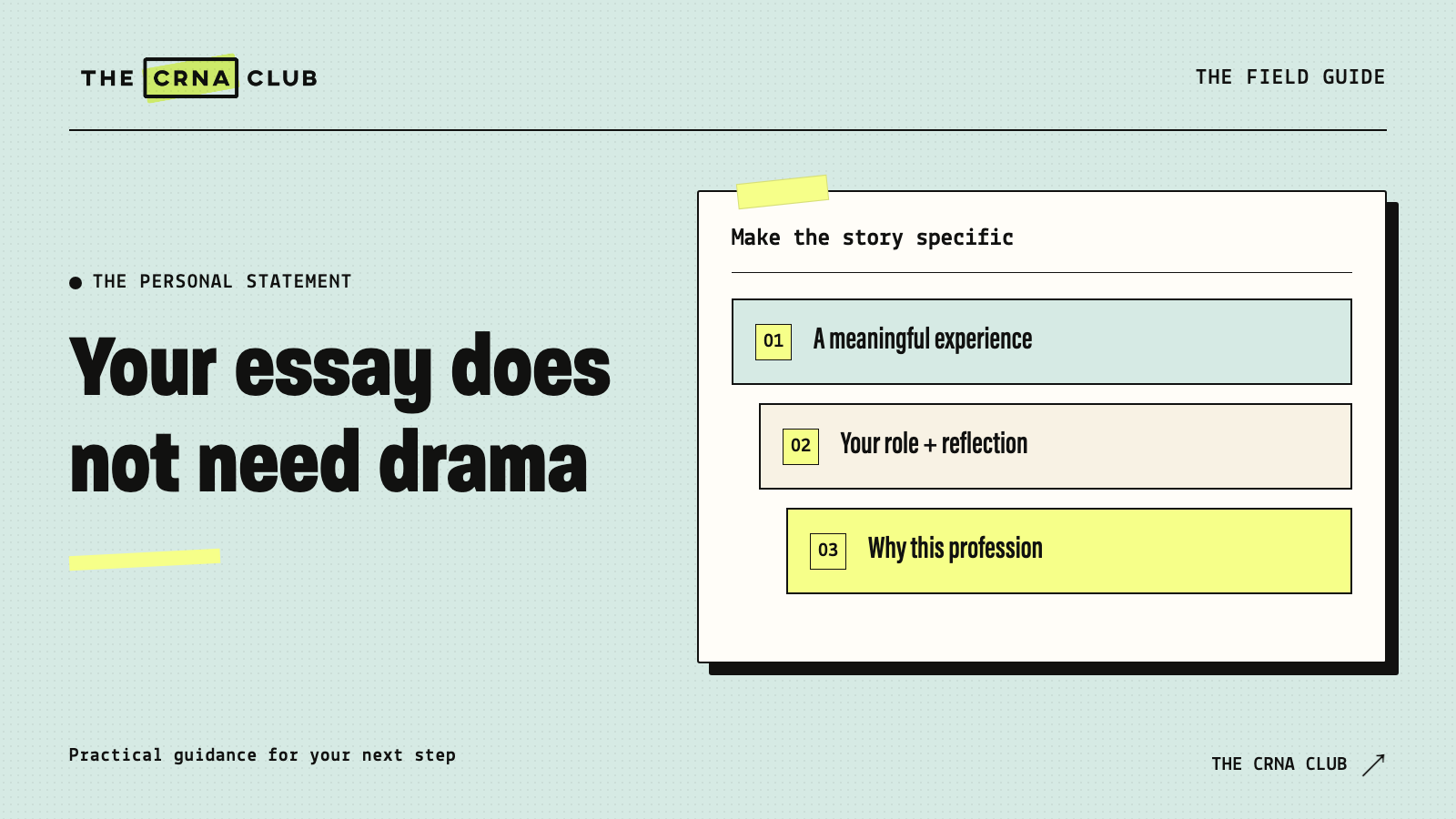
A routine learning story works when it reveals a specific question or change in your approach. Describe enough of the situation to make that change understandable, then spend your words on the learning. You don’t need to raise the stakes by adding a crisis, exaggerating your independence, or claiming an outcome you can’t support.
The passages below are entirely fictional teaching examples. They aren’t real applicants’ essays, patient stories, or language to copy into an application.
Vague opening:
My ICU experience has taught me the importance of lifelong learning. I am passionate about understanding complex patients and taking the next step in my career.
More specific fictional opening:
After a preceptor asked me to explain why I expected a medication to help, I realized I could describe our usual practice more easily than its reasoning. I began keeping a short list of questions to review after work. The habit changed how I prepared for patient discussions and made me more deliberate about asking for clarification.
The writer gives you something specific to follow. They noticed they couldn’t explain the reasoning, asked for help, and changed how they studied. That’s useful material for an essay about growth.
It still needs more work to become a CRNA essay. What made the writer interested in anesthesia specifically? How did they explore that interest? The opening starts the argument; the rest of the essay has to develop it.
If you use this kind of story, choose feedback you actually received. Don’t borrow the medication question from the example and manufacture a memory around it.
How can shadowing create an opening without a life-changing moment?
A shadowing opening works when you explain an observation and what it helped you understand about the role. Keep the claim proportional to the experience. One day of observation gives you questions and a closer view of practice; it doesn’t mean you’ve seen every setting, responsibility, or challenge in anesthesia.
Vague opening:
The moment I entered the operating room, I knew I was meant to become a CRNA. I was inspired by the autonomy and the ability to make a difference.
More specific fictional opening:
During shadowing, I paid attention to how the CRNA moved between explaining a plan to the patient and discussing its details with the team. I had expected the technical work to hold my attention. I left thinking about the preparation and communication supporting each decision, and I wanted to understand the education behind that responsibility.
This version describes what caught the observer’s attention. It also leaves room for the writer to explain the next step: more shadowing, conversations about the profession, or a more focused review of educational requirements.
Be precise about your role. Watching a professional perform a procedure isn’t the same as performing it yourself. Asking a question afterward isn’t the same as directing the plan. Accurate verbs make the passage more trustworthy and easier to discuss later.
The AANA guide to becoming a CRNA provides professional and educational context. Use official information to check your understanding of the role, then explain your own observations in your own words.
Can you write about changing your mind?
Yes. A change in understanding gives you useful material when you explain your earlier assumption, what challenged it, and what you did afterward. Keep the focus on your own learning. You don’t need to criticize another profession or make your earlier self sound careless to show a thoughtful change.
Vague opening:
I have always wanted to provide the highest level of care. Becoming a CRNA is the natural progression of my nursing journey.
More specific fictional opening:
I initially thought choosing an advanced role meant deciding which procedures I wanted to learn. Conversations with anesthesia providers pushed me to ask different questions: what knowledge would I need, what responsibility would I be taking on, and how would I prepare for the training? Those questions made my interest more specific and gave my application preparation a clearer purpose.
This example gives the writer an argument about deliberate career exploration. The next paragraph should provide real evidence of that exploration. Otherwise, the essay stays at the level of a nice thought.
If the prompt also asks why this particular program fits, you’ll need to answer that next. This paragraph explains how the interest developed; it hasn’t answered the whole application yet.
In our podcast conversation about making a personal statement personal, we discuss moving beyond broad labels such as being a team player. An ordinary experience becomes useful when the reader sees how you think.
Our learning library has personal-statement lessons that help you choose your material and connect it to the prompt. If you’re staring at several possible stories and can’t find the point, explore those lessons through the seven-day membership trial.
How do you compare two possible stories?
Compare stories by relevance, accuracy, and the amount of reflection they support. The most dramatic event doesn’t automatically win. Pick the experience that helps you answer the prompt with the least explanation of unrelated circumstances and the clearest account of your own role.
Ask these questions about each story before drafting:
- Prompt: Which exact part of the question does it answer?
- Your role: What did you personally do or observe? Use accurate verbs.
- Reflection: What changed in your thinking or behavior?
- Evidence: Which later action supports that change?
- Privacy: Can you share it without identifying a patient? Remove unnecessary details.
- Accuracy: Could you discuss it honestly in an interview? Check what you remember.
Suppose Story A is a complicated emergency that takes 200 words to explain. Your role was limited, and you aren’t sure what happened afterward. Story B is a precepting conversation that changed how you explain a concept. If the prompt asks about growth, Story B might give you a clearer answer in far less space.
Don’t award yourself points for tragedy or intensity. You’re selecting evidence for a writing task, not ranking the importance of patients’ experiences.
What if you don’t remember an event clearly enough?
Choose another example or write at the level you can accurately support. Don’t reconstruct dialogue, merge separate events into one scene, or add clinical details because the story feels incomplete. A clear explanation of a pattern across your experience is an option when a single scene isn’t the right fit.
For instance, you might explain how repeated questions during shadowing changed what you wanted to learn. Say it developed over several observations. You don’t need to invent a single afternoon when everything came together.
Protect privacy throughout. Leave out dates, facility details, unusual identifying circumstances, and other information the essay doesn’t need. If removing those details destroys the point, consider whether another example would be more appropriate.
Finally, follow the program’s rules about outside help and authorship. Columbia’s nurse anesthesia application page explicitly addresses accuracy and authenticity. Your final essay needs to represent your experience and comply with your own school’s instructions.
Our Final Thoughts
Choose one true experience that answers the prompt and draft the reflection before polishing a hook. That tells you what the opening needs to lead toward.
Take the Next Step
Choose one real experience and write a rough paragraph before polishing the first sentence. Then try the free essay critique for an initial review. Bring the program’s exact prompt so the feedback stays focused on the writing task you’re trying to complete.