How Deep Should You Study Drug Mechanisms for a CRNA Interview?
Sachi, CRNA
CRNA
In This Article (8 sections)
- How do you decide what “deep enough” means?
- What does that progression look like with a real medication?
- Should you learn every step in a signaling pathway?
- How can you connect receptor knowledge to bedside observations?
- What should your medication study sheet include?
- When should you move on to the next drug?
- Our Final Thoughts
- Take the Next Step
Study drug mechanisms deeply enough to explain the effect, the relevant receptor or target, the next important cellular step, and how that connects to what you assess. Start with medications you actually use. There’s no universal molecular-depth requirement for every CRNA interview, so use specific knowledge gaps and your school’s instructions to guide further review.
It’s easy to keep adding detail because you’re worried the next question will be the one you haven’t studied. You start with a medication you give regularly, and an hour later you’re copying a signaling diagram you can’t explain without looking at it.
We recommend our pharmacology lessons for working through those connections, starting with receptor foundations and the drugs you use. Pair the review with our Mock Interview Lab to hear yourself explain it and get feedback. The seven-day trial includes the lessons and a personalized study guide for reviewing weak topics afterward.
How do you decide what “deep enough” means?
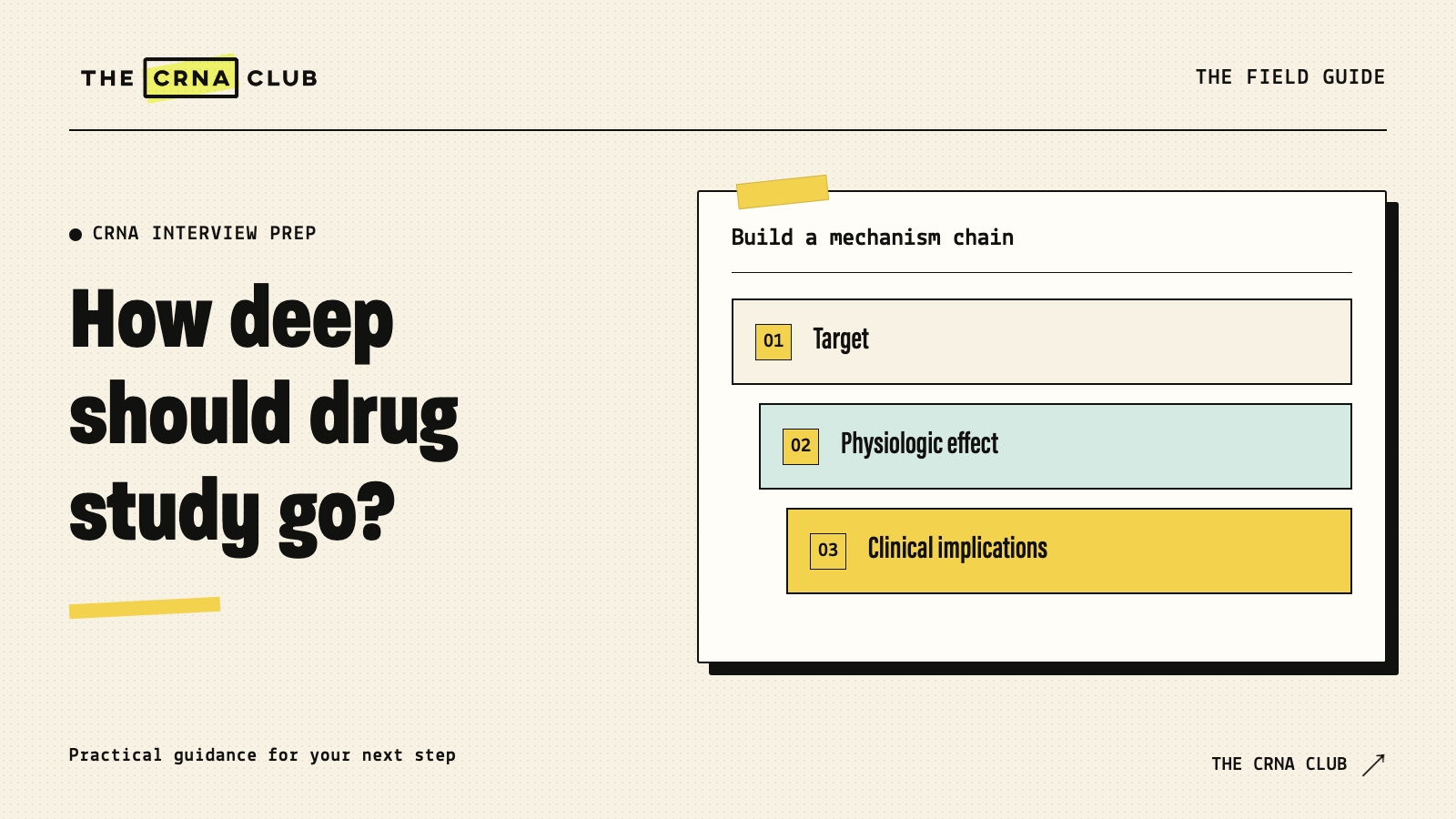
Use a progression from a plain-language explanation to the mechanism and its clinical relevance. Check whether each new detail helps you explain the previous one. If you can recite a pathway but can’t connect it to the medication’s effect, review the connection before adding another layer.
We suggest checking each drug with these questions. They guide your studying, rather than predict a faculty panel’s score:
| Level | Question to answer | Evidence that you understand it |
|---|---|---|
| Effect | What does this medication do? | You describe the relevant effect in ordinary words |
| Target | Where does that action begin? | You identify the relevant receptor or other target |
| Mechanism | What happens after that target is activated? | You explain a connected sequence with correct terms |
| Assessment | Why does the mechanism matter in your work? | You connect it to an assessment or a limitation |
| Boundary | What can’t you conclude from this explanation? | You identify what needs more information |
You may move through this quickly for one drug and find a gap immediately for another. That’s useful. An honest gap tells you what to study. “I need to know more pharmacology” is too broad to tell you what to do after work tomorrow.
For a wider starting list of topics, use our CRNA interview pharmacology questions. This article helps you decide how to work through one topic once you’ve chosen it.
What does that progression look like with a real medication?
Take one effect of one medication and build a short explanation around it. Vasopressin provides a useful example because you can connect a vascular receptor to an intracellular signal and then to vascular smooth muscle contraction. Keep the explanation focused on that action before discussing its other effects.
The vasopressin prescribing information on DailyMed describes vascular V1 receptors linked through a Gq/11 and phospholipase C pathway to intracellular calcium release. That helps explain its vasoconstrictive action. The same labeling distinguishes antidiuresis through V2 receptors, so “vasopressin only affects blood vessels” would be incomplete.
For this practice exercise, write three sentences in your own words. First, state the vascular effect. Second, identify the receptor and summarize the signaling connection. Third, explain why naming the medication alone doesn’t fully describe its effects in a particular patient.
Then close the source and say those sentences out loud. Where do you get stuck? Maybe “Gq” is familiar, but you can’t explain where phospholipase C belongs. That’s your next reading task. You don’t need to restart an entire pharmacology course because one link is unclear.
Now try a follow-up: where does calcium fit in the explanation you just gave? If you have to reopen the diagram immediately, you’ve found the part to review next.
Should you learn every step in a signaling pathway?
Learn the steps needed to understand and accurately explain the pathway you’re studying, then deepen the parts you can’t connect. Avoid using unfamiliar technical terms just to make an answer sound advanced. Each term you introduce should mean something to you and serve the question being asked.
We recommend our Adrenergic Receptor Overview lesson if those pathways are getting mixed up. It connects the receptor, signal and tissue effect. Start by asking what tissue you’re discussing. A label such as “stimulatory” doesn’t mean every tissue responds by contracting.
When you study a new pathway, make a small map with the target, signal, cell response, and organ-level effect. Under each arrow, write a verb. Does this step activate, inhibit, release, or convert something? If you can’t explain an arrow, mark it instead of drawing more arrows around it.
Be precise with those verbs. A signaling molecule binding to a receptor isn’t automatically the same event as phosphorylation. Similar-looking diagrams can hide different processes if you memorize only the order of the labels.
Our article on vasopressor cellular mechanisms offers the deeper pathway review. Use that when the pathway itself is your gap. Here, the practical question is how to tell whether you’ve learned it well enough to explain it.
How can you connect receptor knowledge to bedside observations?
Connect the mechanism to the effect you assess while keeping the patient’s whole situation in view. A receptor action can help explain a response, but it doesn’t establish that every patient will show the same change. Separate a drug’s direct action from the overall response you observe.
Norepinephrine is a good reminder. Its prescribing information describes alpha-adrenergic vasoconstrictive and beta-adrenergic cardiac actions. It also describes reflex slowing of heart rate as resistance and pressure rise. Saying “it has beta activity, so the heart rate always increases” leaves out that broader response.
Use that distinction as a study question: “What does knowing the receptor tell me, and what does it leave unanswered?” You can explain a direct action without pretending that the receptor label predicts every hemodynamic measurement.
When you review a medication from your own practice, list the assessments you actually perform and explain the rationale using current references. Keep patient information out of your study sheet. If you need a case to practice, build a clearly fictional scenario with only the information required for the question.
You can review how to organize a clinical explanation in our guide to discussing an ICU patient during a CRNA interview. The mechanism should help you explain your reasoning within that larger picture.
What should your medication study sheet include?
Create a one-page sheet that separates facts, explanations, and unanswered questions. Keep it small enough that you can use it for retrieval practice. A page filled with copied paragraphs may look complete while giving you very little opportunity to check what you can recall.
Try these fields for one medication you use:
- My opening explanation: two or three sentences answering what it does and how.
- The mechanism connection: a short sequence I can explain without the source open.
- My assessment connection: what I evaluate and why it relates to the effect.
- A useful comparison: one medication with a different relevant mechanism.
- My knowledge boundary: one specific point I still need to check.
- My source: the reference, relevant section, and date I reviewed it.
Use our pharmacology workbook and lessons to keep mechanism, receptor and side-effect notes separate while you learn them. Then close the page and explain how they connect. Knowing the drug’s name isn’t the same as being able to make that connection.
Leave dosing and preparation tied to the correct current product information and your clinical policies. Similar drug names or familiar unit shorthand aren’t a substitute for checking the actual formulation. This interview study sheet is a learning aid, rather than an administration reference.
When should you move on to the next drug?
Move on when you can explain your current topic accurately without reading, answer a reasonable follow-up, and name any remaining gap specifically. Return to it later for another retrieval check. Moving on doesn’t mean the subject is permanently finished or that you can predict every interview question.
Here’s a fictional example. An applicant can explain a medication’s effect and receptor but confuses two signaling steps. They choose one targeted task: review that connection, redraw it from memory, and explain why it matters. Their next session checks that task before adding a comparison medication.
Another applicant knows a detailed pathway but can’t give a concise opening. Their next task is speaking practice. They need to answer the actual question before offering more detail. More reading may feel productive, but it doesn’t directly address that problem.
Try marking each topic “can explain,” “needs a fact check,” or “needs speaking practice.” These categories tell you what to do next. Avoid giving yourself a readiness percentage based on how many pages you’ve highlighted.
Use your next mock interview’s study guide to choose the lesson you need, then return to the explanation. That gives the review a clear purpose: fix the signaling step, improve the opening, or practice the follow-up you couldn’t answer.
Our Final Thoughts
Choose one medication you use regularly. Explain the effect and mechanism without notes, then identify the first step you cannot connect. Make that step your next review task.
Take the Next Step
Choose one drug and complete the six-field study sheet today. For help reviewing the underlying mechanisms and building an organized practice routine, explore our pharmacology and interview lessons with the seven-day trial.