How to Cut a CRNA Personal Statement to 500 Words
Sachi, CRNA
CRNA
In This Article (8 sections)
- What should you protect before making cuts?
- What does a 650-word draft look like before editing?
- Which 150 words can you remove first?
- What if your 540-word draft is already specific?
- How do you check whether the shorter essay still works?
- What if you’re still over the limit?
- Our Final Thoughts
- Take the Next Step
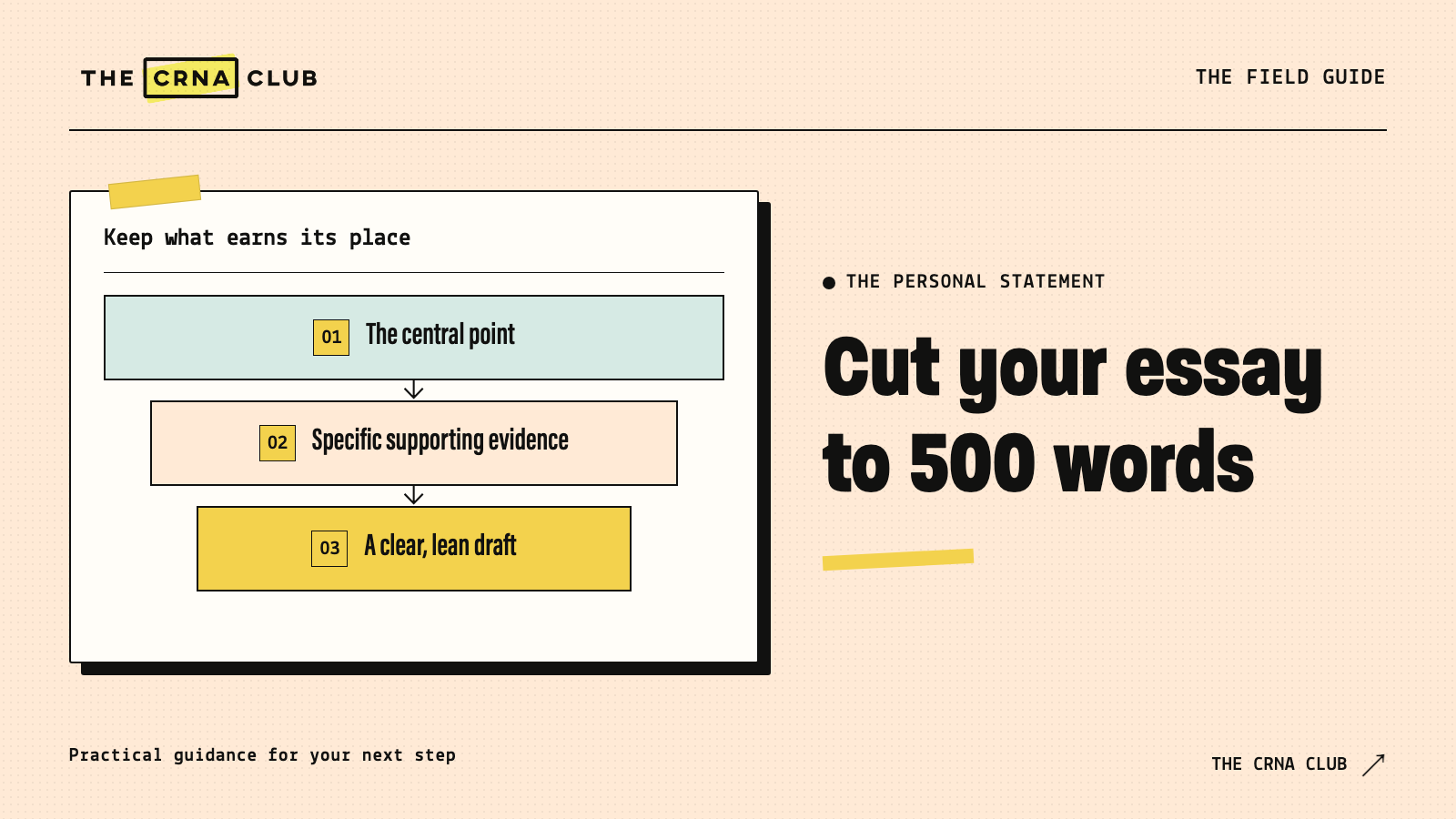
To cut a CRNA personal statement to 500 words, remove repeated claims before shortening sentences. Keep the experiences and reflection that answer the prompt. Then check the count in the application. This exercise uses a 500-word limit; follow your own school’s instructions.
When you’re 150 words over, look for a paragraph repeating something you’ve already explained. Cutting that paragraph saves more space than attacking every “and” and “that,” and often makes the argument clearer.
We suggest using our Essay Critique tool to check which parts of your draft answer the school’s prompt. Use that feedback to choose your cuts, then compare versions. Our personal-statement lessons cover this process too. Below, we’ll work through a complete 650-to-500-word edit so you can see what stays and why.
What should you protect before making cuts?
Protect the parts of the essay that answer the actual prompt. Mark the passages covering:
- Your reason for pursuing anesthesia.
- Evidence of preparation.
- Reflection on your experience.
- Any program-specific or future-goal questions.
Before cutting a sentence, ask whether the reader would lose an example they need or whether the answer would remain complete. That’s more useful than keeping a line because you like how it sounds.
Save a copy before editing. Label each paragraph with the question it answers. Where two paragraphs repeat the same point, keep the one with clearer evidence.
NursingCAS explains that program questions and document requirements vary. A 500-word essay you’ve written for one school isn’t automatically the right submission for another. Columbia, for example, currently describes a two-page written essay requirement. A page limit needs its own formatting check.
What does a 650-word draft look like before editing?
The fictional draft below has 650 words using whitespace-separated counting. Its strongest material describes learning and preparation. Three additional paragraphs add broad claims already supported elsewhere. Those three paragraphs account for 150 words, so removing them reaches this exercise’s 500-word limit without cutting the concrete examples.
Teaching example only: We invented the applicant, experiences, school, and prompt. Fictional School A offers case-based seminars and a supervised clinical sequence. These aren’t real admissions materials or experiences to copy.
The fictional prompt asks the writer to explain motivation for nurse anesthesia, preparation for education, and interest in School A.
Fictional first draft: 650 words
I have always been someone who cares deeply about helping other people and making a positive difference in their lives. Nursing has provided many wonderful opportunities to develop this passion, and I believe my continuing interest in learning has been an important part of my professional journey throughout my career.
My interest in nurse anesthesia became more specific when I began asking what happened before and after the moments I saw during shadowing. I noticed the CRNA reviewing information, explaining a plan, and reassessing throughout care. I wanted to understand the knowledge supporting those decisions. That interest led me to investigate the education required for the role and examine how I was preparing for further study.
In the ICU, I have learned to take questions about my reasoning seriously. Early in orientation, I could describe a familiar treatment more easily than I could explain its purpose. With my preceptor, I identified the connection I was missing and reviewed it before our next discussion. I began keeping a short list of topics to revisit after work. The habit helped me recognize the difference between remembering a routine and understanding why it fits a particular situation.
I consider myself a hardworking, dedicated, compassionate, motivated, and reliable professional who enjoys working with others and contributing to a team. These qualities are very important in health care, and I believe they will continue to serve me well as I pursue the next phase of my education and development.
I later brought the same approach to precepting. When a newer nurse asked a question I could not answer confidently, I acknowledged the gap and helped locate a reliable explanation. We discussed what we had learned afterward. The experience reminded me that supporting another learner includes being willing to show the limits of my own knowledge. I want to bring that willingness to ask, check, and revise into graduate education.
My preparation has also required practical changes. I have set aside regular time for coursework and tested that schedule alongside my work responsibilities. When a study plan became unrealistic, I adjusted the workload rather than leaving the same unfinished tasks on the calendar. These changes haven’t made the demands of anesthesia education feel familiar, but they have given me a clearer picture of the support and discipline I will need. I have discussed those demands with my family and begun planning for them.
School A’s case-based seminars interest me because I want regular, structured practice explaining the reasoning behind a decision. I would bring the habit of preparing focused questions and checking gaps after a discussion. Its supervised clinical sequence would also give me opportunities to connect scientific learning with patient care as my responsibilities develop. I am interested in learning how faculty use timely feedback across that sequence and how students are expected to respond when an explanation or decision needs to change.
I am pursuing nurse anesthesia because I want to develop the knowledge and judgment required for that responsibility. My ICU experience has given me examples of careful assessment, teamwork, and the value of seeking help, while shadowing has shown me how much I still need to learn. During training, I hope to develop into a thoughtful learner who responds constructively to feedback. After graduation and certification, I want to contribute through clinical practice and by supporting nurses who are exploring the profession. My goals will continue to develop as my understanding grows. I have also begun identifying practical questions about training to discuss during future shadowing. I am ready to approach that education with curiosity, accountability, and respect for the work ahead.
In conclusion, I am very excited about the possibility of taking this important next step. I know the journey will be challenging, but I am committed to working hard and doing my best. Thank you for considering my application and for the opportunity to share my goals with your committee.
Which 150 words can you remove first?
Remove the three paragraphs that repeat a broad point without adding evidence. This example uses whole-paragraph cuts so the decision is visible. Your own draft might need several smaller cuts or a structural rewrite. Don’t delete an explanation that the prompt requires just because it would bring the count down quickly.
| Cut | Words removed | Reason |
|---|---|---|
| A: paragraph beginning “I have always been someone…” | 50 | Repeats the motivation without explaining it further |
| B: paragraph beginning “I consider myself…” | 50 | Lists qualities the specific examples already illustrate |
| C: paragraph beginning “In conclusion, I am very excited…” | 50 | Adds a second generic closing after the essay already ends |
| Total | 150 | 650 minus 150 leaves 500 |
The preceptor example stays because it shows what the writer did after identifying a gap. The precepting paragraph stays because it develops that habit in another setting. The preparation paragraph explains changes the writer made, rather than relying on “I am dedicated” to carry the point.
Our learning library covers essay planning and revision, including how to connect your experience to the question a school asks. If choosing what to keep is where you’re stuck, explore those lessons with the seven-day membership trial.
What remains in the 500-word version?
Keep the six concrete paragraphs beginning with “My interest in nurse anesthesia” and ending with the writer’s goals. They total 500 words under this exercise’s counting method. The shadowing observation explains motivation, the ICU and precepting examples show learning, and the School A paragraph answers program fit. Read them together after the three cuts and check whether every required answer remains.
What if your 540-word draft is already specific?
Cut repeated explanation within a useful paragraph instead of deleting the experience. The fictional passage below preserves feedback, action, observed response and reflection while removing 25 words. This is a separate editing example; it isn’t a paragraph from the 650-word draft above.
Before: 88 words
During orientation, my preceptor pointed out that I was presenting every detail before explaining my main concern. I initially thought giving more information would make my communication more useful. After asking which part was difficult to follow, I practiced stating the priority first, then adding the findings that supported it. At our next review, my preceptor said the sequence was easier to follow. I learned that knowing the information and helping another person use it require different skills, and I continue to ask for feedback on my presentations.
After: 63 words
My preceptor noted that I presented details before stating my concern. I asked which part was unclear, then practiced opening with the priority and supporting findings. At our next review, the preceptor found the sequence easier to follow. I learned to separate knowing the information from communicating it, and I still seek feedback during patient presentations and conversations about a changing clinical picture.
The revised passage keeps what the preceptor said, what the applicant changed and how they checked the change. It removes the initial assumption and compresses repeated descriptions. The response remains an observation about communication; it doesn’t become a claim of improved patient outcomes.
If your complete draft started at 540 words, that cut leaves 515. Find another 15 words of repeated setup elsewhere. For example, this fictional program-fit sentence has 21 words:
I am particularly interested in the opportunity to take part in case discussions where I can explain my own clinical reasoning.
This version has six:
Case discussions offer practice explaining reasoning.
Together, those cuts remove 40 words: 540 minus 25 minus 15 equals 500. That only works if the shorter wording still matches your purpose and the program’s verified teaching. You shouldn’t cut the only explanation of why a feature connects to your goal. Keep the surrounding paragraph’s evidence and check the whole answer afterward.
How do you check whether the shorter essay still works?
Read the shorter version against every part of the prompt, then ask a reader to explain your argument back to you. Check what the reader learned about your decision and preparation. A shorter draft still needs to sound like you and make sense as a whole, rather than read like sentences left behind after a word-count exercise.
The School A paragraph links a fictional program feature to the writer’s learning habits. In your own essay, use a verified feature and an honest connection.
Check transitions too. Does “This experience” still refer to an event you’ve kept? Read the last sentence of each paragraph beside the next paragraph’s opening and repair any missing connection.
For a smaller edit, change “I was able to begin the process of reviewing” to “I began reviewing.” Keep accuracy intact: watching a procedure and performing it describe different experience.
What if you’re still over the limit?
Check for extra examples, long scene-setting, or a repeated ending before compressing every line. Ask a reader which passages add something new. Keep the clearest evidence for each required point and remove repetition around it.
Use our annotated personal statement revisions to see how a specific explanation replaces a list of qualities. The broader personal statement guide helps when the whole structure needs work.
Check the finished version in the application. This exercise uses whitespace-separated counting; a portal might handle hyphens differently. Follow its counter and the school’s instructions.
Our Final Thoughts
Read the shorter essay against the prompt before making the last cut. Keep the action, evidence and reflection the reader needs, then check the final version inside the application.
Take the Next Step
Try the free essay critique with your draft and the current program prompt. Use the feedback to choose a revision, then recheck the word limit in your application before submitting.