How to Practice CRNA Interview Answers With a Partner
Sachi, CRNA
CRNA
In This Article (9 sections)
- What should your practice partner listen for?
- How do you run a 20-minute practice session?
- What belongs on a listener scorecard?
- What does specific feedback sound like?
- Can a nonclinical partner help with clinical questions?
- How do you make follow-up questions useful?
- What should you do after the session?
- Our Final Thoughts
- Take the Next Step
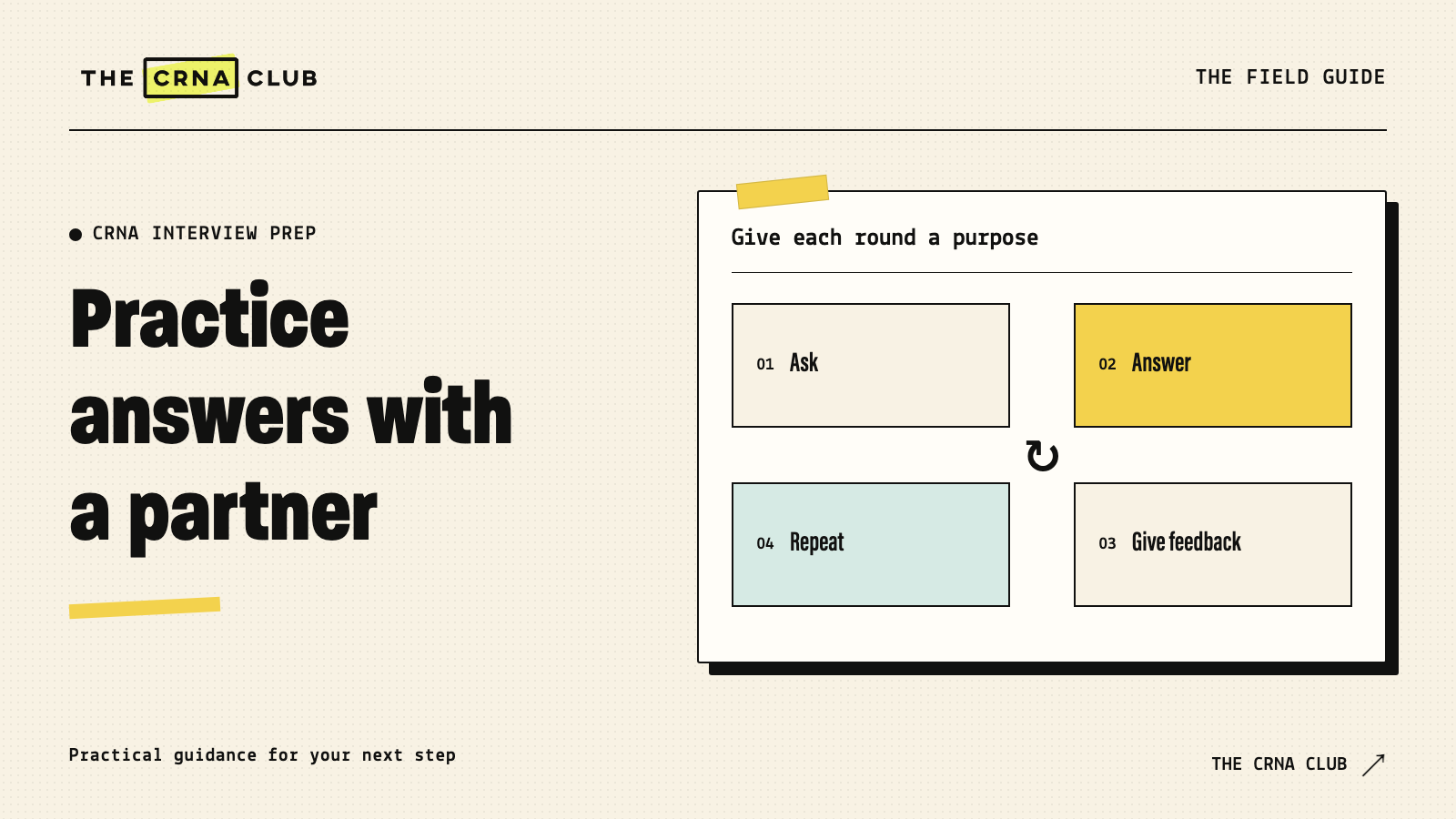
Practice CRNA interview answers with a partner by giving each session one clear job: answer a few questions aloud, let your listener explain what they understood, and repeat one answer after specific feedback. A partner helps you hear where your explanation gets confusing. Check clinical accuracy against a reliable source separately.
You don’t need a friend who knows every receptor pathway to get useful practice. You need somebody willing to listen carefully and say, “I still don’t know what you actually did.” That’s a very helpful sentence, even when you were hoping to hear, “You sound great!”
We suggest pairing those conversations with our Mock Interview tool. It gives you question-level feedback for partner practice. With the seven-day trial, you also get a personalized study guide to review weak topics before trying again. Below, we’ll give you a 20-minute session and a listener scorecard you can use today.
What should your practice partner listen for?
Ask your partner to listen for a direct answer, a clear explanation, and enough evidence to understand your point. They should flag unfamiliar jargon and places where they lose the thread. They don’t need to judge whether you’d get accepted, and they shouldn’t guess about a clinical fact they haven’t checked.
Start with a behavioral question. “Tell me about a time you received difficult feedback” works well because your partner can follow the story without being an ICU nurse. Your listener should be able to tell you what happened, what you did, and what changed afterward.
Our What-How-Why interview guide walks through that structure. For this session, you’re testing whether somebody else actually hears those three pieces.
Keep the listener’s job small. Don’t ask, “Was that good?” Ask, “What did you think my main point was?” The second question gives you information you can use.
How do you run a 20-minute practice session?
Use a short session with time for an uninterrupted answer, listener feedback, one follow-up question, and a revised attempt. Twenty minutes gives you room to try again after feedback. If you have ten focused minutes between other responsibilities, work on one answer and finish with one change to make.
Here’s a sample session for two applicants. Switch roles next time, or extend the session if both people have the energy.
| Time | Applicant’s job | Partner’s job |
|---|---|---|
| Minutes 0–2 | Read the question and name the skill you’re practicing | Agree on the question and feedback rules |
| Minutes 2–5 | Answer without reading a script | Listen without coaching or interrupting |
| Minutes 5–9 | Listen and take brief notes | Summarize the answer and flag one confusing point |
| Minutes 9–12 | Answer one natural follow-up | Ask for the missing action, reason, or reflection |
| Minutes 12–17 | Revise and answer again | Check whether the specific problem improved |
| Minutes 17–20 | Write the next study task | Agree on what needs a source check or another attempt |
Have the question ready before the call. Otherwise, your practice time disappears while you scroll through prompts. Use the CRNA interview question hub to select a few questions that fit your current needs.
If you’re practicing virtually, test the actual camera, microphone, and connection you’ll use. Columbia’s nurse anesthesia application guidance includes practical setup advice for its video essay, including camera position and background. Your own invitation determines the format you’re preparing for.
What belongs on a listener scorecard?
A useful partner scorecard records observable problems, such as an unanswered question or an unexplained acronym. It doesn’t predict an admissions decision. Use simple notes or yes-and-no checks, then choose one issue for the next attempt. A total score usually adds less value than a clear example of where the listener got lost.
Copy this into a shared document:
- Direct answer: Did the first few sentences answer the question? Write the answer you heard.
- Personal action: Was the applicant’s own action clear? Name what they personally did.
- Evidence: Was there enough support? Flag a claim needing an example.
- Language: Could you follow the explanation? List one acronym or phrase needing clarification.
- Ending: Did the answer reach a useful ending? Write the takeaway you heard.
- Follow-up: Ask one specific question.
Be concrete. “Too wordy” doesn’t tell your partner much. “You explained the staffing situation three times before describing the conversation” gives them a place to edit.
And don’t confuse a polished speaking style with understanding. A smooth explanation with an incorrect mechanism needs a factual correction. A correct explanation that wanders needs a communication fix. Those are different next tasks.
What does specific feedback sound like?
Specific feedback names the moment the answer became unclear and asks for a change the applicant can make. Describe what you heard before suggesting wording. That keeps the applicant’s experience and voice intact. Your job as a partner is to help them communicate their reasoning, rather than supply a better story for them.
Here’s a fictional practice exchange:
Question: Tell me about a time you had to respond to feedback.
First attempt: “I really value feedback, and I’m somebody who always wants to learn. We have a busy unit, and sometimes people have different opinions about how things should be done. I try to be open-minded because communication is important.”
Helpful listener response: “I heard that you value feedback, but I didn’t hear an actual example. What feedback did you receive, and what did you do differently afterward?”
Revised direction: The applicant chooses a real, appropriate example. They describe the feedback, how they clarified it, and the change they made. The partner doesn’t invent the event or tell them to make the outcome more impressive.
Notice that the problem wasn’t a missing inspirational sentence. The question asked for an experience, and the answer stayed at the level of personal qualities.
In our conversation with communications coach Michelle Miller, we discuss practicing the interview experience and making the point of a story clear. A partner session gives you somewhere to try that advice out loud.
After you try the scorecard, compare your partner’s notes with the feedback from our Mock Interview tool. If both point to an answer that never reaches your own action, that’s your next practice task. The seven-day membership trial also gives you interview lessons to work through before trying again.
Can a nonclinical partner help with clinical questions?
A nonclinical partner helps test whether your explanation is understandable, but they can’t establish whether the clinical reasoning is correct. Give them permission to ask plain questions such as, “What does that number represent?” Keep a separate list of clinical claims to verify with current teaching materials or a qualified clinical reviewer.
Suppose you explain a medication and your partner says, “You told me the receptor, but I don’t understand what happens to the patient.” That’s useful communication feedback. It shows you skipped a connection in your explanation.
It doesn’t prove the connection you add is accurate. Review the mechanism and the patient context before practicing the corrected answer. If two sources appear to disagree, resolve the difference instead of choosing whichever version is easier to memorize.
Avoid turning your partner into an examiner who pressures you to improvise facts. Saying what you know, identifying what you’re unsure about, and explaining how you’d check it is worth practicing too. The guide to answering when you don’t know addresses that situation.
Keep all patient examples de-identified. You can describe your learning without sharing names, dates, screenshots, or details that identify a patient.
How do you make follow-up questions useful?
A useful follow-up tests the explanation you just gave. It asks about a missing reason, an alternative, or what you learned. You don’t need a list of trick questions. Listen to the answer and ask the next honest question that would help you understand the applicant’s thinking.
For behavioral answers, try:
- “What did you say in that conversation?”
- “What would you do differently now?”
- “How did you know the change helped?”
For a motivation answer, ask what the applicant observed during shadowing and how it influenced their decision. Don’t let “I loved the autonomy” end the discussion if they haven’t explained what they actually saw.
Program formats vary. AdventHealth University’s admissions page describes several areas its interview may assess, including communication, professional behavior, problem-solving, and motivation. That’s one program’s guidance, not a promise about the questions every school will ask. Build practice around your invitation and the public information your program provides.
What should you do after the session?
Leave with one communication change and any factual questions that need checking. Save a short note about the original problem so you can compare the next attempt. If you record, get your partner’s permission first and agree on where the recording lives. Keep it private and delete it when you no longer need it.
Your next task should be small enough to complete. “Get better at interviews” is huge. “Explain my own action before giving the outcome” is something you can test tomorrow.
If you’re repeatedly receiving the same feedback, stop running full mock interviews for a moment. Work on that one answer or concept. Then return to a fresh question to see whether the improvement carries over. Our mock interview feedback guide explains how to turn a review into your next study task.
Our Final Thoughts
Give your partner one question and one listening task. After their feedback, answer again before ending the session so you can test the change while it is still clear.
Take the Next Step
Try the free mock interview, then bring one question you want to improve to your next partner session. The free entry includes one lifetime session. If you’d like broader interview lessons and application support, explore the CRNA Club membership trial.