How Do You Prepare for a CRNA Interview Without Memorizing Scripts?
Sachi, CRNA
CRNA
In This Article (11 sections)
- What should you prepare instead of full scripts?
- How do you build a useful story bank?
- What should one story card contain?
- How do you adapt one experience to different questions?
- What should the first practice pass do?
- What should the next practice pass change?
- How long should an answer be?
- Does clinical preparation work the same way?
- How do you tell whether preparation is helping?
- Our Final Thoughts
- Take the Next Step
Prepare for a CRNA interview by building brief notes around real experiences, then practicing answers aloud with different wording and follow-up questions. Know the point you want to communicate, the action you took and what you learned. This lets you answer the question in front of you instead of trying to recover a memorized paragraph.
You can have a beautifully written answer and still struggle when someone asks the question differently. That doesn’t mean you need another polished script. You need practice choosing the relevant part of your experience and explaining it clearly.
We recommend our Storytelling Basics lesson and Mock Interview Lab for this. The lesson helps you organize your own experiences, and the mock interview gives you personalized feedback. The seven-day trial includes a personalized study guide too. Use it to choose a topic to review, then practice the same point with a different question.
What should you prepare instead of full scripts?
Prepare the experience, your contribution and the lesson you can support with evidence. Use short bullet notes as reminders, then speak without reading them. You should be able to explain why the example fits a question, shorten it when needed and answer a follow-up without inventing new details.
MIT’s behavioral interview guidance recommends preparing adaptable stories and cautions against memorizing word for word. That’s general interview guidance, while your CRNA preparation also needs accurate clinical knowledge and a clear understanding of the role.
Our What-How-Why answer guide explains the basic structure. Use the structure to keep your point clear. Don’t turn the structure itself into a sentence pattern you have to recite perfectly.
A note can be as short as: “Feedback on a rushed handoff. Asked what information was missing. Changed the sequence and sought another review. Learned to check understanding.” The details have to be yours, and they need enough context to remain accurate.
How do you build a useful story bank?
Choose experiences that reveal something about how you work, learn or respond to difficulty. Include a range so you aren’t forcing one story into every question. Start with events you can describe accurately, including your limits and other people’s contributions. You don’t need the most dramatic case on the unit.
Use these themes as brainstorming prompts:
| Theme to explore | Question to ask yourself | Useful evidence |
|---|---|---|
| Feedback | When did someone identify a gap in my work? | What I changed afterward |
| Teamwork or conflict | When did people see a problem differently? | How I listened and communicated |
| Learning | What concept or responsibility took effort to understand? | The work that changed my understanding |
| Leadership | When did I help a team or process improve? | The part I actually owned |
| Stress or a setback | When did my first approach stop working? | How I adjusted and what remains difficult |
These are practice prompts, not a prediction of every interview category. Add another experience when your current bank leaves a meaningful gap.
Keep patient and colleague details private. A story about your behavior doesn’t need names or a distinctive clinical timeline that identifies someone else.
What should one story card contain?
Write the point, brief context, your action and reflection. Add a note about the detail you shouldn’t claim. It’s easy to reach for a stronger ending when you’re nervous. The card should prompt a conversation, not contain a paragraph you can read without thinking.
A fictional example:
- Point: I learned to ask for specific feedback when my communication was unclear.
- Context: An educator said my patient presentations contained details but no clear priority.
- Action: I asked which part was hard to follow, reorganized the presentation around the main problem and practiced again.
- Reflection: Knowing the facts and communicating the clinical priority required separate practice.
- Limit: Don’t claim the change reduced complications or that I taught the entire unit.
That card can support several questions. It might fit feedback, a weakness or learning. But the answer needs to change its emphasis according to the question you receive.
How do you adapt one experience to different questions?
Keep the event accurate and change the part you emphasize. A feedback question needs the feedback and your response. A weakness question needs the limitation and what you’re doing about it. A teamwork question needs your interaction with others. Don’t deliver the same opening paragraph regardless of what was asked.
Using the fictional presentation example, a feedback answer could begin, “An educator pointed out that my presentations weren’t making the priority clear.”
A weakness answer might begin, “I used to include too much information before stating the main problem. I’ve been working on making the priority clear earlier.”
Those openings lead into the same underlying event, but they answer different questions. You don’t need to memorize either one. Practice making the connection yourself.
If the event doesn’t fit, choose another. Don’t turn every prompt into the story you practiced most often.
What should the first practice pass do?
Answer one question aloud without stopping to polish every sentence. Record it if you’re comfortable, or ask someone to listen. Your first goal is to discover what you actually say when you speak. A written answer can hide missing context, repetition and a point that arrives too late.
Then ask a narrow question: did I answer the prompt? Identify the first sentence where your actual answer became clear.
Harvard’s interview guidance describes practice as a way to assess clarity and communication rather than memorize answers. Use that idea to review the recording without judging every pause or disliking the sound of your own voice.
Use the question-level feedback from our Mock Interview Lab to choose one change for the next attempt. If your action was unclear, practice that part. If the ending never explained what you learned, add that reflection. Don’t rewrite your entire speaking style after one practice answer.
What should the next practice pass change?
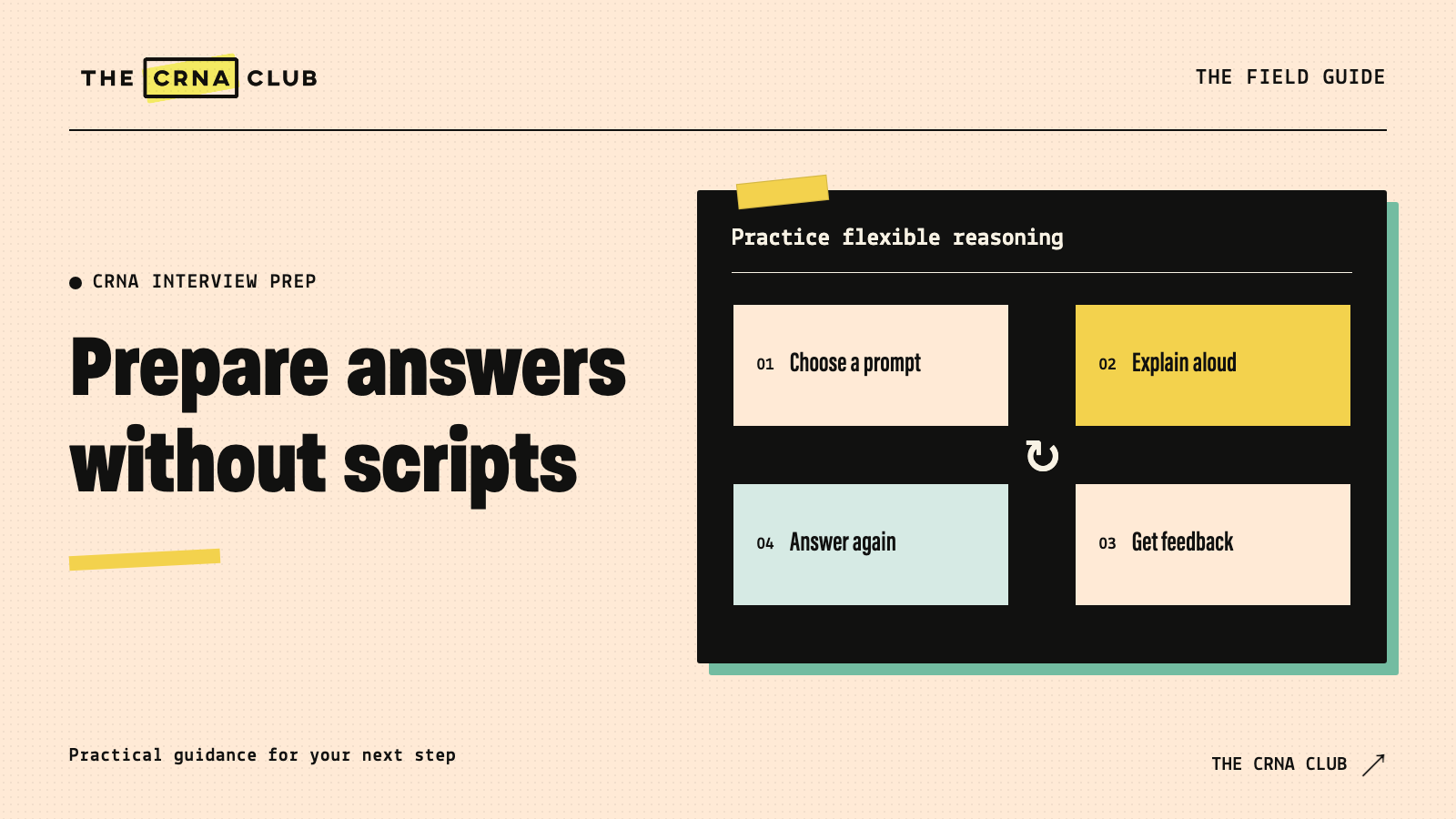
Keep the facts and answer the question again using fresh wording. Then try a related prompt and a follow-up. This tests whether you understand the experience well enough to discuss it flexibly. If you need the exact first sentence to begin, shorten the notes and return to the point you’re trying to explain.
For the fictional card, a listener could ask, “What exactly did the educator tell you?” or “How did you know the next presentation was clearer?”
You need a truthful answer to those questions. If the result was only that you received more specific feedback, say so. Don’t add a measurable outcome because the first version sounds modest.
Try this practice sequence:
- Give one initial answer aloud.
- Review one issue.
- Answer a changed prompt.
Repeat later with another example rather than rehearsing the same paragraph until it sounds recited.
How long should an answer be?
Use enough time to answer the question, explain the relevant action and finish the reflection. Follow the program’s format and any stated time limit. Practice shorter and fuller versions so you can adapt. There is no single answer duration that fits every personal question, clinical explanation or follow-up.
Try explaining the fictional presentation example briefly, then with more context. Notice which details you remove and whether the listener still understands what changed.
You don’t need the patient’s entire history for a story about communication feedback. But removing all context can make your action hard to interpret. Keep the detail that helps the listener understand your decision.
Our rambling and reasoning guide helps you identify when an answer has finished and you’re continuing mainly because you feel nervous.
Does clinical preparation work the same way?
Clinical answers also need flexible explanation, but they require verified knowledge beyond your personal experience. Practice connecting mechanism, patient findings and your reasoning, then check uncertain details against reliable sources. Don’t treat a smooth spoken explanation as proof the physiology is correct or use a personal story to cover a knowledge gap.
If you can name a medication but cannot explain its receptor or monitoring implications, give that a separate learning task. Our clinical pharmacology interview guide can help you identify the depth to review.
And when you don’t know, be clear about the limit. You can explain what you do understand without turning a guess into a confident claim. That kind of honesty deserves practice too.
How do you tell whether preparation is helping?
Look for clearer answers, accurate details and a better response to follow-up questions. You should be able to choose a relevant example without forcing it, explain your action and stop when the point is complete. Those observations are more useful than whether every attempt uses the same polished wording.
Keep a short practice note: question, what worked, one change and next review. If your feedback repeatedly identifies the same problem, address it directly rather than collecting more sample answers.
Ask a listener what point they heard. For a clinical explanation, also check the facts with a reliable source or someone qualified to review the content.
Our Final Thoughts
Choose one story card and answer two different questions from it. If you can keep the facts straight and change the emphasis to fit the question, you’re practicing the flexibility an interview requires.
Take the Next Step
Try our free mock interview, then choose one answer to improve. The free entry includes one lifetime session. For more practice, personalized study guides and our storytelling lessons, explore the seven-day trial.