How Do You Prepare for a Written Essay During a CRNA Interview?
Sachi, CRNA
CRNA
In This Article (9 sections)
- Do all CRNA interviews include a written essay?
- What should you do before you start writing?
- How can you practice with a short writing clock?
- What would a useful outline look like?
- How do you write clearly without sounding rehearsed?
- What should you check before time runs out?
- How do you improve after the first practice essay?
- Our Final Thoughts
- Take the Next Step
Prepare for a written essay during a CRNA interview by practicing how to read an unfamiliar prompt, plan a direct answer, write within a limit, and leave time to check your work. Confirm your school’s actual instructions. A timed writing exercise calls for a different practice routine from revising your application essay over several weeks.
You may have a personal statement you’re proud of and still feel uncomfortable when someone says, “You have twenty minutes.” That’s understandable. Your finished essay doesn’t show you what happens when you have to choose a point and organize it without a long editing window.
We recommend our personal statement lessons for organizing your ideas and Essay Critique for reviewing a completed practice draft. Use the feedback to see which part of the prompt you missed or where the explanation gets unclear. Explore the lessons and writing tools with the seven-day trial, then try the timed exercise below on your own.
Do all CRNA interviews include a written essay?
Don’t assume that every CRNA interview includes writing. Check your invitation, the program’s published interview information, and any instructions provided directly to you. If an important logistical detail is missing, ask the designated program contact. Another applicant’s experience doesn’t establish your own format or permitted materials.
Look for whether the exercise is typed or handwritten, its time or length limits, and any rules about references or assistance. If the school hasn’t supplied those details, keep your practice flexible rather than inventing requirements.
A simple clarification could be, “Could you confirm whether the interview day includes a written exercise and whether applicants need to bring anything for it?” You don’t need to request protected questions to prepare for the format.
Our CRNA school essay prompt guide can help you reflect on common application themes. Use those themes for practice, then answer the new question when the clock starts.
What should you do before you start writing?
Identify the task, the parts of the question, and the limits before choosing an example. Then write a one-sentence answer and a brief outline. Planning gives each paragraph a job, which helps prevent a familiar story from taking over an answer to a different question.
The UNC Writing Center’s guidance on essay exams emphasizes reading what the prompt directs you to do, including its action words. “Describe” and “evaluate” can ask you to do different work even when they address the same general topic.
Try this original practice prompt:
Describe a time feedback changed how you approached a professional responsibility. Explain what you changed and how you evaluated that change.
Underline the three jobs: describe the experience, explain the change, and explain your evaluation. If your entire draft describes how uncomfortable the feedback felt, you’ve answered only part of the question.
Choose a real experience you can explain without private patient or coworker information. Jot down the feedback, your specific action, and what you actually observed afterward. You don’t need the most dramatic event in your career. You need an experience that allows you to answer all three parts accurately.
How can you practice with a short writing clock?
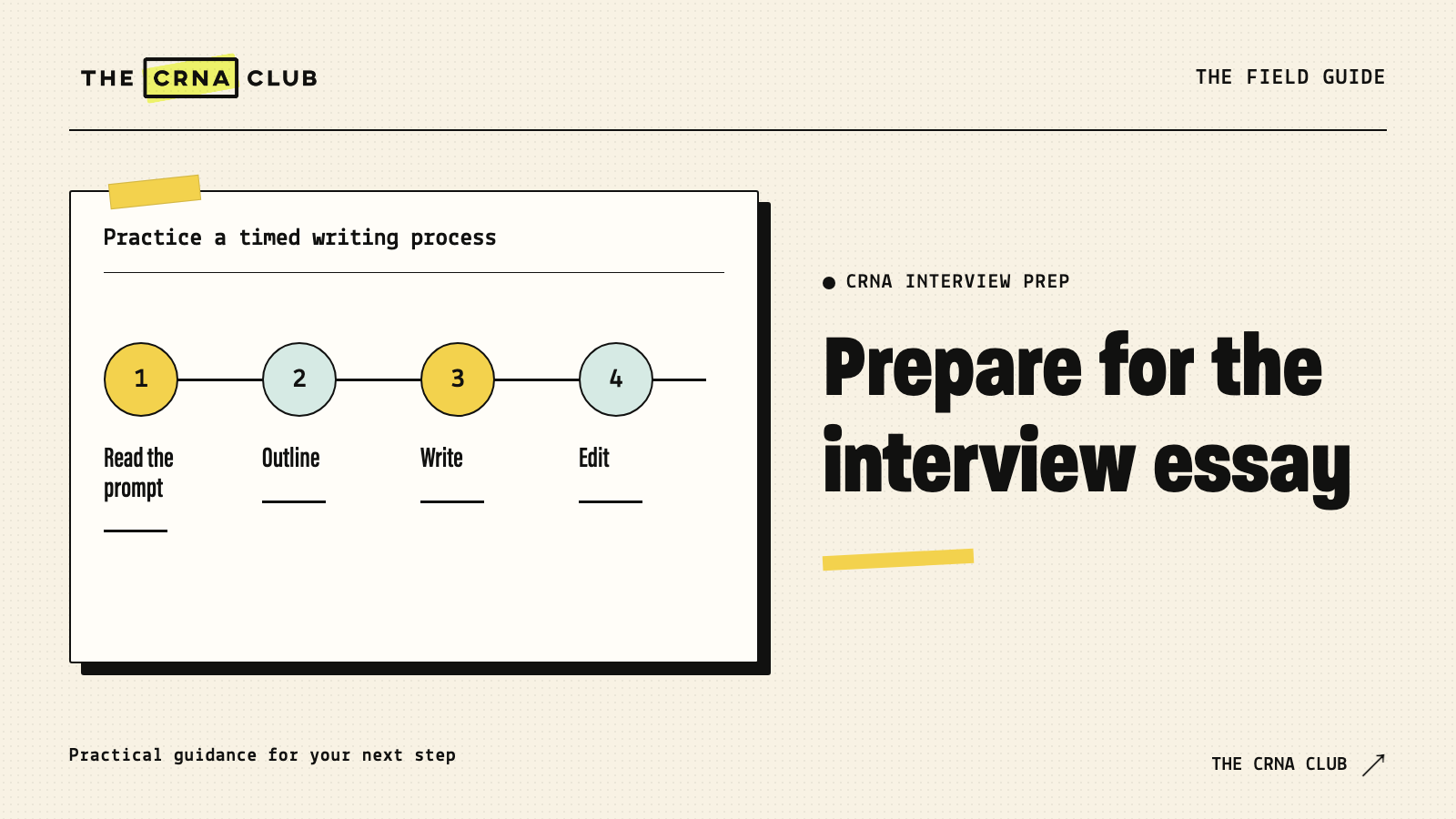
Use a practice schedule that reserves time for reading, outlining, drafting, and checking. Adjust it to the school’s stated format when you have that information. The 25-minute example below is an invented training exercise, not a claim about how long a CRNA program gives applicants.
| Practice time | Task | What you should have afterward |
|---|---|---|
| Minutes 0–3 | Read and mark the prompt | Required tasks and constraints |
| Minutes 3–6 | Choose the point and outline | Main answer and paragraph jobs |
| Minutes 6–21 | Draft the response | A complete answer within the exercise limit |
| Minutes 21–25 | Review and correct | Missing parts addressed and unclear sentences repaired |
For this exercise, set your own modest length limit before starting. Don’t spend the first practice session testing how many words you can produce at maximum speed. You’re trying to learn whether you can finish a coherent answer and still check it.
When the drafting period ends, move to review even if the wording feels imperfect. That’s part of the exercise. If you keep extending the clock, you won’t learn which decisions are taking too long.
Afterward, record where you spent extra time. Was it choosing a story, writing the opening, or editing every sentence as you went? That observation tells you what to practice next. Repeating the whole exercise without looking at the bottleneck may leave you with the same problem again.
What would a useful outline look like?
Build the outline around the prompt’s required tasks. Give enough context to understand the experience, explain your individual action, and connect the reflection to what changed. Keep the explanation proportional to the space available. A short answer usually can’t support several unrelated stories and still develop each one well.
We recommend our CRNA School Essay Basics lesson if your practice draft keeps wandering. It helps you decide why each paragraph belongs. Under a clock, ask yourself: does this paragraph answer the question, or am I keeping it because I already wrote it for another essay?
For the feedback prompt, here’s a fictional outline showing the method:
- Opening: Feedback helped me recognize that giving a learner more information wasn’t always helping them organize it.
- Context: During precepting, I received feedback that my explanations were arriving too quickly for the learner to process.
- Action: I began asking the learner to state their plan first, then focused my teaching on the gap they identified.
- Evaluation and reflection: I checked whether the learner could explain the plan back and adjusted my approach based on that response.
These details belong to a fictional exercise. Use your own experience when practicing an autobiographical prompt. Don’t turn the outline into a claim that a particular teaching change improved patient outcomes unless you have evidence for that outcome.
The outline also exposes what’s missing. If you can’t explain how you evaluated the change, you may need a different example. It’s easier to make that choice before writing three paragraphs.
How do you write clearly without sounding rehearsed?
State your point in plain language and support it with specific, truthful details. You can sound professional without replacing everyday words with formal phrases. Read the opening back to yourself: could someone identify your answer before reaching the middle of the essay?
Purdue OWL’s guidance on writing essay exams emphasizes a focused, organized, supported answer. Those are useful targets for practice. They don’t require a dramatic hook or an elaborate introduction for every response.
Compare two openings for the fictional example. “Throughout the trajectory of my nursing career, I have encountered numerous opportunities for development” uses space without identifying one. “Feedback from a precepting conversation changed how I checked a learner’s understanding” tells the reader where the answer is going.
Then explain the action with the same clarity. “I facilitated improved communication” is difficult to picture. “I asked the learner to explain their plan before I added teaching points” describes something a person did. The second sentence is also easier to support honestly.
Our guide to What, How, and Why storytelling offers another way to organize an experience. Use the structure to think, while allowing your actual response to fit the prompt in front of you.
What should you check before time runs out?
First check that you’ve answered every part of the prompt. Then check whether the response is complete, understandable, and within the stated limits. Use your final minutes to repair missing meaning before polishing small stylistic preferences. A perfect opening doesn’t compensate for an unanswered second question.
Use this order during your practice review:
- Point to the sentence that answers the main question.
- Find where you addressed each required task.
- Check that every claimed action and outcome is accurate.
- Clarify unclear references such as “this” or “they.”
- Correct obvious errors and confirm the format or limit.
If you’re handwriting, include legibility in your practice. If you’re typing, practice completing an answer without relying on tools you may not be allowed to use. Follow the actual exercise rules, including rules about AI or outside assistance. Preparing beforehand doesn’t authorize help during an independent writing task.
Keep your original timed draft. Review it in Essay Critique with the practice prompt, then choose one issue to work on. Try a new prompt under the same clock afterward. You’ll see whether the change helped your process, rather than only improving one familiar essay.
How do you improve after the first practice essay?
Choose the largest problem and practice that skill directly. If choosing an example took ten minutes, work on matching experiences to different prompt tasks. If the draft wandered, outline before writing. If you ran out of time, reduce unrelated context and check whether each paragraph serves the answer.
Try a second original prompt: “Explain a professional goal and one experience that helped you refine it.” Give yourself a new clock and a fresh response. A different prompt helps you test whether the method transfers beyond the first topic.
If the feedback says your example doesn’t answer the prompt, go back to the personal statement lessons before polishing sentences. Choose a better example, then try the process again in your own words.
Our Final Thoughts
Try one timed answer and keep the original draft. Afterward, find where you lost time or missed part of the prompt. Practice that decision before starting a new full essay.
Take the Next Step
Write one timed practice answer, then try our free essay critique with that prompt. The free entry includes one lifetime review. For more writing support and the personal statement lessons, explore the seven-day trial.