How Do You Request CRNA Application Feedback After a Rejection?
Sachi, CRNA
CRNA
In This Article (10 sections)
- Should you ask every program for rejection feedback?
- What information belongs in the email?
- How should the request change after an interview?
- What should you leave out?
- When should you follow up?
- How do you turn feedback into a useful plan?
- What if the feedback is generic?
- What if you receive no feedback at all?
- Our Final Thoughts
- Take the Next Step
Request CRNA application feedback with a short, professional email after checking the program’s policy. Identify your application cycle, thank the school for its review and ask which areas would benefit from improvement before reapplying. Accept that some programs won’t provide individualized feedback. If they do respond, turn the advice into specific work you can document.
You don’t need to send a long defense of your GPA or explain how hard the rejection hit. The request has one purpose: learn whether the program will share useful guidance for your next application.
We suggest keeping the request and any reply with that saved school, then choosing one next action in My ReadyPlan. You can try our school-planning tools with the seven-day trial. They help you keep advice attached to the program that gave it and make a plan you can return to after work.
Should you ask every program for rejection feedback?
Check each school’s published policy and decision message first. If the program offers feedback, use its stated route and timing. If the policy is silent, a concise request is reasonable. When the school says it does not provide individual feedback, respect that limit rather than contacting several faculty members to seek a different answer.
The University of Wyoming’s professional-school guidance recommends checking whether schools offer feedback and recognizes that access varies. This is general professional-school advice, not a promise that a CRNA program will review your file with you.
Vanderbilt’s health-professions interview guidance likewise suggests asking what to strengthen when a program offers feedback. If your program offers feedback, use the route it gives you.
If the decision is still pending, don’t call it a rejection. Follow the stated status and waitlist instructions until you receive the actual outcome.
What information belongs in the email?
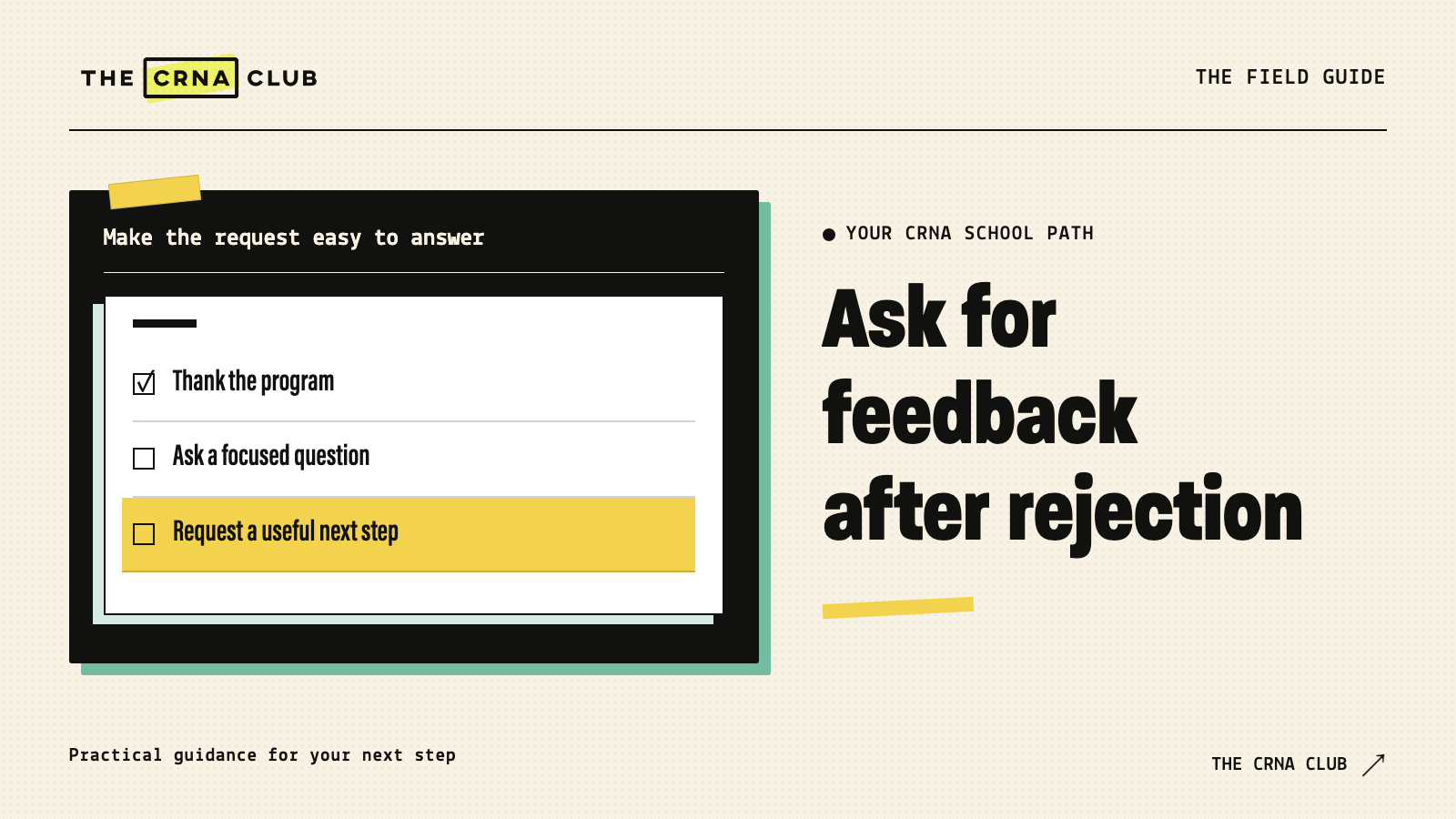
Keep the message short enough to find your file and understand the request. Include:
- Your name, program and entry term or application cycle.
- An application identifier, if requested.
- Whether you reached the interview stage.
- One clear question about what to improve.
You don’t need a long personal history or several attached documents.
You can use this fictional example as a starting point:
Subject: Feedback request for future nurse anesthesia application
Dear Admissions Team,
Thank you for reviewing my application for the 2028 nurse anesthesia cohort. I was not selected for an interview and am planning how to strengthen a future application. If your program provides feedback, would you be willing to identify one or two areas I should prioritize? My application ID is listed below for reference. I understand if individualized feedback is unavailable.
Thank you for your time,
Alex Rivera
That’s enough. It identifies the file and the question, and it gives the school room to respond within its policy.
Use the correct professional title when writing to a named faculty member. “Dear Dr. Lee” and a direct question are enough. You don’t need a paragraph of formal praise.
How should the request change after an interview?
Name the interview stage and ask what to strengthen for a future application without assuming the interview caused the rejection. The school considered a broader record, and you don’t know how it weighed each part. If it offers specific interview feedback, ask for a useful improvement area rather than private scoring details or comparisons with other candidates.
For example:
Dear Dr. Lee,
Thank you for the opportunity to interview for the 2028 cohort. Although I was not offered admission, the visit helped me understand the program more clearly. If your feedback process allows it, I’d appreciate guidance on the preparation I should prioritize before reapplying. I’m especially interested in whether my clinical explanations or communication need more work, while recognizing the overall decision involved my full application.
Thank you for your time and consideration.
Keep that last distinction if it fits your situation. A difficult clinical question can dominate your memory, but it isn’t proof you failed the interview or that answering it differently would have changed the outcome.
For the broader next-cycle plan, our reapplication improvement guide helps connect feedback with the rest of your preparation.
What should you leave out?
Leave out arguments about why you deserved a seat, comparisons with applicants you saw online and requests for confidential committee discussions. Don’t attach your whole application unless the program asks. You’re requesting guidance for future work, so keep the message centered on what you can improve.
Avoid a sentence like, “I know people with lower GPAs got interviews, so I don’t understand your decision.” You don’t know those applicants’ complete records, and the comparison doesn’t give the recipient a practical question to answer.
Also avoid combining feedback with an appeal unless the school has a specific appeal process you’re using for a legitimate reason. “What should I work on?” and “Please reconsider me” ask for different actions. Mixing them makes the intent unclear.
It’s fine to acknowledge you’re disappointed. But the admissions email doesn’t need to hold every emotion the decision created. Talk through that part with someone who supports you, then send the focused request when you’re ready.
When should you follow up?
Use any timeline the program provides. If it invites feedback requests but gives no response window, allow a reasonable interval and consider one brief follow-up through the same approved channel. Don’t repeatedly contact staff or switch to personal messages after the school has declined to provide feedback.
A follow-up can be as simple as:
I’m following up on my feedback request from May 8. If individual feedback is available through a different process or at a later date, I’d appreciate direction. I understand if your program is unable to provide it.
You don’t need an escalating sequence of emails. If the program says no, thank it if appropriate and move to the work you can do independently.
How do you turn feedback into a useful plan?
Record the exact meaning of the advice, identify what you can act on and define the evidence you’ll have afterward. Separate a requirement from a recommendation. Ask a clarifying question when a vague phrase would lead you to spend significant time or money, but don’t expect the program to design your entire development plan.
Use this fictional feedback log:
| Feedback received | Question to clarify | Action | Evidence for the next cycle |
|---|---|---|---|
| “Show more recent science performance” | Is there a specific course or recency concern? | Choose an approved, relevant course if appropriate | Final grade and changed study process |
| “Develop your clinical explanations” | Which type of reasoning needs work, if feedback is available? | Practice explaining familiar cases and get accuracy feedback | Clearer spoken rationale and corrected knowledge gaps |
| “Gain more critical-care experience” | Is a minimum unmet or is the recommendation developmental? | Build deliberate learning within the actual role | Specific new responsibilities and observed growth |
| “Strengthen your program fit” | Did the statement answer the stated prompt? | Research curriculum and connect it to actual goals | A more specific, truthful statement |
Match the next step to the advice. If your clinical explanations need work, we recommend our Mock Interview Lab. Use the question-level feedback to choose what to practice. The seven-day trial also gives you a personalized study guide for reviewing weak topics. If the school wants recent science performance, start with your transcript and its course guidance instead.
What if the feedback is generic?
Treat generic advice as a starting point, not a diagnosis. “Improve competitiveness” doesn’t tell you which course to retake or whether you need to change jobs. Compare it with published requirements and the application you actually submitted. Then select a gap you can verify and explain before committing to a large new project.
In our episode about applying to the same program again, the useful planning principle is to identify and describe meaningful changes between applications. You don’t need to add an accomplishment in every category merely to make the resume longer.
A stronger change log says, “I completed the missing prerequisite, corrected the academic classification question and revised the essay to answer the program prompt.” “I worked harder” leaves the change unclear.
What if you receive no feedback at all?
Review the evidence you can access: application completion, eligibility, transcript calculations, reference roles, document clarity and school fit. Ask a trusted reader to assess the materials they can see. Keep their observations separate from guesses about the committee’s discussion, which neither of you can reconstruct from a rejection alone.
Our application blind-spots guide gives you places to inspect. If you reached an interview, use a practice session to observe your own current strengths and weaknesses rather than repeatedly replaying one difficult answer.
And keep your timeline realistic. Some changes take a semester or sustained clinical development. You don’t have to compress them into the next opening date if that would leave you submitting essentially the same evidence again.
Our Final Thoughts
If the school offers feedback, ask one focused question. Then turn its response into a task with evidence you can show next time, such as a final grade, a corrected document or a clearer clinical explanation.
Take the Next Step
Send the short request if your program allows it, then choose one improvement you can explain. We recommend My ReadyPlan and your saved-program notes for keeping that work organized. Explore them with the seven-day trial, along with the interview and application lessons that match the feedback you received.