How Do You Turn Your CRNA Resume Into an Interview Study List?
Sachi, CRNA
CRNA
In This Article (9 sections)
- Where should you start when reviewing your resume?
- What should your resume-to-study worksheet contain?
- How do you work through a clinical skill claim?
- How should you study medications mentioned on your resume?
- How do you prepare to discuss leadership and project claims?
- What about shadowing, volunteer work, and education?
- How do you choose what to study first?
- Our Final Thoughts
- Take the Next Step
Turn your CRNA resume into an interview study list by reviewing each claim, identifying what you personally did, and writing the questions you need to answer about it. Separate factual gaps from speaking practice. Include leadership, projects, education, and shadowing alongside clinical skills, then choose specific next tasks instead of studying every line equally.
You already made decisions about what belongs on your resume. That makes it a useful place to start preparing. “Preceptor,” “quality improvement,” and “hemodynamic monitoring” each represent something you should be able to explain beyond the phrase on the page.
We recommend our Communicating Value Add lesson to review what your resume says about your work, then our Mock Interview Lab to practice explaining it. Use the feedback to choose which topic needs another look. The seven-day trial includes the lessons and a personalized study guide to help you review it.
Where should you start when reviewing your resume?
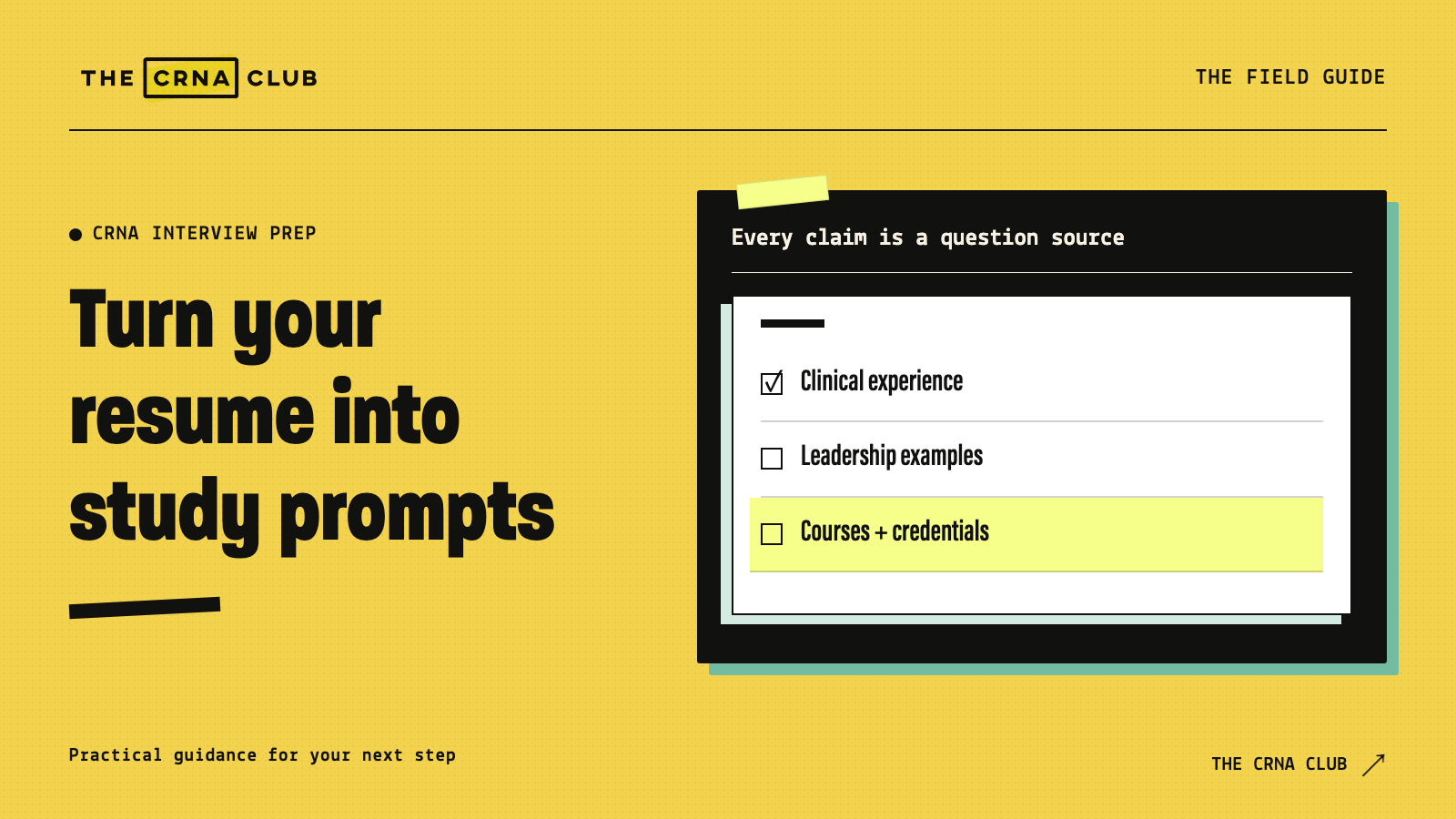
Start with the exact version you submitted and mark every claim that could benefit from an explanation. Keep a separate working copy for study notes. Identify your role, the relevant knowledge, and one example before adding more topics. Keep the submitted version beside your notes so you’re preparing to explain what the school actually received.
Harvard’s interviewing guidance recommends knowing your resume and practicing clear explanations of your experiences. That’s general interview advice, rather than a rule about which questions a CRNA faculty panel must ask.
Read your resume as if you’re meeting yourself for the first time. Would “led” mean you designed a project, coordinated meetings, or helped implement someone else’s plan? Would a device listed under skills imply more independent experience than you actually have?
Our Communicating Value Add lesson emphasizes specific contributions and removing repetitive descriptions. Apply that thinking to your study copy: underline the verbs, circle technical terms, and mark any statement whose meaning is broader than your actual experience.
If the document itself needs work, our guide to what to include in a CRNA resume covers that job. Here, you’re using the submitted document to organize preparation.
What should your resume-to-study worksheet contain?
For each selected claim, record your actual role, a likely explanation question, a knowledge gap, a trustworthy source, and a next practice task. One completed row should tell you what to study or practice next.
Use this blank structure:
| Field | What to write |
|---|---|
| Resume claim | The exact phrase from your submitted version |
| Actual role | What I did, observed, assisted with, or coordinated |
| Explanation question | What would help someone understand this claim? |
| Knowledge gap | The specific fact or connection I need to review |
| Source | Where I will verify it |
| Practice task | The answer or explanation I will produce |
Don’t turn the “explanation question” column into a list of rumors about a school’s interview. You’re generating original practice questions from your own claims. Keep any confidential or protected interview content out of the worksheet.
MIT’s interview primer describes using application-related experience and competencies to develop practice prompts. That approach translates well here: take a broad phrase and ask what specific experience supports it. The worksheet and examples below are a way to do that for your own application.
How do you work through a clinical skill claim?
Choose a skill you truly use and explain its purpose, your responsibilities, and one limitation of what it tells you. Then identify the underlying knowledge you need to verify. Keep experience and study separate: reading about a device doesn’t change an observed-only experience into independent management.
Consider a fictional applicant whose resume lists invasive hemodynamic monitoring. Their worksheet might look like this:
- Actual role: Assessed the patient, checked relevant measurements, recognized changes, and communicated concerns within their RN role.
- Explanation question: What did the monitored information help you understand, and what else did you assess?
- Knowledge gap: Review how one selected measurement relates to the physiology it is used to assess.
- Source: Current learning material and the relevant device reference or policy.
- Practice task: Explain that measurement’s purpose and a limitation without using a patient chart.
Notice the task doesn’t say, “Master all hemodynamics tonight.” It has a defined output. After reviewing, the applicant closes the source and explains the concept. If the explanation breaks down, they mark the exact connection that needs another look.
For clinical cases and topics organized by unit background, use our CRNA interview questions by ICU. Use those cases after choosing the skills you need to review from your own resume.
How should you study medications mentioned on your resume?
Start with what you actually administer or assess, then separate the medication’s effect, mechanism, and relevant assessment considerations. Check facts with an appropriate current reference. If a medication isn’t named but a broad skill such as “vasoactive infusions” is, choose a few representative medications from your own practice to review.
We recommend our pharmacology lessons and workbook when a medication claim turns into a knowledge gap. Check the mechanism, receptors and side effects separately, then explain how they connect. Close the notes before you try the spoken answer.
For example, a fictional study task could be, “Explain the mechanism of one medication I regularly use and why that effect relates to an assessment I perform.” The output is an explanation you can check, rather than another page of highlighted notes.
Be careful with familiar local shorthand. A concentration or preparation at your workplace isn’t automatically universal. Verify current facts and keep clinical administration decisions tied to the actual product and your clinical processes. An interview worksheet shouldn’t become a substitute medication reference.
Our pharmacology interview guide can help you choose questions after identifying the medication-related claims you want to review.
How do you prepare to discuss leadership and project claims?
Write what you personally contributed, how you made decisions, and what you can truthfully say happened afterward. Distinguish your contribution from the team’s work and distinguish a measured result from an observation. A project title alone doesn’t provide enough detail to explain your role.
Here’s a fictional example. A resume says, “Participated in a unit education project.” The applicant created a teaching handout and helped present it during a staff meeting. They didn’t design the entire project, collect outcome data, or lead the implementation.
Their practice questions could be: Why was the handout needed? How did you decide what to include? What feedback did you receive? What would you change next time? Those questions fit the actual contribution without adding a leadership title that wasn’t theirs.
If the applicant observed that coworkers used the handout, they can describe that observation. They can’t claim the handout reduced complications unless that outcome was actually measured and the claim is supported.
The same applies to precepting. Prepare a concrete example of how you adjusted teaching or checked understanding. Avoid turning every precepting experience into a claim about staff retention. You can show thoughtful work without attaching an unsupported metric to it.
What about shadowing, volunteer work, and education?
Prepare to explain why you chose the experience, what you learned, and how it relates to your goals. Stay within your role. Shadowing is observation, and attending an event isn’t the same as organizing it. A course on your transcript represents study, rather than proof that you’ve mastered every related clinical application.
For shadowing, choose one observation that helped you better understand the CRNA role. Explain what you noticed and what question it raised. You don’t need to recount every case or include patient details.
For volunteer work, identify the work you actually did and why the commitment mattered to you. For education, mark any recent course or project you may want to discuss. If you claim the course changed your study habits, prepare one specific example of that change.
Our Storytelling Basics lesson helps organize these experiences into what happened, how you participated, and why it matters. Keep brief factual notes for each experience, then practice adapting them to different questions instead of memorizing a paragraph for every resume line.
How do you choose what to study first?
Prioritize claims with a meaningful knowledge gap, unclear role boundaries, or an explanation you can’t yet give. Then choose tasks that fit the time you have. A short session can resolve one specific issue even when you can’t review the entire resume after a shift.
Mark each row with one next action:
- Verify: I need a reliable source before practicing this explanation.
- Clarify: I need to distinguish my role from the broader project or team.
- Practice: I know the content but need to explain it clearly.
- Recheck later: I can explain it now and will return for another retrieval attempt.
Choose one “verify” row and one “practice” row for your next session. Afterward, update the action. That gives you a record of what changed, rather than a growing list of topics that all feel unfinished.
Use your next Mock Interview Lab session to test one topic from the worksheet. With trial or membership access, open the personalized study guide afterward, review the weak concept, then update that row with your next task. We suggest this loop because it connects the studying to something you actually struggled to explain.
Our Final Thoughts
Complete three worksheet rows from the resume you submitted. Choose one factual check and one spoken explanation, then update those rows after your next study session.
Take the Next Step
Complete three worksheet rows and choose one for spoken practice. We recommend our Mock Interview Lab and its personalized study guide for finding the next thing to review, alongside the clinical and interview lessons. Explore them with the seven-day trial.