How Do You Use Anki to Study for a CRNA Interview?
Sachi, CRNA
CRNA
In This Article (11 sections)
- What is Anki useful for in interview preparation?
- What should you understand before making cards?
- How can one concept become eight useful cards?
- How short should a card be?
- What belongs in a spoken explanation prompt?
- How do you decide whether a card was answered correctly?
- How many new cards should you add each day?
- Should you use a shared or AI-generated deck?
- How do you know when to move beyond the deck?
- Our Final Thoughts
- Take the Next Step
Use Anki for CRNA interview preparation by turning verified concepts into focused recall questions, then adding spoken prompts that require you to explain the reasoning. Keep the deck small enough to review consistently. Flashcards can support memory, but you still need to practice answering unfamiliar questions aloud and checking whether your explanations are accurate.
The problem isn’t owning too few cards. You can have hundreds and still struggle to explain one medication or hemodynamic change without reading the back.
We recommend pairing Anki with our clinical lessons and Mock Interview Lab. Learn the concept, make a few cards, then use a spoken question to see whether you can explain it. The lab’s feedback helps you choose what to review next. With the seven-day trial, you also get a personalized study guide and the clinical lessons to work on that topic.
What is Anki useful for in interview preparation?
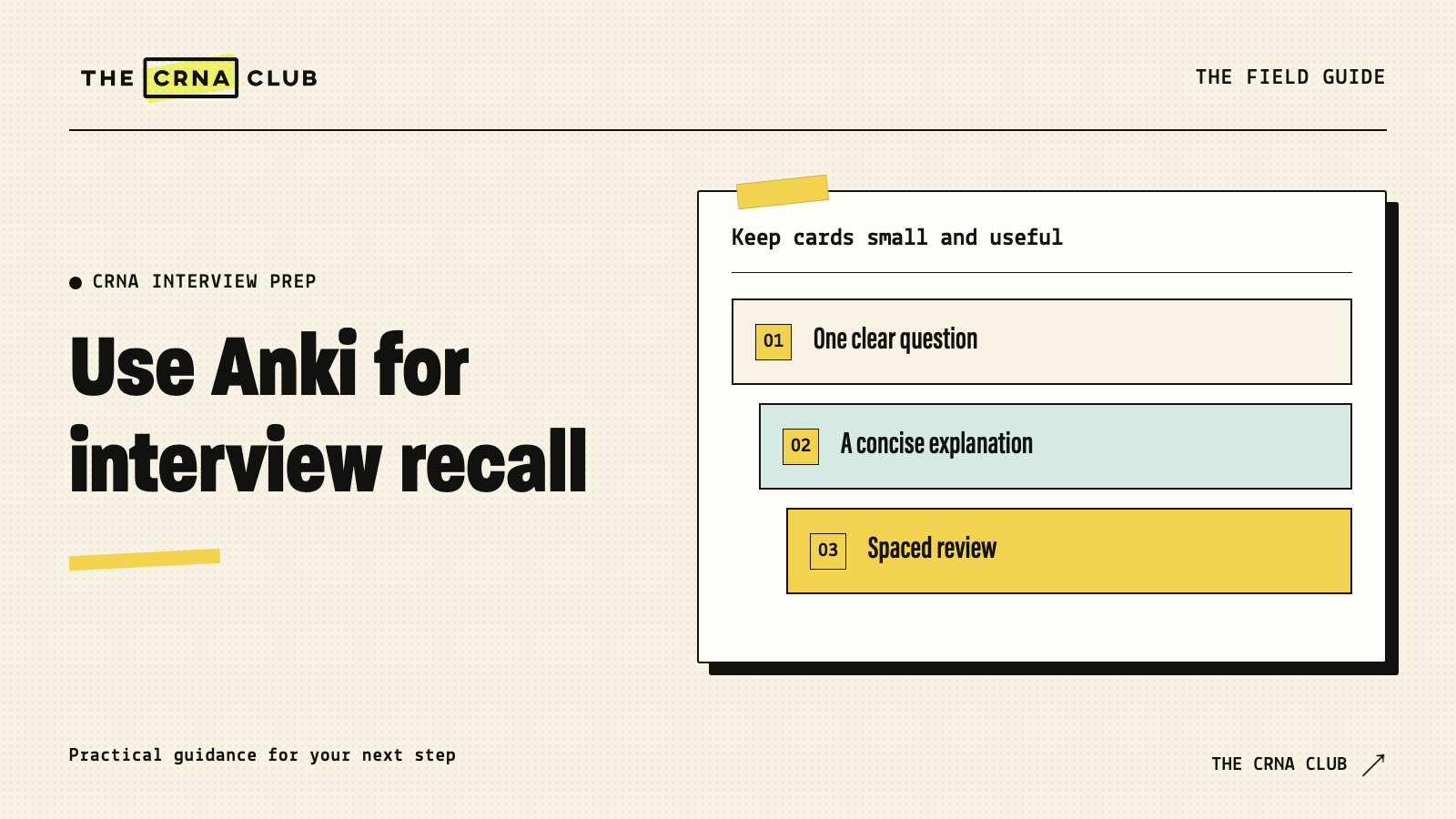
Anki can help you revisit material through active recall and spaced review. Use it for definitions, mechanisms, relationships and short calculations you need to retrieve. For an interview, pair those cards with spoken explanations so remembering a phrase becomes the beginning of an answer rather than the whole answer.
The Anki manual explains active recall and spaced repetition as the program’s foundation. You don’t need to customize every setting before starting a useful deck.
Experimental work by Roediger and Karpicke supports retrieval practice for later retention in the materials studied. That supports practicing recall. It doesn’t tell you whether a particular deck prepares you for a CRNA interview, so check what you can explain out loud too.
Our interview study-plan guide helps you place review beside clinical learning and spoken practice.
What should you understand before making cards?
Read or watch the source material first and work through the concept. If the explanation is unclear, resolve that gap before compressing it into a flashcard. A short card is useful after the relationship makes sense. Otherwise you risk repeatedly memorizing wording you cannot interpret or verify.
Choose one topic from your actual experience, such as cardiac output. You don’t need a deck covering every drug in anesthesia before you begin practicing.
For the worked example below, cardiac output equals heart rate multiplied by stroke volume. Stroke volume is the volume ejected per beat, while output describes volume per minute. OpenStax’s cardiac physiology chapter provides a public source for that relationship.
Keep a source note with the topic and section. You’ll want to find it again when a card seems oversimplified or another resource gives a conflicting explanation.
How can one concept become eight useful cards?
Use a mix of focused retrieval and application. Keep the prompt specific enough that you know what a successful answer requires. The example cards below all use the same cardiac-output relationship, but they ask you to define, calculate, compare and explain it. The numbers are hypothetical learning examples, not treatment targets.
| Card front | What the back should check |
|---|---|
| What does cardiac output describe? | Volume pumped by a ventricle per minute. |
| What is the relationship among CO, HR and SV? | CO = HR × SV. Define each term. |
| What units result from beats/min × mL/beat? | mL/min. Convert to L/min when needed. |
| HR is 80/min and SV is 60 mL. Calculate CO. | 4,800 mL/min, or 4.8 L/min. |
| HR is 100/min and SV is 40 mL. Calculate CO. | 4,000 mL/min, or 4.0 L/min. |
| Why can the second example have a higher HR but lower CO? | The lower stroke volume more than offsets the higher rate. |
| What can’t you determine from HR alone? | Cardiac output, because stroke volume is also needed. |
| Explain the comparison aloud, then name its limit. | Show both products. The equation alone does not identify why SV changed. |
Don’t reveal the answer as soon as the card feels familiar. Try to produce it first. If you can’t, review the source and the reasoning rather than repeatedly clicking through the same uncertainty.
How short should a card be?
Make a card narrow enough to review honestly. If the back contains several unrelated mechanisms, risks, doses and exceptions, split the work into focused prompts. Keep a larger spoken question separately so you also practice connecting the pieces. Small recall cards and a fuller explanation serve related but different purposes.
“Tell me everything about norepinephrine” is difficult to grade consistently. You might remember a receptor and forget the rest, then mark the card correct because part of it looks familiar.
A focused prompt asks for one defined relationship. A later explanation prompt asks you to connect the verified relationships to a clinical picture.
Our pharmacology interview guide helps identify those connections. Avoid turning a medication into an isolated list of receptor letters with no explanation of what follows.
What belongs in a spoken explanation prompt?
Ask yourself to explain a relationship in ordinary language, apply it to a hypothetical change and state what remains unknown. Keep a short accuracy checklist on the back rather than a paragraph to memorize. That gives you room to speak naturally while still checking whether the required reasoning is present.
For the cardiac-output example, a spoken answer could explain that rate and volume per beat both affect flow per minute. It would show the two calculations and acknowledge that the numbers don’t reveal the cause of the stroke-volume difference.
You don’t need to use identical wording every time. You do need the math and the relationship to remain correct.
If a listener asks, “So does a faster heart rate always mean more cardiac output?” answer the actual question. The comparison gives you a reason to discuss stroke volume instead of reciting only the formula.
How do you decide whether a card was answered correctly?
Define the essential point before reviewing and compare your attempted answer with the verified source. Recognizing the back is different from retrieving it. If the wording changes but the concept remains accurate, that can be a successful explanation. If you omit a condition that changes the meaning, review and correct the card.
For a calculation, check the setup, arithmetic and units. A correct number with an unexplained unit error is a useful problem to catch during practice.
For a mechanism, ask whether you can connect the steps rather than name the final effect alone. If you’re unsure about clinical accuracy, ask a knowledgeable reviewer or return to a reliable reference.
Don’t mark a card correct because you remember seeing the answer yesterday. The purpose is to find what you can produce when the prompt is in front of you.
How many new cards should you add each day?
Add only what you can review while keeping time for understanding and spoken practice. There is no universal daily card target for CRNA interviews. Begin with a small topic, observe the review workload and adjust. If card creation consumes the study session, simplify the deck before expanding it.
A hypothetical shift worker might use a short review block on workdays and a longer explanation session on an off day. Another nurse might prefer fewer, longer sessions. Choose a routine that fits your actual schedule.
Track whether reviews accumulate faster than you complete them. That’s information about the workload, not a reason to turn every day off into a card-clearing marathon.
You can also pause adding new cards while you repair weak ones. A smaller accurate deck you use is more helpful than a large collection you avoid opening.
Should you use a shared or AI-generated deck?
Treat outside cards as unverified until you check the content, scope and sources. A convenient deck can contain outdated details, context-free statements or errors. Keep only cards that support your learning goals and that you can explain. Don’t let the ease of importing a deck become a reason to memorize claims you haven’t reviewed.
If a card gives a medication dose, verify the indication, route, units and relevant context. If it makes a universal physiology claim, check whether a condition or exception has been removed.
Avoid putting patient identifiers or copied clinical records into cards. Use approved educational material and hypothetical examples.
Our interview resource guide helps you choose tools by the work you need to do. You don’t have to adopt every app another applicant mentions.
How do you know when to move beyond the deck?
Use a new spoken question to decide what to do next.
- Answer a question that combines the material differently.
- If you retrieve the facts but cannot explain their relationship, spend the next session teaching the concept aloud.
- If that explanation reveals a knowledge gap, return to the source and revise the relevant cards.
Our Mock Interview Lab helps you test the spoken explanation beyond the card. With trial or membership access, open the personalized study guide afterward and choose a weak topic to review. Then fix or add the card that addresses that topic, rather than importing another whole deck.
You’re preparing to communicate understanding. The review schedule supports that work, but the interview happens in a conversation rather than on the back of a flashcard.
Our Final Thoughts
Make a few cards from one concept you have checked. Then answer a fresh spoken question about it. The part you cannot explain tells you what to review before adding more cards.
Take the Next Step
Try our free mock interview and use the feedback to choose one concept for your next cards. The free entry includes one lifetime session. Explore our clinical lessons, more interview practice and personalized study guides with the seven-day trial.