How Does Rolling Admission Work for CRNA School?
Sachi, CRNA
CRNA
In This Article (10 sections)
- Does rolling admission always mean the class fills before the deadline?
- Which dates do you need to separate?
- How does a priority round work?
- What application status starts the review clock?
- Should you submit as early as possible?
- What should you ask admissions if “rolling” is unclear?
- How do you compare three different school timelines?
- What happens if another applicant already has an offer?
- Our Final Thoughts
- Take the Next Step
Rolling admission means a CRNA program evaluates or makes decisions during an application period, but the exact process depends on the school. Review can begin before a final deadline, follow a priority round or produce decisions after applications close. Read the program’s actual review, interview and decision dates before deciding when to submit.
“Rolling” looks like a simple word until you try to build a calendar around it. Does it mean your application gets read next week? Does the class fill before the posted deadline? Should you rush an unfinished essay so you’re earlier in line?
We recommend putting each school’s review dates into our Application Timeline before you choose your own submit date. Keep the school’s missing requirements in its saved-program checklist and use My ReadyPlan to decide what needs attention next. You can try those planning tools with the seven-day trial.
Does rolling admission always mean the class fills before the deadline?
No. Some programs review completed applications while the application remains open, and some release rolling decisions after a fixed deadline. Others use separate priority and final rounds. Find out when offers begin and whether the school continues accepting applications after seats are offered. The word alone won’t answer either question.
The University of New England’s detailed nurse anesthesia admissions page describes rolling admission decisions after the application deadline. That’s a useful reminder to read the detailed timeline rather than assume every rolling process rewards the earliest possible submission date in the same way.
Union University’s nurse anesthesia FAQ describes priority and final deadlines with interview rounds and seat decisions tied to those rounds. Its explanation gives more useful planning information than the label by itself.
Those are current examples checked in November 2026. Your application belongs to a specific entry year, so recheck that cycle’s instructions when you create your plan.
Which dates do you need to separate?
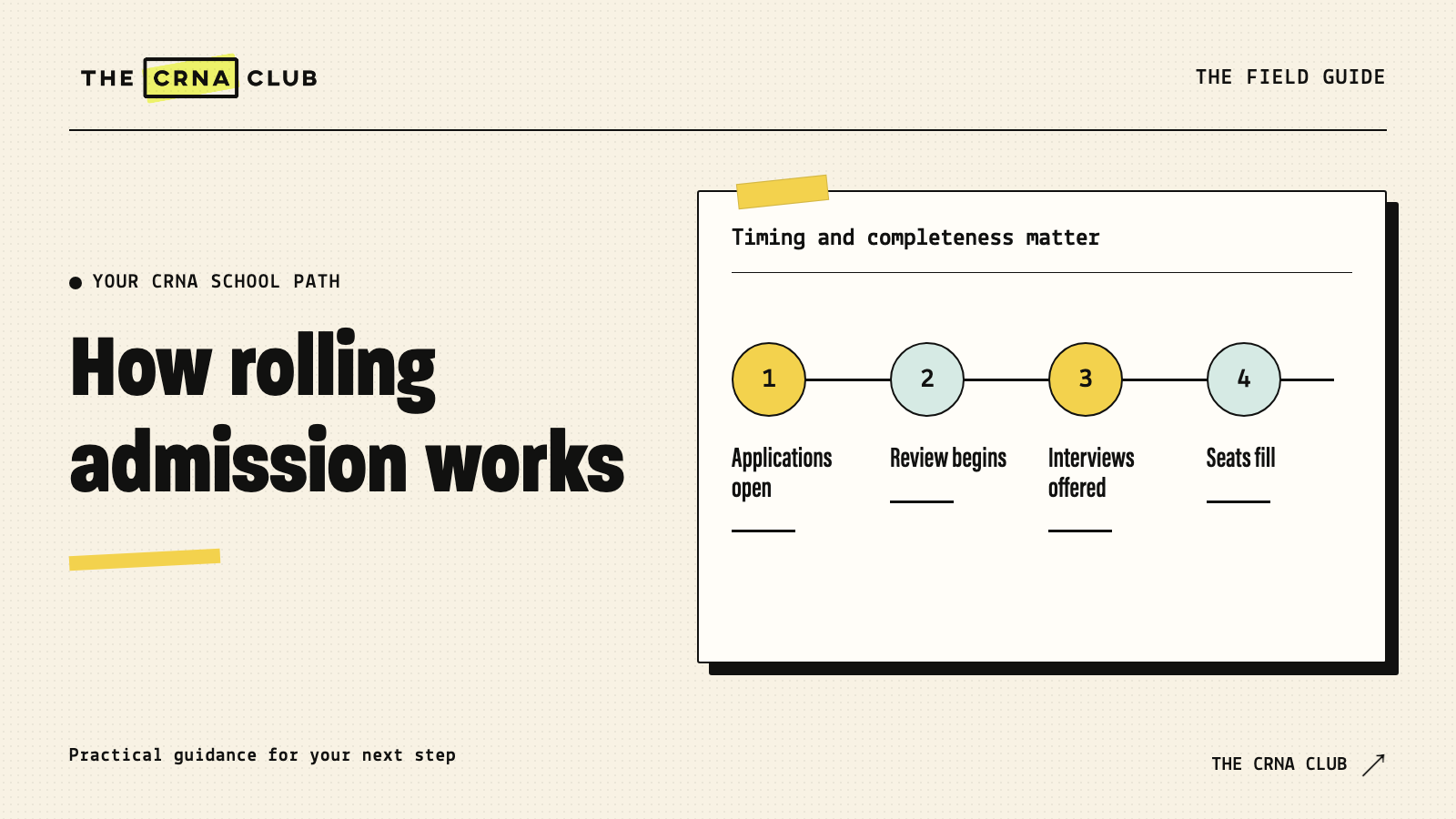
Record the opening date, any priority deadline, final submission deadline, required completion or verification date, interview period and decision timing. Then add deposit and enrollment deadlines if you receive an offer. Write them separately. The final closing date might be too late for the review round you want.
Use this worksheet for every program:
- Application opens: Check the correct cycle and entry term so you generate requests in the right application.
- Priority review: Find the required file status. A pending reference might keep you out of that round.
- Final deadline: Check submission and supporting-material rules; payment alone might leave the file incomplete.
- Interview selection: Find the timing and whether rounds differ, then leave preparation time before an invitation.
- Offers begin: Check when seats are offered so you can understand later-round availability.
- Decision response: Record the deposit date and terms. Another program’s decision might arrive later.
If a date isn’t published, write “ask” rather than inventing a standard interval. The missing information becomes a specific admissions question.
How does a priority round work?
A priority round gives the school a stated point for considering a group of applications, but its benefits and requirements depend on the published process. Check whether applications must be submitted, complete or verified by that date, and what happens to people who apply afterward. Don’t assume priority consideration guarantees an interview or admission.
Consider hypothetical School A. It opens in June, reviews completed files for an October priority round and has a January final round. You expect to complete a required course in December.
The first question is whether the course must be complete to apply, to enter review or to start the program. If December completion is allowed, you might have a workable earlier application. If the course is required before review, an October application with an unfinished prerequisite doesn’t become eligible because you paid early.
Now consider School B. It accepts applications until February and releases decisions afterward. Your January submission could follow its process perfectly. You still need time for transcripts and references, but you shouldn’t import School A’s priority-round assumptions into School B’s calendar.
What application status starts the review clock?
Use the status the program actually requires. Submitted, complete and verified can describe different stages. Paying the fee doesn’t tell you whether the school has every required item or has started reviewing your file. Check both the application service and the program’s own instructions so you know which unfinished tasks still affect eligibility.
Some schools require a supplemental application in addition to NursingCAS. Others use a university portal instead. Your tracker needs a separate field for every route the school requires.
For a fuller walkthrough of platform stages, use our NursingCAS application checklist. This article’s focus is how those stages fit the school’s admission timeline, so you can choose a sensible submission target.
A useful status note says, “NursingCAS submitted, official transcript still pending, university supplement complete.” “Applied” is too vague when you’re deciding whether you’re ready for a particular review round.
Should you submit as early as possible?
Aim for the earliest date when you can submit an accurate, eligible and well-prepared application for that program’s process. If the school reviews and offers seats during the open period, unnecessary delay can limit the rounds available to you. But an early timestamp doesn’t repair a missing requirement or a rushed statement.
Think through the actual trade-off. Waiting two weeks for a required certification is different from waiting two months to add an optional activity. A school that accepts a pending course creates another scenario. You need the relevant policy before comparing those choices.
Our application deadline planning guide works backward from the required status. Add the rolling or priority information to that process, then choose your internal target date.
Give external tasks room. Your own essay revision is under your control. A reference, transcript delivery or application-service review has additional people and processing steps involved. Plan around that difference instead of spending the whole available window on your own documents.
What should you ask admissions if “rolling” is unclear?
Ask when completed files enter review, when interviews are selected, when offers begin and how the final deadline relates to seat availability. Describe the specific application cycle. A short, focused question gets you more useful information than asking whether it is “too late” without explaining your status or intended entry term.
For example:
I’m preparing an application for the 2028 entry cohort. Your page lists a January final deadline and rolling admission. Are completed applications reviewed before that deadline, and are admission offers made during the open period? Is there a priority date or required verification status I should plan around?
If you have one remaining requirement, add it briefly: “My final course grade posts December 12. Is that grade required before review?”
You’re asking about the published process. Don’t ask for a private estimate of your chance of acceptance based only on a GPA and certification list. The school might not provide that kind of assessment, and it wouldn’t solve the timing question anyway.
How do you compare three different school timelines?
Put the schools on one calendar, then look for the first date you need to meet. Our Application Timeline gives you a place for those milestones. Keep a school-specific task in that school’s checklist so you don’t mistake one program’s rule for everyone’s.
Suppose your hypothetical plan includes these dates:
- School A: Priority file completion October 1, final round January 15.
- School B closes February 1 and begins decisions afterward.
- School C: One fixed deadline in December, followed by interviews.
Your October reference requests deserve attention first. But you can also use the same month to gather the program-specific information needed for Schools B and C. An earlier school shouldn’t cause you to forget a later prerequisite that takes a full semester.
Put busy work periods, courses and personal commitments beside the application tasks so your target dates reflect your available time. Our Application Timeline and My ReadyPlan tools help organize program milestones and prioritize your next actions. You can explore them with the seven-day trial and use that structure to plan around the dates you have verified.
What happens if another applicant already has an offer?
Another person’s offer tells you they received a decision. It doesn’t tell you whether your file has been reviewed, how many seats remain or what the program will do with your application. Check the school’s process and your own status before interpreting someone else’s timeline as a decision about you.
If the program welcomes status inquiries, ask whether your file is complete and whether there’s a published decision schedule. Follow any instruction to avoid additional updates or contact during review.
And keep preparing for an interview while you wait. Don’t delay all practice until the invitation arrives, especially if interviews occur in several rounds. Your shift-friendly interview study plan can run alongside applications without requiring you to study every possible topic every day.
Our Final Thoughts
Before you choose a submit date, find out which event happens early: file review, interviews or offers. Put that event and its required file status on your calendar, then work backward.
Take the Next Step
Choose your earliest review date and work backward from it in our Application Timeline. Save the required tasks with that school, then use My ReadyPlan to organize what you’ll do next. Try the planning tools with the seven-day trial, or start mapping your application with our 9-Step Applicant Checklist.