How Do You Respond When a CRNA Interviewer Challenges Your Answer?
Sachi, CRNA
CRNA
In This Article (9 sections)
- Does a challenging follow-up mean your answer was wrong?
- What should you do in the first few seconds?
- How do you respond when you realize you made an error?
- How do you hold an accurate answer without becoming argumentative?
- What if the follow-up contains a mistaken assumption?
- How can a partner help you practice follow-ups?
- What should you write down after a practice round?
- Our Final Thoughts
- Take the Next Step
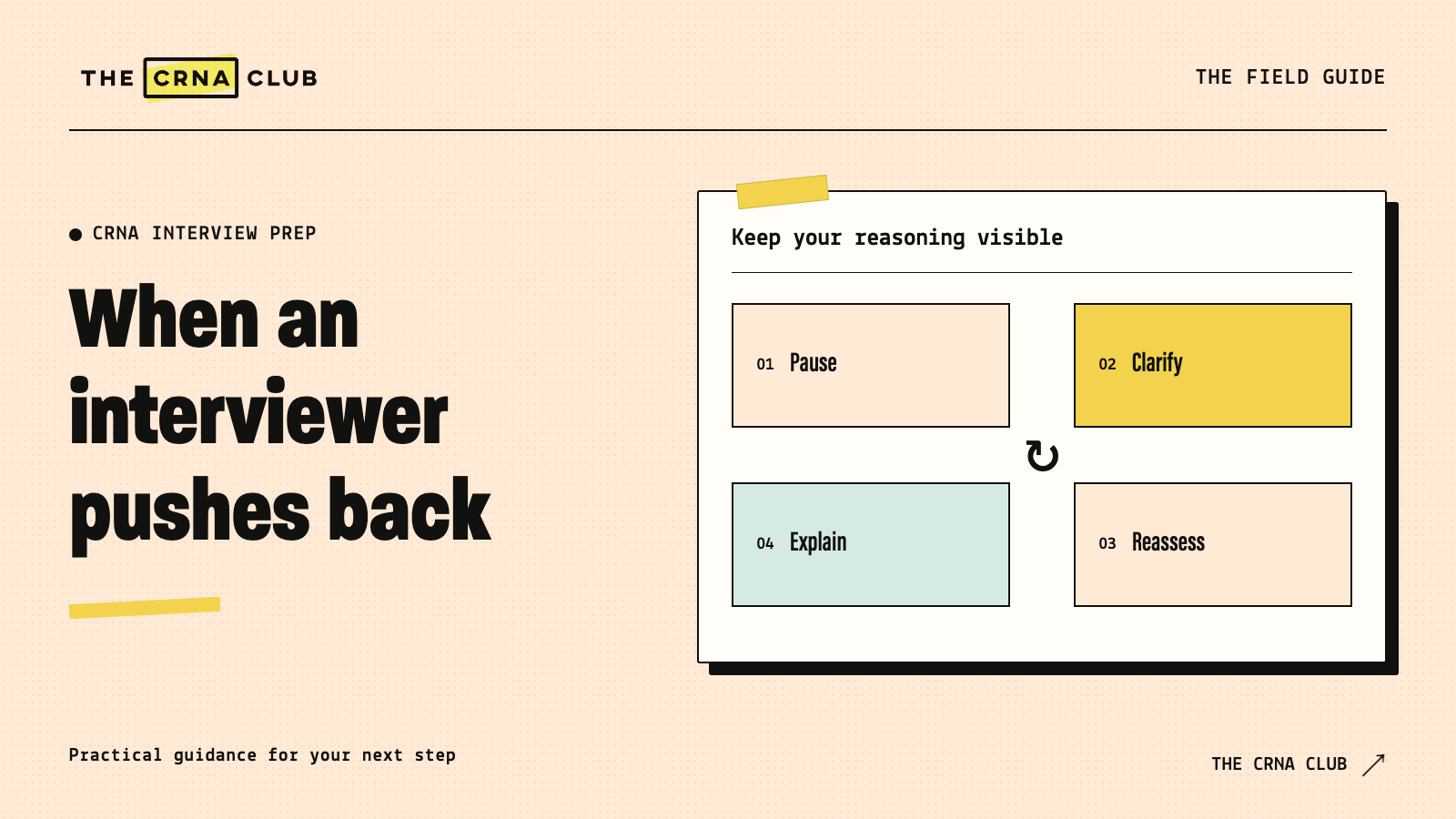
When a CRNA interviewer challenges your answer, listen to the specific concern, pause, and check whether you need to clarify, correct an error, or explain your reasoning. Don’t change an accurate answer solely because someone questions it, and don’t defend a mistake. Keep the conversation respectful and be precise about what you know.
You finish an answer, and the next question is, “Are you sure?” That can feel very different from practicing alone. Maybe you want to change your answer immediately. Maybe you want to keep talking until the other person looks satisfied.
We recommend our Emotional Intelligence and faculty interview lessons for working on this moment. Use our Mock Interview Lab to find an explanation you want to improve, then practice the follow-up with a partner using the dialogues below. The seven-day trial includes those lessons and personalized study guides for reviewing weak topics after practice.
Does a challenging follow-up mean your answer was wrong?
A follow-up alone doesn’t establish that your answer was wrong or that the interviewer is trying to intimidate you. Respond to the content of the question. Identify whether new information changes your answer, whether a term needs clarification, or whether you’ve made a real error.
In our faculty interview lessons, you can see applicants practice explaining how they think and responding to feedback. We suggest watching for what changes between the first answer and the next attempt, then trying that improvement yourself.
Try separating what happened from what you inferred. “The interviewer asked how I knew the result” is an observation. “They thought I was lying” is an interpretation you may not be able to support. Responding to the first gives you something useful to do: explain your evidence or correct the claim.
Our guide to reasoning, rambling, and confidence helps with the broader habit of explaining your thought process. Here, we’re focusing on the moment when the next question challenges something you’ve already said.
What should you do in the first few seconds?
Let the interviewer finish, take a brief pause, and identify the point being questioned. If you don’t understand it, ask a short clarifying question. Then respond to that point. A pause gives you room to check your answer without filling the space with an unrelated explanation.
Useful clarification depends on the actual question. “Are you asking about my individual contribution or the project’s overall result?” can resolve a role question. “Would you like me to explain that step further?” can help when the requested depth is unclear.
Avoid asking for clarification when you’ve already understood a specific correction. If you said the wrong unit, correct the unit. If you overstated your role, fix the description. You don’t need to make the interviewer repeat a clear concern while you search for a way around it.
MIT’s interview primer recommends practice, feedback, and maintaining a professional conversation. You can use a practice partner to rehearse this small pause and response. It becomes easier to assess your actual words when you’re practicing a specific interaction rather than just hoping to feel more confident.
How do you respond when you realize you made an error?
Name the specific error and correct it clearly. If the correction changes the rest of your explanation, update that part too. If you can’t verify the correct information from what you know, acknowledge the limit. Avoid replacing the original error with a second confident guess.
Here’s an original fictional practice dialogue about a project:
Applicant: “I led the entire education project.”
Interviewer: “What did you personally lead?”
Applicant: “I need to correct how I described that. I created the teaching handout and presented it. Our educator led the overall project.”
That correction is specific. The applicant doesn’t need a long speech about why the wording happened. They can continue by explaining their actual contribution and what they learned from it.
For a clinical fact, the same principle applies: identify the exact correction rather than talking around it. If you don’t know the missing fact, say so. Our guide to answering when you don’t know covers how to state a knowledge boundary without bluffing.
Practice that short correction out loud. You want it to feel familiar before you need it.
How do you hold an accurate answer without becoming argumentative?
Recheck your reasoning, state the basis for your answer, and leave room for clarification or new information. Explain why you believe the answer is accurate, and listen for any new information in the follow-up.
Consider another fictional dialogue:
Interviewer: “You said you coordinated the teaching sessions. Were you responsible for all of the educational content?”
Applicant: “No. I coordinated the schedule and helped present one session. The educator developed the content. When I say coordinated, I’m referring to the scheduling and communication.”
The applicant can maintain the accurate part of the original description while narrowing what the wording means. They don’t have to abandon their contribution or expand it beyond the facts.
Our Emotional Intelligence lesson emphasizes listening, self-awareness, and responding constructively under stress. Those skills can help you notice an urge to argue without acting on it. They don’t require agreeing with every statement or minimizing an accurate contribution.
AACN’s skilled communication standard emphasizes listening, relevant perspectives, and respectful information sharing. That’s a professional communication standard, rather than an admissions scoring rule. It provides a useful foundation for practicing how you explain a disagreement.
What if the follow-up contains a mistaken assumption?
Correct the relevant premise briefly and respectfully before answering the larger question. Identify what you actually said or did, then address the concern that remains. Avoid spending the entire response arguing about how the misunderstanding occurred.
Here’s a third fictional example:
Interviewer: “Why did you leave that volunteer role after only one event?”
Applicant: “The resume lists the first event date, but I continued volunteering monthly afterward. I can clarify the dates. The reason I chose that organization was…”
The applicant corrects the timeline, then answers the underlying question about the commitment. If the submitted dates were unclear, they can acknowledge that too. A clarification doesn’t need to assign blame to the reader.
The same approach helps when a question assumes independent experience you didn’t claim. Explain whether you observed, assisted, or performed the responsibility within your role. Don’t accept an inflated description simply because correcting it feels awkward.
These dialogues are original practice examples. They aren’t reports of real school questions or advice to rehearse someone else’s experience. Use your own facts and choose language you would naturally say.
How can a partner help you practice follow-ups?
Give your partner one answer to listen to and one kind of follow-up to ask. Practice clarification, correction, and explanation in separate rounds before mixing them. Your partner should help you evaluate the response, rather than trying to imitate a hostile committee or inventing clinical facts to confuse you.
Start with a professional experience that doesn’t involve private information. Answer a simple question about your contribution. Your partner can then ask, “Which part was yours?” or “What supports that result?” You should be able to answer from the actual experience.
For a technical topic, agree on a trusted source before practicing. If your partner challenges a factual point, check it together afterward. Don’t turn the exercise into a contest where the most confident person decides what is correct.
Ask your partner to notice three things: whether you heard the question, whether your correction or explanation was specific, and whether you stopped once the point was clear. Use our guide to mock interview feedback to turn those observations into a focused next practice task.
After a session in our Mock Interview Lab, choose one answer from the feedback for partner practice. If the explanation was unclear, ask your partner for a follow-up on that point. If the facts were wrong, review the topic in your study guide before you try the dialogue again.
What should you write down after a practice round?
Record the challenged point, whether the answer was accurate, what you said next, and the specific improvement you’ll practice. Keep your interpretation of the interaction separate from the factual check. “I felt uncertain” doesn’t necessarily mean the answer was wrong, and “I sounded confident” doesn’t establish accuracy.
Use this debrief worksheet:
- Challenged point: Write the exact claim or step.
- Factual check: Mark correct, incorrect, unclear or needs verification.
- Your response: Note whether you clarified, corrected, explained or guessed.
- What needs work: Identify knowledge, wording, role boundaries or listening.
- Next task: Choose one concrete review or practice action.
If your response was accurate but confusing, practice a shorter explanation. If your facts were wrong, study before repeating the answer. If you kept interrupting, practice listening through the whole follow-up. Those are different problems with different next steps.
Our Final Thoughts
Practice one correction and one explanation with a partner. Ask whether you answered the challenged point, kept the facts accurate and stopped once the concern was clear.
Take the Next Step
Try our free mock interview, then bring one answer and the debrief sheet to a partner session. The free entry includes one lifetime interview. For more practice, personalized study guides and the EQ lessons, explore the seven-day trial.