Should You Apply Early or Wait for Your CCRN, Course Grade or Recommendation?
Sachi, CRNA
CRNA
In This Article (10 sections)
- What must be finished before this school considers your application?
- How do you separate a missing requirement from an optional improvement?
- Should you wait for your CCRN result?
- Should you wait for a stronger final course grade?
- Can you submit while a recommendation is pending?
- How does rolling admission affect the choice?
- What should a submit-versus-wait decision table look like?
- When are you waiting because the application still needs work?
- Our Final Thoughts
- Take the Next Step
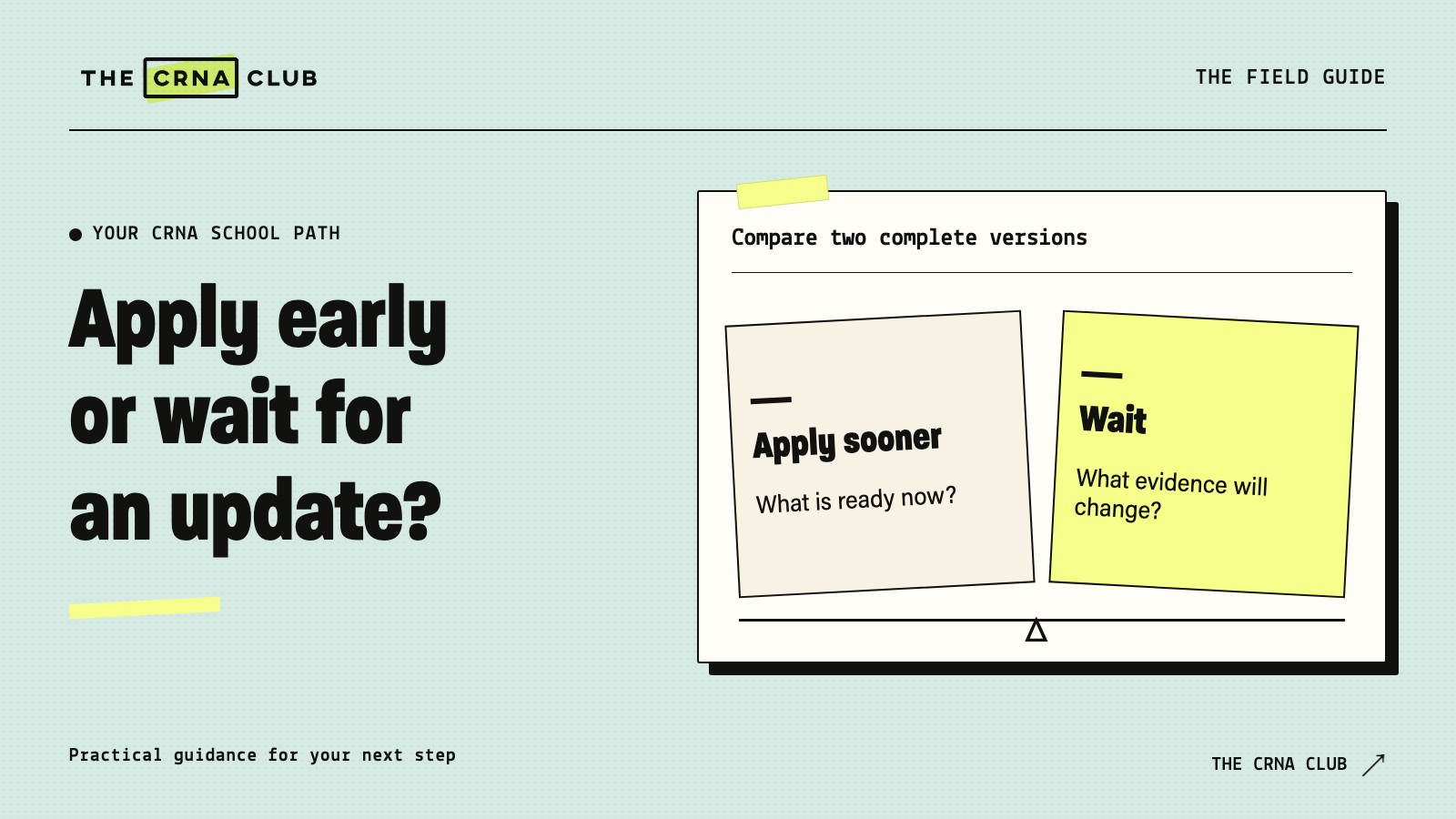
Apply early when you already meet the program’s requirements and can submit a complete, accurate application. Wait for a CCRN result, course grade or reference when that item is required before the school will consider your file. If the school allows it later, compare the benefit of waiting with the program’s actual review schedule.
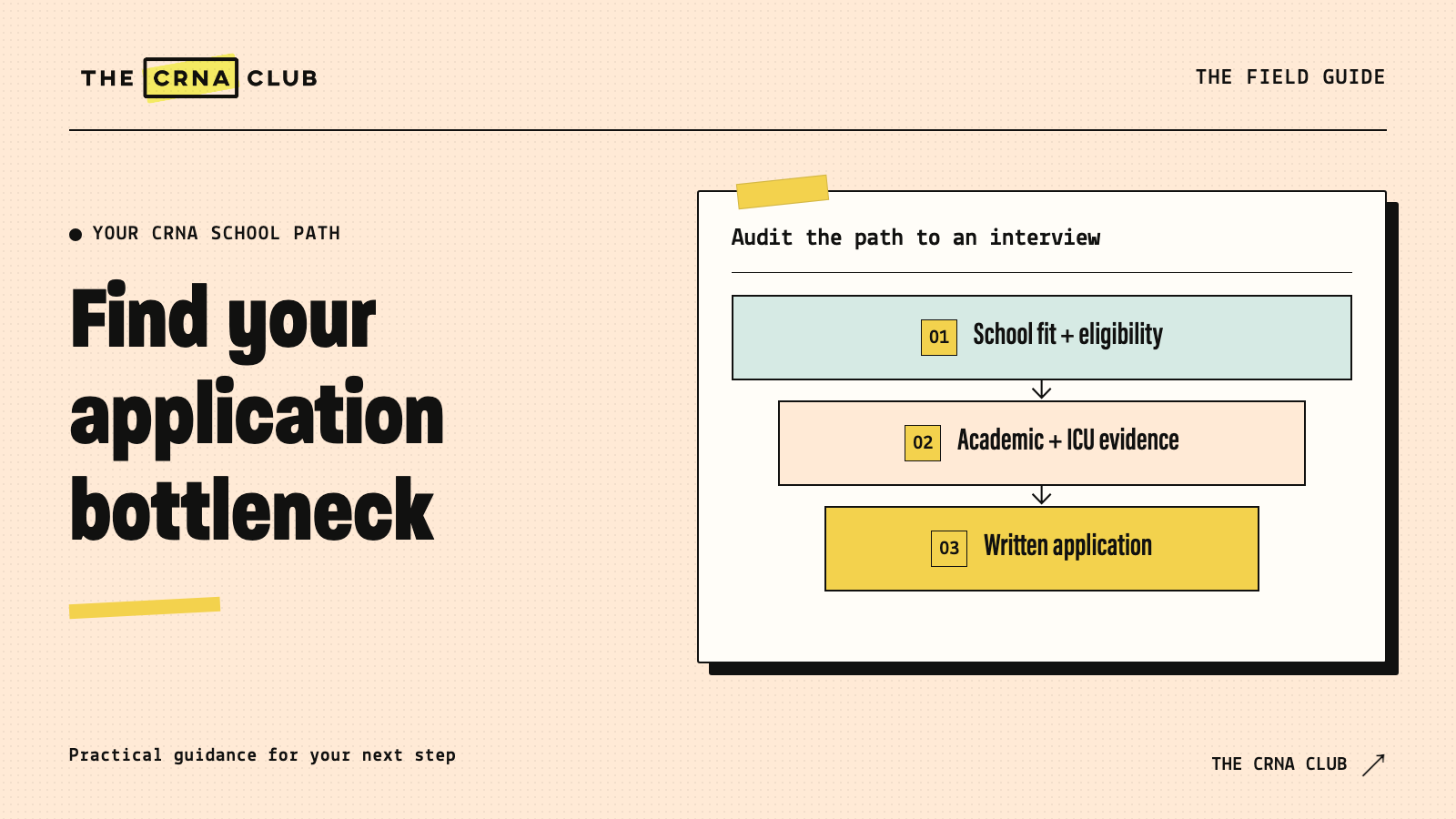
The question feels simple: submit now or make the application stronger first? But three different situations get mixed together. You might be missing an eligibility requirement, waiting for evidence the program permits later or trying to add an optional accomplishment.
We suggest working through this with your school’s checklist and our Application Timeline open. Put the required item beside the date it must be done, then compare that with your exam or course finish date. You can try those planning tools with the seven-day trial. You’ll have a concrete timing question to answer instead of a vague feeling that you should apply sooner.
What must be finished before this school considers your application?
Identify the required completion point for each item: application submission, file review, interview, admission or matriculation. Copy the actual wording rather than assuming every credential and course has the same deadline. Then check which application status the school requires, including any supplemental portal or verification requirement.
The timing can differ even within one program. Duke’s nurse anesthesia admission page states that its graduate research methods or inferential statistics requirement can be completed after application submission. That specific allowance doesn’t tell you whether another school permits an unfinished course.
Certification rules differ too. Johns Hopkins’ nurse anesthesia requirements require CCRN at application. If that’s the published requirement for your program, an exam booked for next month isn’t the same as having the credential today.
Once you have the answer, keep it with that saved school. Recheck it if the program updates the cycle’s instructions. Our deadline dependency guide helps you organize the work backward from the required status.
How do you separate a missing requirement from an optional improvement?
A missing requirement affects whether the application meets the school’s stated rules. An optional improvement adds evidence without necessarily changing eligibility. Mark those items separately before deciding to wait. Otherwise you can spend weeks adding an optional activity while an actual course or reference problem remains unresolved.
Try this worksheet using your own program’s language:
- CCRN exam next month: Find whether it is required or preferred, and when. Ask whether proof is accepted after submission.
- Final course grade pending: Find the course and minimum-grade deadline. Ask whether in-progress work is eligible for review.
- Reference accepted but incomplete: Check the required file status by the deadline. Ask whether review can begin before that reference is complete.
- Optional leadership project: Check whether updates are accepted and whether waiting would add useful evidence.
Don’t label an item optional because you don’t have time to finish it. Use the published rule. If the wording is unclear, ask a focused question before spending money on an application or exam date you hope will fit.
Should you wait for your CCRN result?
Wait when the program requires CCRN before application or review and you haven’t earned it. When it is preferred or permitted later, ask how the school handles pending certification and updates. Then weigh the actual review schedule against your realistic exam readiness. Don’t rush an exam simply to put a date in the application.
Consider two hypothetical nurses, both testing in six weeks.
Nurse A wants to apply to a program requiring CCRN at submission. The application stays open long enough to allow the result. Her plan is to finish the application materials now and submit after she earns the credential, within the school’s deadline.
Nurse B’s target program prefers CCRN and explicitly accepts a later update. The school reviews completed applications throughout the open period. She can ask how to report the pending exam and decide whether the rest of her evidence supports submitting now.
The credential is the same. The policy changes the timing decision. You don’t need a universal rule about which nurse is more motivated.
Should you wait for a stronger final course grade?
First determine whether the course is required and whether the final grade must be available for review. If the school accepts an in-progress course, consider what the pending grade would add and whether the program accepts academic updates after submission. Keep your expected grade clearly separate from a grade you have actually earned.
Suppose you’re taking graduate pathophysiology to demonstrate recent academic work. The course ends in December, and your target application has an October priority date. An A would be useful evidence, but it isn’t a completed A in October.
Ask whether the program will review an in-progress course and receive the final transcript later. If it won’t update reviewed files, your choice differs from a school that considers the new grade before a later interview round.
Don’t estimate your final GPA using an unearned grade and present that number as current. You can plan scenarios privately, but the application needs accurate completed coursework and correctly labeled work in progress.
For the academic decision itself, use the science retake guide. A course chosen to address a real academic gap deserves a different conversation from one added mainly to delay the discomfort of submitting.
Can you submit while a recommendation is pending?
A platform can allow submission before every reference arrives, while the school still requires a complete file by a particular date. Check both rules and the status shown for each evaluator. Submitting your portion doesn’t remove the need to get the required references completed on time or make the file ready for faculty review.
If your supervisor accepted the request yesterday, confirm the agreed date and correct portal. Don’t select an ineligible replacement because you want a faster checkbox.
A missing reference is also different from an evaluator who cannot complete the request at all. The first might need a reminder or technical support. The second calls for a new eligible evaluator or the program’s alternative process.
Our NursingCAS checklist explains why application statuses matter. For this decision, write down the date the whole required file is likely to be ready, not only the day you can click submit.
How does rolling admission affect the choice?
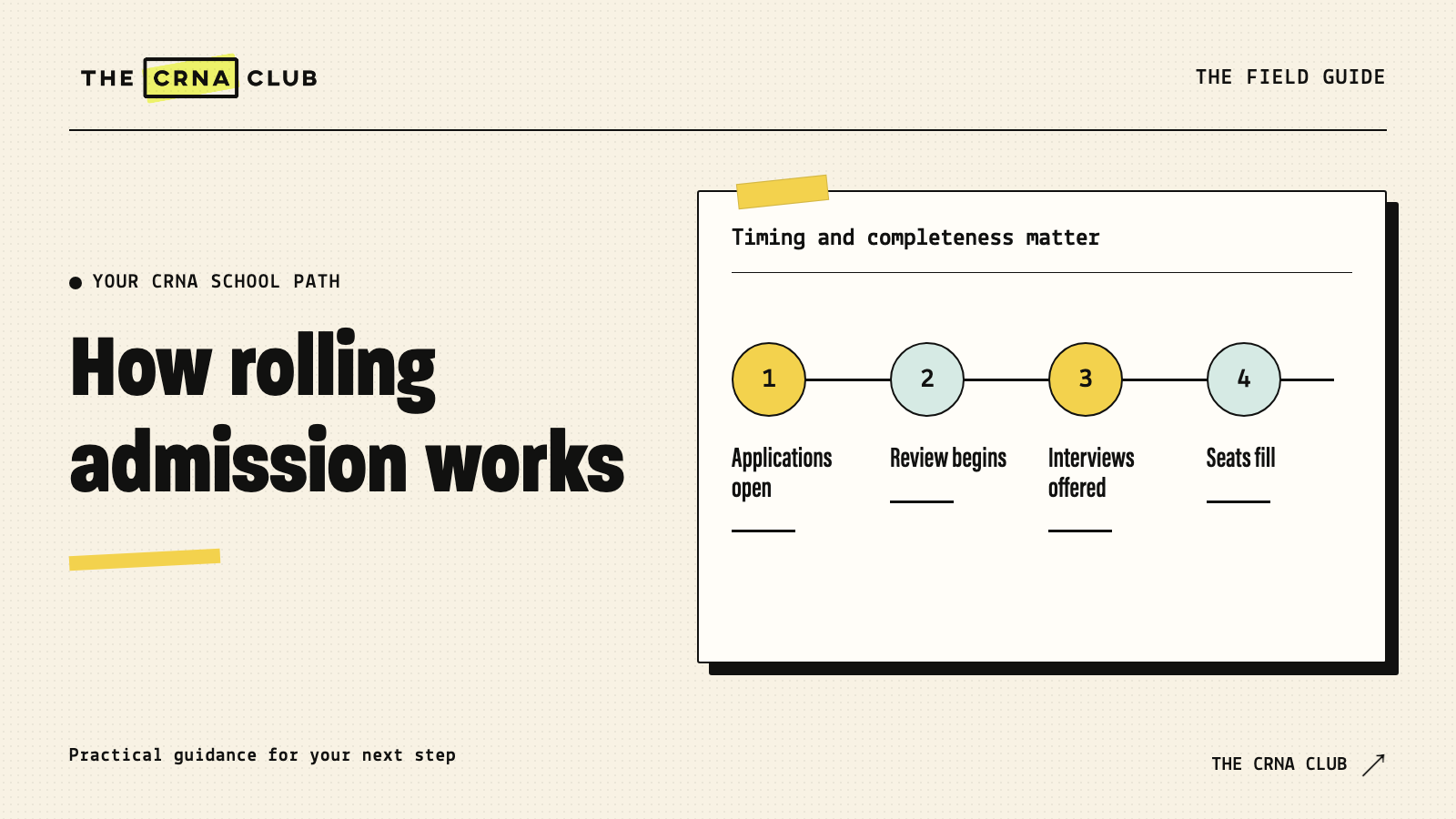
Find out when the program reviews files, selects interviews and offers seats. A process that makes offers during an open period gives you a different timing trade-off from one that reviews everyone after closing. “Rolling” alone doesn’t tell you which event happens early or whether your pending item is acceptable.
USF’s nurse anesthesiology application timeline separates priority consideration, application closing and a later verification deadline for its stated entry cycle. That kind of detail is what you need before deciding whether another week changes your place in the process.
Build a personal target date early enough to fix errors and missing materials. That’s different from treating opening day as an obligation to submit. You can be purposeful about timing while still giving your essay and data entry a real accuracy check.
What should a submit-versus-wait decision table look like?
Write down the school’s rule, when you expect to finish the item, and what waiting would change. Then choose your next action. Revisit it when a school answers your question or your expected completion date changes.
| Situation | Working decision | Next action |
|---|---|---|
| Required credential missing before submission | Wait until earned, within the permitted window | Finish the rest of the application and protect the exam preparation plan |
| Course allowed in progress, final grade accepted later | Consider submitting when the remaining file is ready | Confirm how and when to send the final grade |
| Required reference pending | Follow the school’s submission and completion rules | Check the request and agreed date |
| Optional accomplishment finishes after an early review round | Decide whether the added evidence justifies the delay | Ask whether updates are accepted after submission |
These are planning examples. A program’s actual instructions decide whether the working choice applies to you.
When are you waiting because the application still needs work?
Check whether your remaining work would change what a reviewer can understand about you. A generic essay, inaccurate employment dates or an unresolved reference role deserves attention. Repeatedly changing a polished sentence because submitting feels scary has a different purpose. Give yourself a final check and a date to finish it.
Ask a reader to check whether you answered the prompt, supported your claims and explained why the particular program fits your goals. Review the application fields for consistency with your resume and transcripts.
Then decide. You can continue developing clinically and academically after a truthful, well-prepared application is submitted. You don’t need to invent a state of perfect readiness before applying, and you shouldn’t ignore a real requirement because you want the process started.
Our Final Thoughts
Write down what you’re waiting for and when that school requires it. That gives you a concrete submit-or-wait decision instead of another week spent wondering whether your application is ready.
Take the Next Step
Open the checklist for your next school and mark what’s truly holding up submission. We recommend our Application Timeline to place that task beside your course, certification and school dates. Explore the planning tools with the seven-day trial. If you’re still building your first plan, use our 9-Step Applicant Checklist.