What Basic Chemistry Should You Review for a CRNA Interview?
Sachi, CRNA
CRNA
In This Article (8 sections)
- What should you review first if you feel rusty?
- How should you explain amount and concentration?
- What does pH tell you, and why does direction matter?
- What’s the difference between a weak acid and a weak base?
- How do pH and pKa help you discuss ionization?
- How can you turn this review into spoken practice?
- Our Final Thoughts
- Take the Next Step
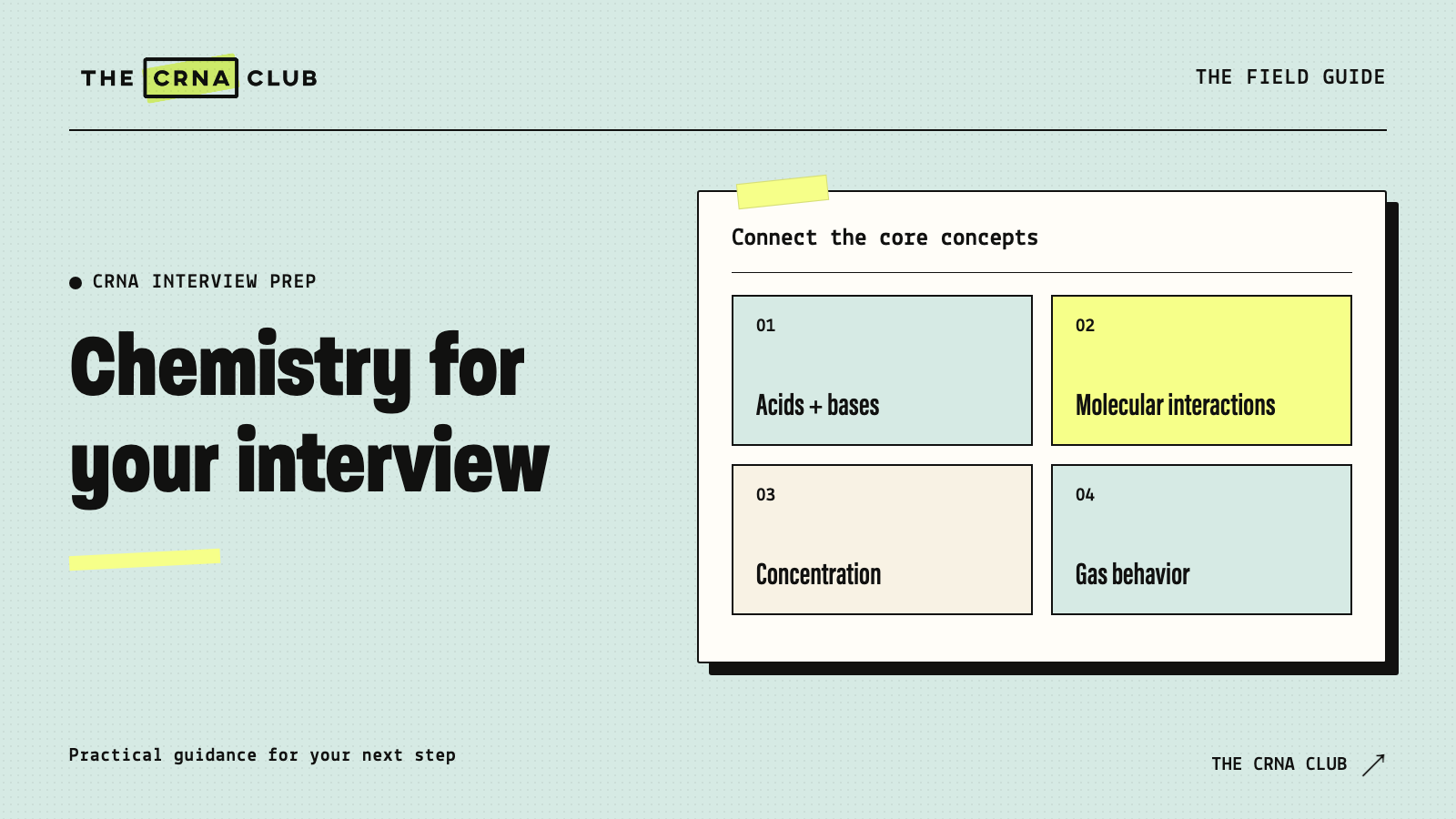
For a CRNA interview, start your chemistry review with concentration and units, pH, weak acids and bases, and the relationship between pH and ionization. Practice explaining the ideas and solving simple examples. Check your school’s instructions for any additional topics to prepare.
If chemistry has been sitting in the back of your brain since your prerequisites, you may remember the vocabulary before you remember how to use it. You recognize “pKa,” but someone asks how it’s different from pH and suddenly the explanation gets blurry.
We recommend our Introduction to Drug Ionization lesson if pH and pKa are the confusing part. Pair it with spoken practice in our Mock Interview Lab so you can hear whether your explanation makes sense without the notes. Explore the lesson and interview tools with the seven-day trial.
What should you review first if you feel rusty?
Begin with a short diagnostic: explain concentration, describe what a lower pH means, and distinguish a weak acid from its conjugate base. Then identify which answers need a factual review and which need speaking practice. Familiar vocabulary alone isn’t enough to show that you can use the concept.
Try answering these questions before you read further:
- What’s the difference between an amount and a concentration?
- If the amount of solute stays the same and final solution volume increases, what happens to concentration?
- Does lower pH mean more or less hydrogen ion activity?
- What information do you need before predicting a weak drug’s ionization?
Don’t score yourself based on speed. Write “can explain,” “can calculate but can’t explain,” or “need to review” beside each response. Those notes will help you choose a focused study task.
For clinical application questions, our pathophysiology interview guide covers a different part of your preparation. Choose the concept you couldn’t explain before adding another topic.
How should you explain amount and concentration?
An amount describes how much of something is present. A concentration describes that amount relative to a specified quantity of solution. State the units before calculating. A number in moles answers a different question from a number in moles per liter, even if the arithmetic looks similar.
OpenStax’s molarity chapter defines molarity as moles of solute per liter of solution. Notice the denominator is final solution volume. “Added to half a liter of solvent” and “made into half a liter of solution” don’t automatically describe the same final volume.
Here’s an original classroom example, unrelated to medication preparation. A fictional solution contains 0.20 mol of solute in a final volume of 0.50 L. Its molarity is 0.20 mol divided by 0.50 L, or 0.40 mol/L.
Now explain it without the formula: “The solution has four-tenths of a mole per liter. The half-liter sample contains two-tenths of a mole.” That second sentence checks whether you understand the relationship instead of simply recognizing a division problem.
If the same amount of solute is diluted to a final volume of 1.0 L, the concentration becomes 0.20 mol/L. The amount hasn’t doubled or disappeared. It is distributed across a larger final volume. Keep real medication preparation separate from this classroom exercise and follow actual product information and clinical processes.
What does pH tell you, and why does direction matter?
For introductory aqueous chemistry, pH expresses hydrogen ion activity on a logarithmic scale, commonly approximated using hydronium concentration in dilute solutions. A lower pH corresponds to greater hydrogen ion activity. The scale isn’t linear, so a one-unit difference doesn’t mean a one-unit change in concentration.
The OpenStax explanation of pH uses the familiar introductory relation, pH equals the negative base-ten logarithm of hydronium concentration. The negative sign is why the direction can feel backward when you first return to chemistry.
Use a simple comparison. In the introductory concentration approximation, a solution at pH 6 has ten times the hydronium concentration of a solution at pH 7. We’re using simple classroom solutions for this comparison.
Practice saying the direction before calculating anything: “Lower pH, greater hydrogen ion activity.” Then explain why a logarithmic change differs from adding the same concentration each time. If you can recite a formula but consistently reverse the direction, work on that relationship first.
This foundation can support your later ABG interview review. An ABG interpretation requires additional information and physiology. A single chemistry relationship doesn’t replace the full assessment.
What’s the difference between a weak acid and a weak base?
In a proton-transfer description, an acid donates a proton and a base accepts one. Weak acids and bases participate in reversible equilibria rather than being described as completely ionized in the introductory model. “Weak” refers to this chemical behavior, rather than a judgment about a medication’s clinical strength.
OpenStax’s acid and base chapter explains ionization constants and conjugate pairs. For a simple neutral weak acid written as HA, loss of a proton produces A⁻. For a simple neutral weak base written as B, gaining a proton produces BH⁺.
Read those symbols as a description of a change. HA and A⁻ are related forms. B and BH⁺ are another pair. Don’t memorize “acid equals charged” or “base equals uncharged” as a universal rule. First identify which form you’re discussing.
Write each pair on a blank page, add the proton-transfer direction, and identify the charge on each form. That’s a small task, but it exposes a common learning gap: remembering a table without understanding which form gained or lost the proton.
How do pH and pKa help you discuss ionization?
Identify the compound as a weak acid or base, identify the relevant pKa, and compare it with the surrounding pH. For a simple system with one relevant ionizable group, that comparison helps determine the relative proportions of the two forms. Don’t apply a one-group shortcut to every complex molecule.
In our Introduction to Drug Ionization lesson, we work through the type of compound, its pKa and the surrounding pH. We recommend learning that sequence before memorizing which form predominates. You’ll have a reason for the answer when the values change.
For a simple neutral weak acid HA, a pH above the relevant pKa favors A⁻ relative to HA. For a simple neutral weak base B, a pH below the pKa of BH⁺ favors BH⁺ relative to B. At equality, the paired forms are present in equal proportions in the usual introductory model.
Try a directional exercise with a fictional neutral weak base whose conjugate acid has a relevant pKa of 8. At pH 7, the protonated form predominates. If the environment moves above that pKa, the balance favors the unprotonated form. These are invented study values, not a real drug label.
What can you conclude? You can discuss the relative forms within the model. You can’t jump from that fact alone to a precise onset time, dose, or whole-body distribution. Keep the explanation within what the information supports.
How can you turn this review into spoken practice?
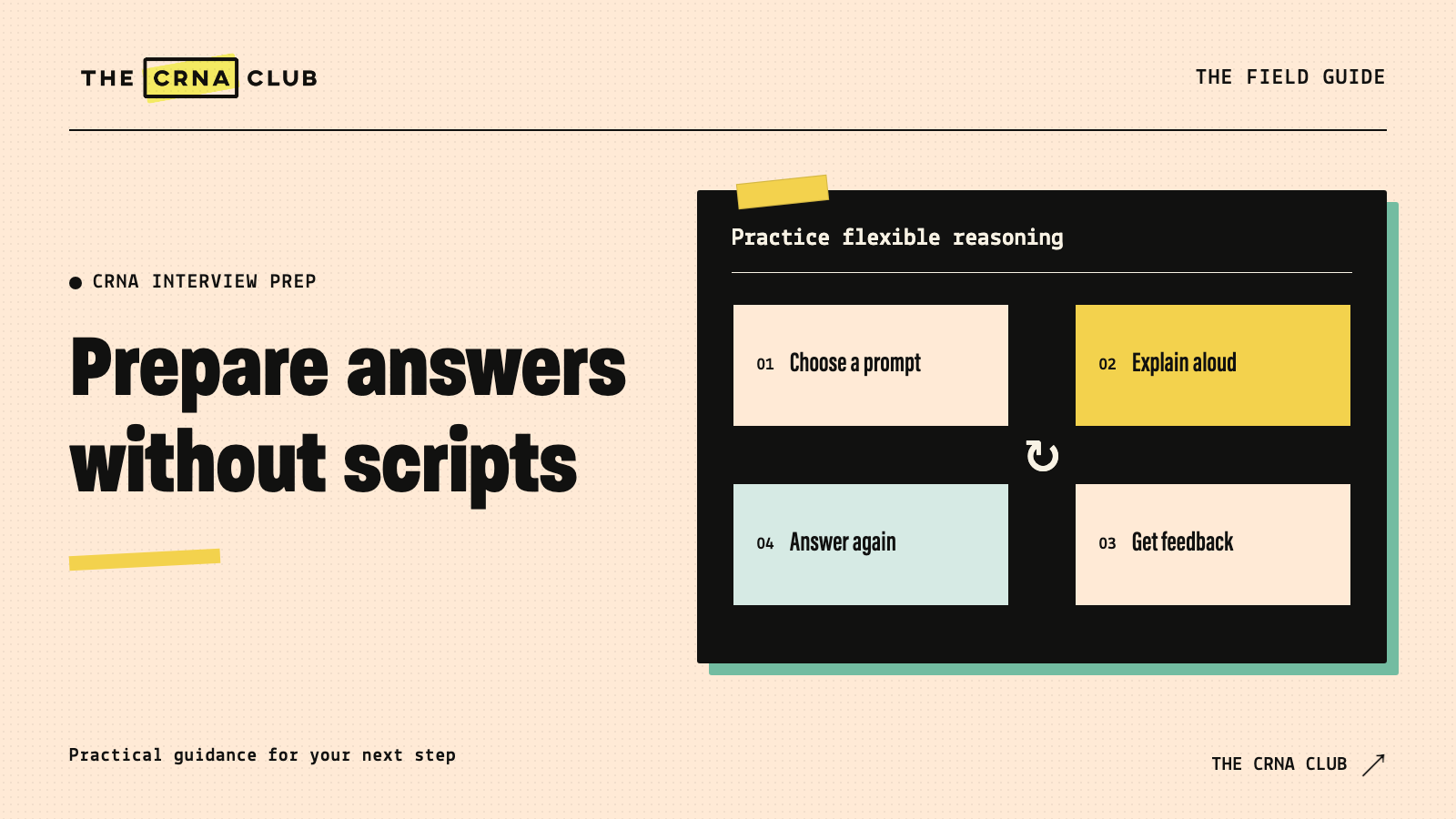
For each concept, prepare a definition, one worked example, and one limit on what you can conclude. Answer without looking, check the result, and repeat it in different words. This helps you find whether the problem is the underlying chemistry or the way you’re organizing your answer.
Here’s a small study sheet you can make yourself:
| Concept | My explanation | My check |
|---|---|---|
| Concentration | Amount relative to solution quantity | Did I give the denominator and units? |
| pH | Logarithmic description of hydrogen ion activity | Did I get the direction right? |
| Conjugate pair | Related forms differing by a proton | Did I identify the charge on each form? |
| Ionization | Relative proportions under stated conditions | Did I identify the system and relevant pKa? |
Choose one row per session if your time is limited. Write your own example, solve it, and ask a partner to change one condition. A different volume or a pH on the other side of pKa can reveal whether you understood the relationship or remembered the first answer.
After the lesson, try explaining the relationship in a mock interview. Review the saved feedback; with trial or membership access, use the personalized study guide too. Decide whether you need more chemistry review or another spoken attempt. That gives you a specific next step instead of “study more chemistry.”
Before your next session, keep the original answer beside the corrected version. Underline the exact change: perhaps the denominator was missing, or you named the wrong conjugate form. That makes your progress visible and gives your practice partner something specific to check when you explain the concept again.
Our Final Thoughts
Pick the diagnostic question you couldn’t explain and work through its example aloud. Keep the units and direction correct, then ask someone to change one condition and try again.
Take the Next Step
Complete the four-question diagnostic and choose your first review topic. For guided foundations and help connecting them to interview preparation, explore the learning library through the seven-day trial.