You Are Not Getting CRNA Interviews: How Do You Find the Application Bottleneck?
Sachi, CRNA
CRNA
In This Article (10 sections)
- Did every application become complete and eligible for review?
- Which stage are you trying to improve?
- Does your GPA meet the school’s actual calculation and threshold?
- Is the school list compatible with your actual experience?
- Does the file show what your accomplishments actually involved?
- Did the personal statement answer the specific prompt?
- How do you choose an improvement when the cause is unknown?
- Should you ask the programs for feedback?
- Our Final Thoughts
- Take the Next Step
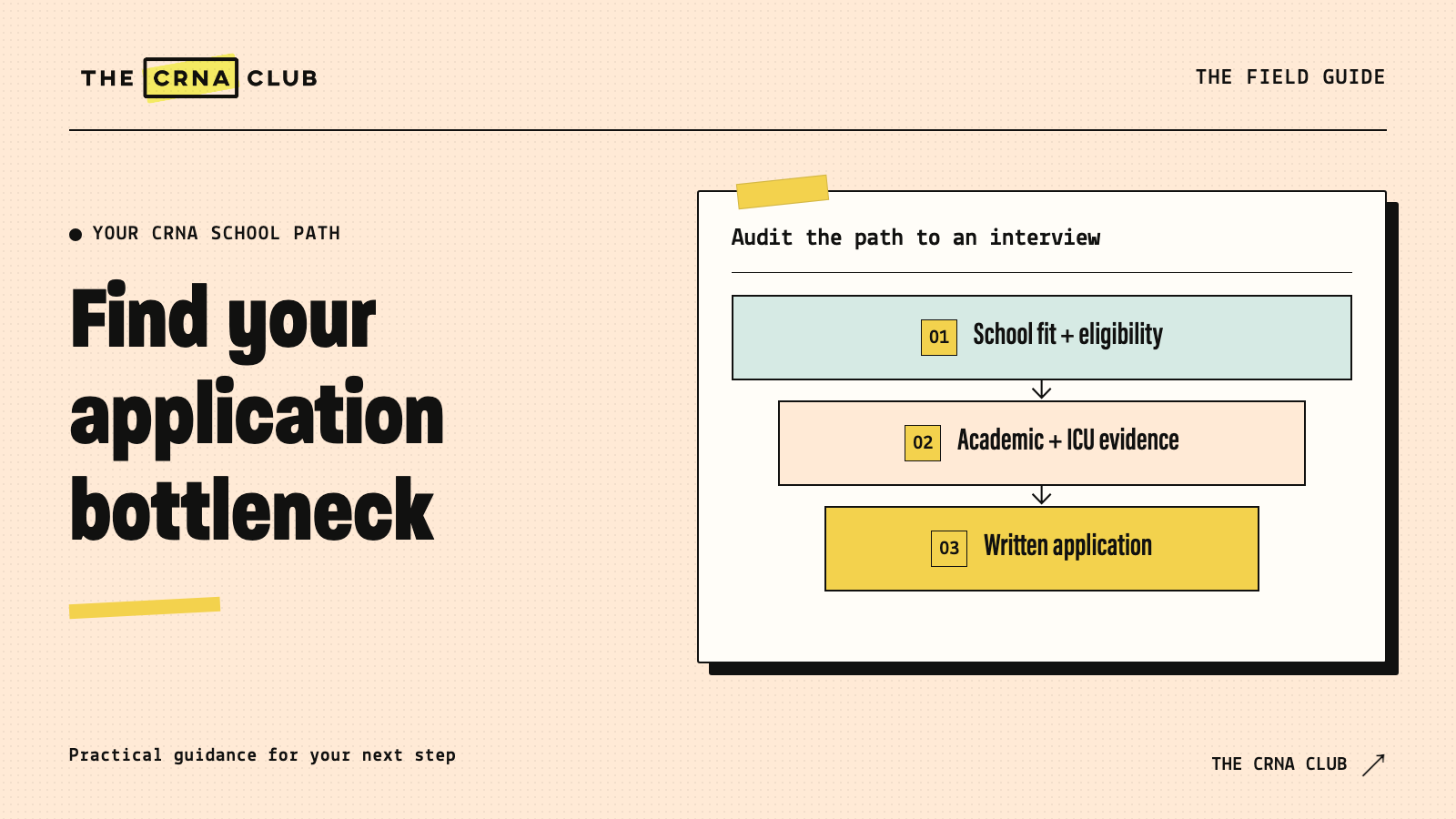
If you’re applying to CRNA schools and receiving no interviews, review where each application stopped before deciding what to improve. Check file completion and eligibility first, then examine school fit and how clearly your materials demonstrate preparation. Without program feedback, you can identify gaps and test explanations, but you can’t know the exact reason for a rejection.
It’s tempting to respond by adding something. Another certification. Another course. More shadowing hours. Those might be useful, but only if they address the problem your application actually has.
We’d start with your saved school checklists, then review the part of your file that needs a closer look. Our Transcript Analyzer helps you understand your GPA record, and Essay Critique helps you check whether your essay answers the school’s prompt. Explore those tools with the seven-day trial. They give you specific things to improve without pretending to know the committee’s rejection reason.
Did every application become complete and eligible for review?
Confirm the final status, supporting materials and program-specific requirements for each school. Look for a missing supplement, late reference, unverified transcript or unmet course rule before treating the result as a judgment about your overall readiness. Submission and payment alone don’t prove the program had a reviewable file by its required date.
Marquette’s nurse anesthesia application guidance describes reviewing complete applications after its deadline. That makes completion a factual question you can check, rather than a concern you need to speculate about.
Open your saved application and compare it with that cycle’s instructions. Record what the portal actually showed. “I think my reference arrived” is unresolved. “The portal showed three required references complete before the deadline” is evidence.
Our NursingCAS application checklist helps you review the technical steps. If you find an administrative gap, fix the process that produced it before paying for another academic credential.
Which stage are you trying to improve?
Separate no interview, an interview without admission and a pending decision. The stage doesn’t prove the cause, but it helps you choose the right evidence to review. A pre-interview audit focuses on the submitted file and program match. A post-interview review also includes your spoken answers and demonstrated reasoning.
Use one line per application:
| Program | Final known stage | What you know | What remains unknown |
|---|---|---|---|
| School A, hypothetical | Incomplete file | One required reference arrived late | Whether an on-time file would have been selected |
| School B, hypothetical | Complete, no interview | All required materials received | Which factors affected selection |
| School C, hypothetical | Interview, no offer | Interview occurred | How file and interview were weighed |
| School D, hypothetical | Pending | File complete, review ongoing | Outcome and timing |
School A needs an earlier reference request and follow-up plan. School B needs a closer look at eligibility and how the record fits that program. School C also needs honest interview practice. School D needs the published timeline, not an early conclusion that it rejected you.
Don’t combine all four into “nobody wants me.” The facts don’t support that statement, and it won’t help you choose the next task.
Does your GPA meet the school’s actual calculation and threshold?
Compare the program’s required GPA types with your complete transcript record. A strong BSN GPA doesn’t automatically establish the same cumulative or science GPA. Check which courses, attempts and degrees the school includes, and whether a minimum is mandatory. Recent improvement is useful evidence, but it doesn’t silently waive a published rule.
A hypothetical nurse, Marcus, reports a 3.9 BSN GPA and assumes his academic record is the strongest part of every application. His earlier bachelor’s degree had lower grades. Two target schools assess a broader cumulative record, and one calculates a science set different from the courses Marcus included.
That doesn’t prove why he wasn’t interviewed. It tells him his self-assessment used the wrong inputs.
Marcus gathers every transcript and checks his numbers before choosing another course. We recommend our Transcript Analyzer for that first look at cumulative, science and recent-credit GPAs, then confirming each school’s calculation with the program. He can then distinguish a missing minimum, a recent-performance question and an overall GPA that changes slowly because it includes many credits.
Use our GPA types guide to organize that comparison. Don’t assume a high certification score replaces the academic requirements you’re checking.
Is the school list compatible with your actual experience?
Check whether each program accepts your ICU population, employment pattern, experience duration and recency. Then review course and degree requirements alongside those clinical rules. A broad list of schools creates more applications, but it doesn’t help if several programs don’t accept the record you’re submitting.
Duke’s nurse anesthesia page is an example of a program publishing specific current-experience requirements. Use the detailed requirements of your own schools, rather than a general statement that you have “enough ICU.”
Suppose you have substantial pediatric ICU experience. Your school list needs programs whose current policies accept that experience. The next useful action might be correcting the list rather than leaving a good job to pursue a unit label your target programs don’t require.
Location restrictions also matter. If you can apply only within a limited region, acknowledge the constraint. You can improve your application while still recognizing that fewer compatible options affect the plan. Don’t add schools you couldn’t attend merely to increase the application count.
Does the file show what your accomplishments actually involved?
Review whether a reader can understand your contribution, responsibility and development from the submitted materials. A title or device list provides limited context. Use accurate descriptions of what you did, what you learned and what changed, without inflating your role or including private patient information.
In our podcast on the four areas of an application, we discuss academic preparation, clinical experience, professional development and understanding of anesthesia. Use those areas to look at what you actually submitted. You’re finding work you can improve, not calculating an admission chance.
For example, “committee member” doesn’t explain your work. “Helped revise orientation materials and gathered staff feedback before the unit education rollout” identifies a contribution. If you attended meetings but didn’t lead the project, say that accurately.
The same applies to clinical exposure. “ECMO” could mean several different levels of responsibility. Describe your actual patient-care role rather than relying on the acronym to do the explaining.
Did the personal statement answer the specific prompt?
Read the prompt and your submitted statement side by side. Identify where you answered each part and where you supplied evidence. Then check whether the program-specific section explains a real fit or could be sent unchanged to any school. A polished essay can still leave the actual question partly unanswered.
Ask a reader to tell you what they learned about your motivation, preparation and understanding of the role. Don’t first explain what you meant. Their unaided response shows what the page communicates.
If the essay mostly repeats your resume, choose one relevant experience and explain the thinking behind it. If it spends most of the word limit defending old grades, check whether the program has a separate explanation field and whether the main statement still answers its prompt.
You don’t need a dramatic patient story. You need a truthful, specific answer in your own words. Use the personal statement guide to review the structure without inventing a new personality for the next cycle.
How do you choose an improvement when the cause is unknown?
Choose a gap you can verify, explain why the proposed action addresses it and define what completion will look like. Rank required-policy gaps first. Then consider improvements supported by actual feedback or weak evidence in the file. Keep uncertain explanations labeled as hypotheses rather than treating them as admissions facts.
A useful action log looks like this:
- Late reference: Use the portal timestamp to check what happened. Request earlier and set a specific follow-up date next cycle. Check that all required requests are complete before your target date.
- Unclear science calculation: Compare the course definitions, recalculate and clarify with the programs. Keep the documented program-specific GPA set.
- Generic fit paragraph: If the essay names only location and reputation, research the curriculum and connect it to your actual goals. A reader should be able to explain why the program fits.
- Unclear clinical role: If the resume lists acronyms without responsibilities, revise the descriptions. A reader should understand what you actually did.
Now you have a reason for the next thing you’re doing. You can still develop in several areas, but your next application should show what changed and why.
Should you ask the programs for feedback?
Yes, if the program permits feedback requests. Ask briefly and accept that some schools don’t provide individualized responses. A useful question identifies the application cycle and asks which areas would benefit from improvement. Don’t demand a comparison with other applicants or assume a delayed response confirms your preferred explanation.
If feedback is unavailable, continue with the evidence audit. You won’t reconstruct the committee’s discussion, but you can correct a missed rule, improve an unclear document or choose a better-matched school list.
Our Final Thoughts
Choose one gap you can point to in the submitted file. Fix it, record the change and then decide what else deserves your time. Another credential should have a clearer purpose than making the rejection feel less uncertain.
Take the Next Step
Pick one finding from your review and choose the tool that helps you work on it. Start with Transcript Analyzer for an unclear GPA record, Essay Critique for an essay that misses the prompt, or your saved-program checklist for unfinished requirements. Explore them with the seven-day trial, then put the next action on your plan.