Can You Leave the ICU After Applying to CRNA School?
Sachi, CRNA
CRNA
In This Article (11 sections)
- Does applying freeze your eligibility on the submission date?
- Which employment changes need clarification?
- How should you separate the application stages?
- What should your clarification email say?
- What if you are applying to several programs?
- Does changing ICUs reset all your experience?
- How should you update the application if your job changes?
- What if staying in the current job is no longer workable?
- How do you make a final employment timeline?
- Our Final Thoughts
- Take the Next Step
You should not assume you can leave the ICU after submitting a CRNA application. Check each program’s current-experience rules and any conditions that continue through review, admission or matriculation. Before changing roles, reducing hours or resigning, get a clear answer about the specific change you’re considering and when it would take effect.
Submitting the application feels like finishing a major task. But the clinical experience described in that file can still be part of an ongoing eligibility requirement. An offer can also include conditions you need to maintain before school starts.
We recommend keeping continued-employment rules with each saved school and putting the confirmed dates into our Application Timeline. Try the school-planning tools with the seven-day trial. You’ll have the rule and the program’s reply in front of you when you decide about changing jobs or hours.
Does applying freeze your eligibility on the submission date?
Don’t assume it does. A program can assess experience at submission and also set conditions for the period before enrollment. Review the admissions page, detailed FAQ and any decision letter. If they don’t explain how an employment change is handled, ask before treating your submitted record as the only requirement that matters.
The University of Toledo’s nurse anesthesia admissions page provides a concrete example: admitted candidates must continue direct critical-care employment until four weeks before matriculation. That is a specific program rule, not a national resignation date.
The University of Cincinnati’s nurse anesthesia requirements specify an experience window tied to the application deadline and advise current ICU work when applying. It illustrates another timing question to read directly rather than borrowing someone else’s program policy.
Use the rule for your actual entry cohort. A screenshot saved last year might not describe the process you’re entering now.
Which employment changes need clarification?
Ask about the actual change, not only whether you can “leave bedside.” Moving to another ICU, reducing to part-time, taking a non-ICU role and stopping work entirely can have different implications. Explain the setting, hours, dates and direct-care responsibilities so the program can answer the question you need resolved.
A short planning table helps:
| Proposed change | Information to provide | Question to ask |
|---|---|---|
| ICU-to-ICU transfer | New unit, population and start date | Does the new role meet the experience rule? |
| Full-time to part-time | Expected hours and responsibilities | Is this pattern accepted during review or before enrollment? |
| ICU to non-ICU role | Last ICU work date and new duties | Would the change affect eligibility or an admission condition? |
| Resignation before school | Intended last day and matriculation date | What continued-employment requirement applies? |
| Temporary leave | Dates and effect on clinical work | How does the program assess this interruption? |
You don’t need to disclose private medical details in an initial general inquiry about leave. Ask which office or process handles your circumstances.
How should you separate the application stages?
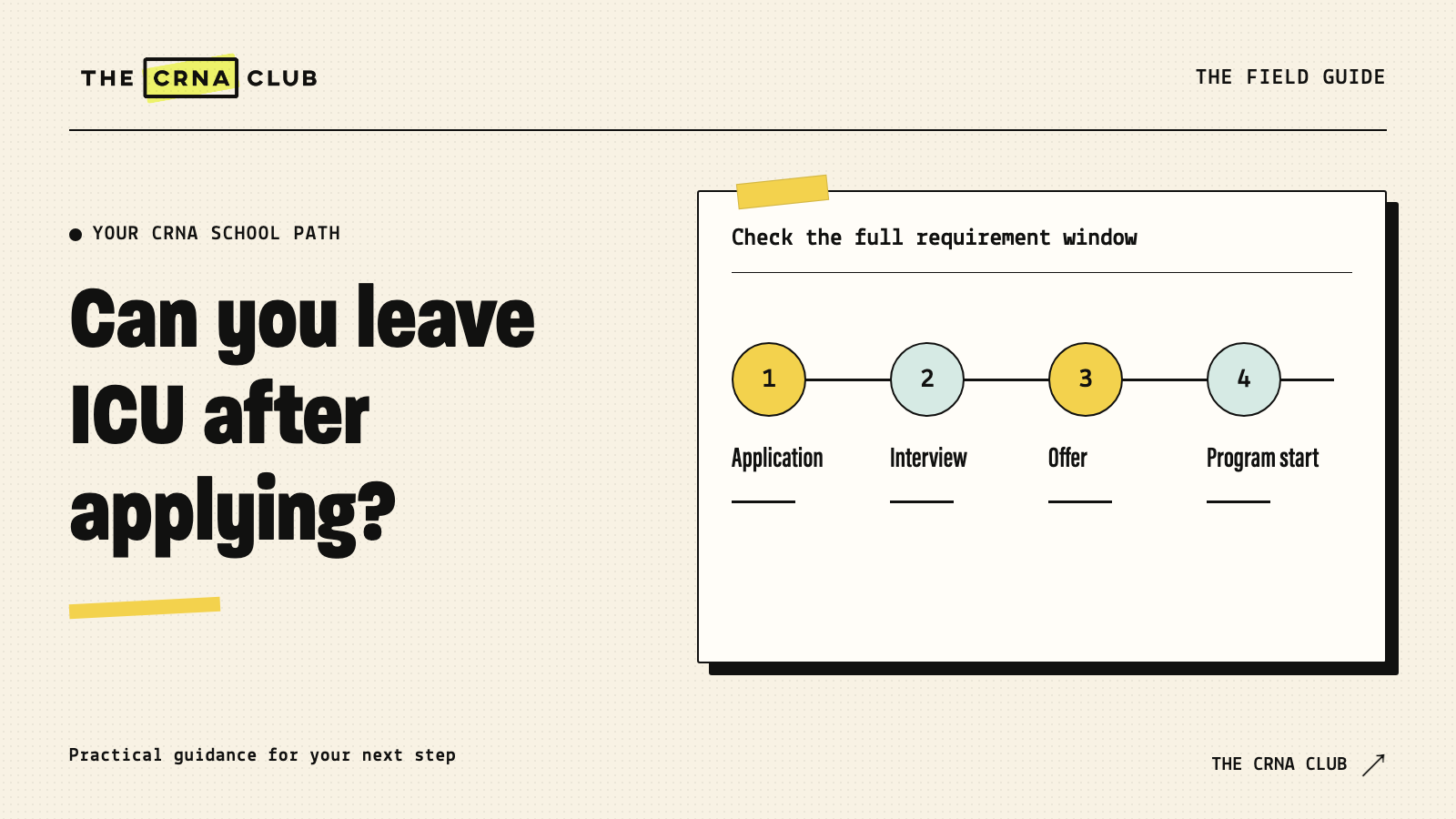
Track application, interview, admission and matriculation as separate points. At each stage, identify what the program has required and what it has confirmed about your proposed change. Check again when you receive an offer. It might include a condition you didn’t have at submission.
Consider hypothetical School A. It requires current full-time ICU work at application and provides further employment conditions with an offer. You don’t yet have that letter, so you need to ask about changes during review.
School B’s hypothetical policy requires employment until a stated interval before matriculation. If you apply many months before school starts, that ongoing rule still affects the plan.
School C describes recent experience but doesn’t address your proposed part-time transition. Silence leaves a question. It doesn’t establish permission or a prohibition.
A dated answer from the appropriate program contact helps you make a clearer decision. Save it with that school’s requirements rather than relying on your memory of a phone conversation.
What should your clarification email say?
Ask how the actual change affects eligibility or admission conditions. Give the program:
- Your application stage and intended entry cohort.
- The proposed role, hours and direct-care responsibilities.
- The dates the change would take effect.
- The specific requirement you need clarified.
You’re asking about its rules rather than asking it to choose your next job.
For example:
I applied for the 2028 entry cohort and currently work full-time in an adult medical ICU. I’m considering a change to a part-time role in the same unit beginning in January. Your page describes current critical-care experience, but I couldn’t find how reduced hours are treated while an application is under review. Would this change affect eligibility, interview consideration or any continuing requirement before matriculation?
If you already hold an offer, identify that and refer to the relevant condition. If your new role is another ICU, describe its population and responsibilities.
Don’t ask a broad question and then apply the answer to a different situation. Permission for a part-time role in the same ICU doesn’t necessarily cover leaving critical care entirely.
What if you are applying to several programs?
Check the change against every active application whose outcome you still want to preserve. One program’s answer doesn’t modify another school’s rule. Put the requirements and responses side by side, then decide whether the proposed work change fits all of them or changes which applications remain realistic options.
A hypothetical applicant, Rina, has three active files. School A accepts the proposed role change after reviewing the details. School B requires continued qualifying direct-care employment until a specified point. School C asks for more information about her hours.
Rina can now compare her options. She saves each reply under the relevant school in My Programs and adds the confirmed employment date to her timeline. She might adjust the timing, choose a different employment pattern or decide an application no longer fits her needs. What she shouldn’t do is use School A’s response as proof all three have approved the change.
Our application deadline planning guide helps organize the dates. Employment conditions deserve a place beside courses, credentials and supporting materials because they can affect what remains eligible.
Does changing ICUs reset all your experience?
There is no universal reset rule. Keep accurate dates for both roles and ask how the program evaluates duration, continuity, orientation and current responsibilities. A transfer can preserve relevant prior experience while changing what you are doing now. The actual effect depends on the school’s policy and the details of the transition.
Don’t assume a new orientation period counts the same way everywhere. Also don’t erase earlier experience from your resume simply because you changed hospitals.
If the new unit offers an experience you need, the change might have a clear clinical purpose. Our ICU job-change worksheet helps you compare that benefit with orientation, references and timing.
Before you make the change, ask whether you’ll still meet each school’s rule when it checks your experience.
How should you update the application if your job changes?
Follow the application service’s and program’s stated update instructions. Report the new role and dates accurately where updates are accepted or required. If an admission condition is affected, contact the program directly through its designated process. A change in one profile field doesn’t prove the relevant office has reviewed or approved the situation.
Keep your resume, employment entries and interview explanation consistent. You can say you transferred roles and explain why without overstating the experience you haven’t yet completed.
If the application becomes read-only, ask how to provide the update rather than trying to disguise the change in an unrelated field. Our NursingCAS checklist covers the broader submission and update questions.
What if staying in the current job is no longer workable?
Take the employment problem seriously and separate it from assumptions about admissions. A health, family or workplace issue can require a change even when it affects a school timeline. Learn the program’s options, then make a decision using your actual circumstances. You don’t need to pretend the application is the only factor.
Ask whether another qualifying role, reduced hours or an approved interruption is acceptable. If none fits, you might need to revise the application timeline. That’s a difficult trade-off, but it’s clearer than resigning on the assumption that submission ended every clinical requirement.
Use appropriate workplace and personal support for the underlying issue. A program can explain its rules, but it won’t have the whole picture of your employment needs.
How do you make a final employment timeline?
Start with the program’s required last point of qualifying employment, then add the employer’s notice process and the practical work of preparing for school. Keep those dates separate. A permitted departure date is not automatically the right personal date, and a desired break doesn’t override an ongoing admission condition.
Record the source of each requirement and the date it was checked. If you receive a revised offer or new program instruction, update the plan.
Our ICU experience guide can help you review the wider eligibility questions. For a work change, ask the program about your actual dates and responsibilities before changing work.
Our Final Thoughts
Before changing jobs or hours, send the school your proposed dates and responsibilities. Keep its answer with your offer conditions so your employment plan matches the requirements you still need to meet.
Take the Next Step
Open each active school’s requirements and write down the employment question you need answered. We recommend the saved-program notes and Application Timeline to keep the replies and dates organized. Explore them with our ICU experience lessons in the seven-day trial.