How Do You Choose Between ICU Job Offers Before CRNA School?
Sachi, CRNA
CRNA
In This Article (11 sections)
- What are the actual patients and responsibilities in each offer?
- What does orientation look like for you?
- When can you access advanced training and assignments?
- How can you compare the offers on one page?
- What would a real comparison change?
- What should you ask about the work environment?
- How should pay, commute and employment terms affect the decision?
- Should you tell the unit about your CRNA goal?
- What should you confirm before accepting?
- Our Final Thoughts
- Take the Next Step
Choose between ICU job offers by comparing the patient care you would actually learn, the orientation and support provided, and the path to more advanced assignments. Check whether the experience fits your target CRNA programs, then consider the work arrangement you can sustain. A unit name alone won’t tell you which offer will develop you well.
Two offers can both sound excellent. One says CVICU and lists several devices. The other is a mixed ICU with a detailed orientation plan and educators who can explain how new nurses progress. You want to know what happens after the job title goes on your badge.
We recommend our Preferred ICU Experience lessons before you compare the offers. They help you look past the unit name and ask about the patients, teaching and training you would actually get. Try the lessons with the seven-day trial, and keep your target schools’ experience requirements open beside the comparison.
What are the actual patients and responsibilities in each offer?
Ask about the unit’s usual patient population, the care that stays on the unit and the patients transferred elsewhere. Then ask which assignments a nurse at your experience level would receive. A unit can care for complex patients while assigning certain devices or roles only after additional training and demonstrated competence.
Your questions can be specific without demanding the sickest assignment immediately:
- What types of unstable patients do nurses routinely manage here?
- Which patients need mechanical ventilation, invasive monitoring or vasoactive support?
- What care is transferred to another unit or facility?
- How do new nurses progress toward more complex assignments?
- Which responsibilities belong to a separate specialty team?
If someone says, “We do ECMO,” ask what that means for the bedside nurse’s role and training pathway. The device appearing in the hospital doesn’t establish what you would do with it.
Our best-ICU overview explains the broader experience comparison. For an actual offer, the job-specific answers need to replace assumptions based on the unit label.
What does orientation look like for you?
Ask how orientation is tailored to your experience, who teaches you and how readiness for independent assignments is assessed. Find out what happens when you need more time or a different teaching approach. A stated number of orientation weeks is useful, but the support and assessment within those weeks matter too.
AACN’s nurse educator resources emphasize identifying learning gaps and assessing readiness during critical-care orientation. That supports asking about the process behind the calendar rather than choosing whichever offer lists the shortest or longest orientation.
Ask whether you’ll have consistent preceptors, scheduled progress meetings and protected education time. If several preceptors rotate, find out how they communicate your goals and progress.
A useful follow-up is, “When an orientee is struggling with prioritization or clinical reasoning, how is the plan adjusted?” You’re asking how teaching works. You aren’t promising that you’ll learn every skill within a fixed number of shifts.
When can you access advanced training and assignments?
Ask which training is available, what eligibility criteria apply and how long nurses usually wait for an opportunity. Ask whether the training has a real schedule and requirements, or is something the unit hopes to offer. If the answer depends on staffing, experience or a limited course schedule, record that uncertainty rather than treating it as a guaranteed first-year assignment.
For example, a unit might offer a device course only twice a year. It might require independent practice experience before enrollment, followed by supervised assignments. Those details matter if you planned to apply to school twelve months after starting the job.
Don’t push to skip preparation. The aim is a strong clinical foundation, including understanding why an intervention fits and how you judge its effect. A device list without that reasoning won’t give you the same learning.
Take the exposure questions from our Preferred ICU Experience lessons to the manager or educator interviewing you. Ask how a nurse with your background gets from orientation to those assignments.
How can you compare the offers on one page?
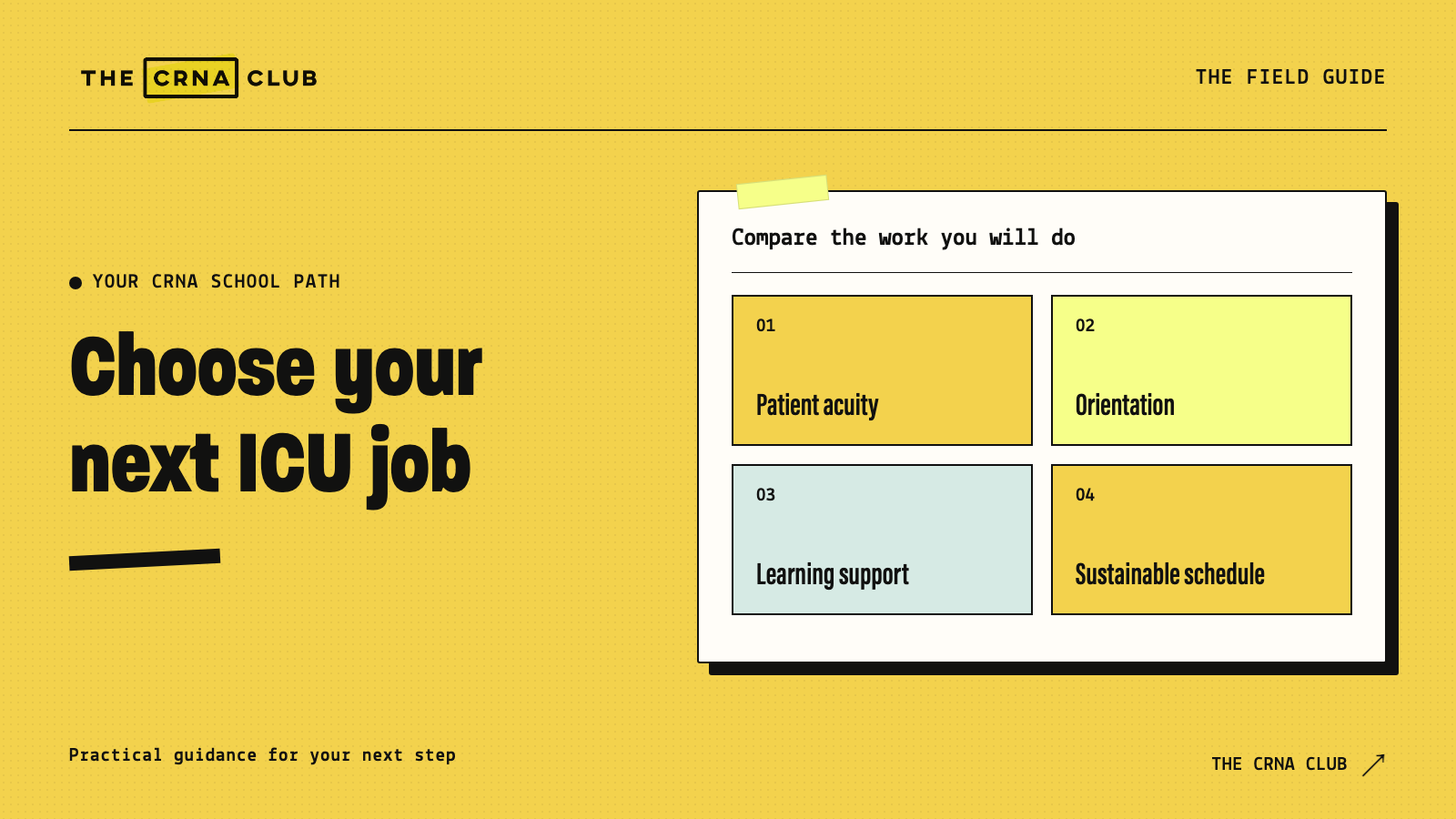
Use the same questions for each unit and keep confirmed details separate from unanswered ones. Record what the manager or educator said, when they said it and whether any commitment is written into the offer. Avoid a numerical score that hides a serious gap behind several attractive minor features.
A practical comparison sheet might look like this:
| Question | Offer A | Offer B |
|---|---|---|
| Routine patient care | What you would manage directly | Same level of detail |
| Orientation | Preceptor structure, education and readiness review | Same questions |
| Advanced assignments | Training criteria and realistic access | Same questions |
| Feedback | Who reviews progress after orientation | Named process or unanswered |
| Work environment | Resources, staffing approach and communication | Specific observations |
| Sustainability | Shift, commute, pay and obligations | Full offer terms |
Don’t fill the blank cells with what you hope is true. A blank identifies the next question you need answered before accepting.
What would a real comparison change?
A specific comparison can show that the more impressive-sounding unit isn’t necessarily the better fit for your current development. It can also show two strong options with different advantages. Use what you know about your learning needs and the actual work, rather than trying to identify one universally best ICU.
Consider hypothetical applicant Daniel, a new graduate with two offers.
Offer A is a cardiac ICU. Advanced-device training is available after a separate experience period, but Daniel hasn’t yet learned how new nurses receive feedback after orientation. Offer B is a mixed medical-surgical ICU with frequent ventilated patients, invasive monitoring and a clear educator-led development plan.
Daniel doesn’t reject Offer A because the training takes time. He asks the missing questions. He also doesn’t dismiss Offer B because its name sounds less specialized. Both deserve a full comparison.
If the final answers show strong teaching and appropriate exposure in both settings, Daniel can consider shift, commute and his interests without assuming one choice ruins his future application.
What should you ask about the work environment?
Ask how the unit matches assignments with nurse competence, handles questions and supports respectful communication. Look for specific examples of teaching and problem-solving. A challenging patient population needs reliable support, especially when you’re new to the unit. Don’t treat poor support as a necessary price of gaining impressive experience.
AACN’s healthy work environment guidance addresses communication, collaboration, staffing and leadership. Use those topics to guide your questions without expecting a recruiter to summarize an entire workplace culture in one answer.
If a shadow or interview visit is available, observe how staff ask for help and respond to uncertainty. One visit is limited information, so pair it with conversations and the orientation details rather than treating it as a complete assessment.
Ask the educator what happens after orientation ends. New learning doesn’t stop when you receive an independent assignment, and a clear follow-up process can help you continue developing deliberately.
How should pay, commute and employment terms affect the decision?
Include the actual terms in the comparison. A job that prevents adequate rest or makes required coursework impossible can be difficult to sustain, even when the unit offers valuable exposure. Review shift expectations, commute, benefits, education commitments and any repayment terms with the appropriate employer contacts before deciding.
You don’t need to choose the highest-paying offer automatically. You also don’t need to ignore money because you have a long-term education goal.
For a nurse supporting a family, a manageable commute and dependable schedule can protect time for learning and preparation. Another nurse might reasonably accept a longer commute for a specific development opportunity. Make the trade-off visible and realistic.
If an offer includes obligations you don’t understand, get clarification before signing. Don’t assume future school acceptance automatically releases you from the terms you agree to now.
Should you tell the unit about your CRNA goal?
Be honest about your long-term interests and what you can commit to now. You don’t need to promise a school start date you don’t have or present the job as a short stop before an inevitable acceptance. Ask about professional development while showing a real commitment to learning the role you’re applying for.
A natural answer might be, “I’m interested in advanced practice long term, and my immediate goal is to become a strong ICU nurse. I’m looking for a unit with structured teaching and opportunities to develop sound clinical judgment.”
Use your own words. Don’t make a retention promise you already know you can’t keep, and don’t invent a different career goal to make the interview easier.
What should you confirm before accepting?
Review the unanswered questions, compare the written terms with what you understood and check your target schools’ experience rules. Then identify the learning plan you would follow during the first months. Choose the offer that gives you the learning you need and a schedule you can live with.
If you’re changing units, our ICU job-change worksheet helps you think through orientation and application timing. If you’re a new graduate, use the ICU learning plan to give the first months a realistic focus.
Our Final Thoughts
Before accepting, get an answer to the training question you still have. A clear pathway from orientation to more complex care is more useful than a device list with no explanation of your future role.
Take the Next Step
Use the offer table with the actual answers from both units. For help choosing the questions and understanding the exposure behind them, we recommend our Preferred ICU Experience lessons. Explore them with the seven-day trial, then check the experience requirements for your saved schools.