Community ICU vs Level I Trauma Center: Do You Need to Transfer for CRNA School?
Sachi, CRNA
CRNA
In This Article (10 sections)
- What does a trauma-center level tell you?
- What experience does your current ICU provide?
- Is the gap in exposure, understanding or access?
- What do your target programs actually require?
- What would the new unit actually add?
- How do two hypothetical nurses reach different decisions?
- What costs and timing changes come with transferring?
- What can you do if you stay?
- Our Final Thoughts
- Take the Next Step
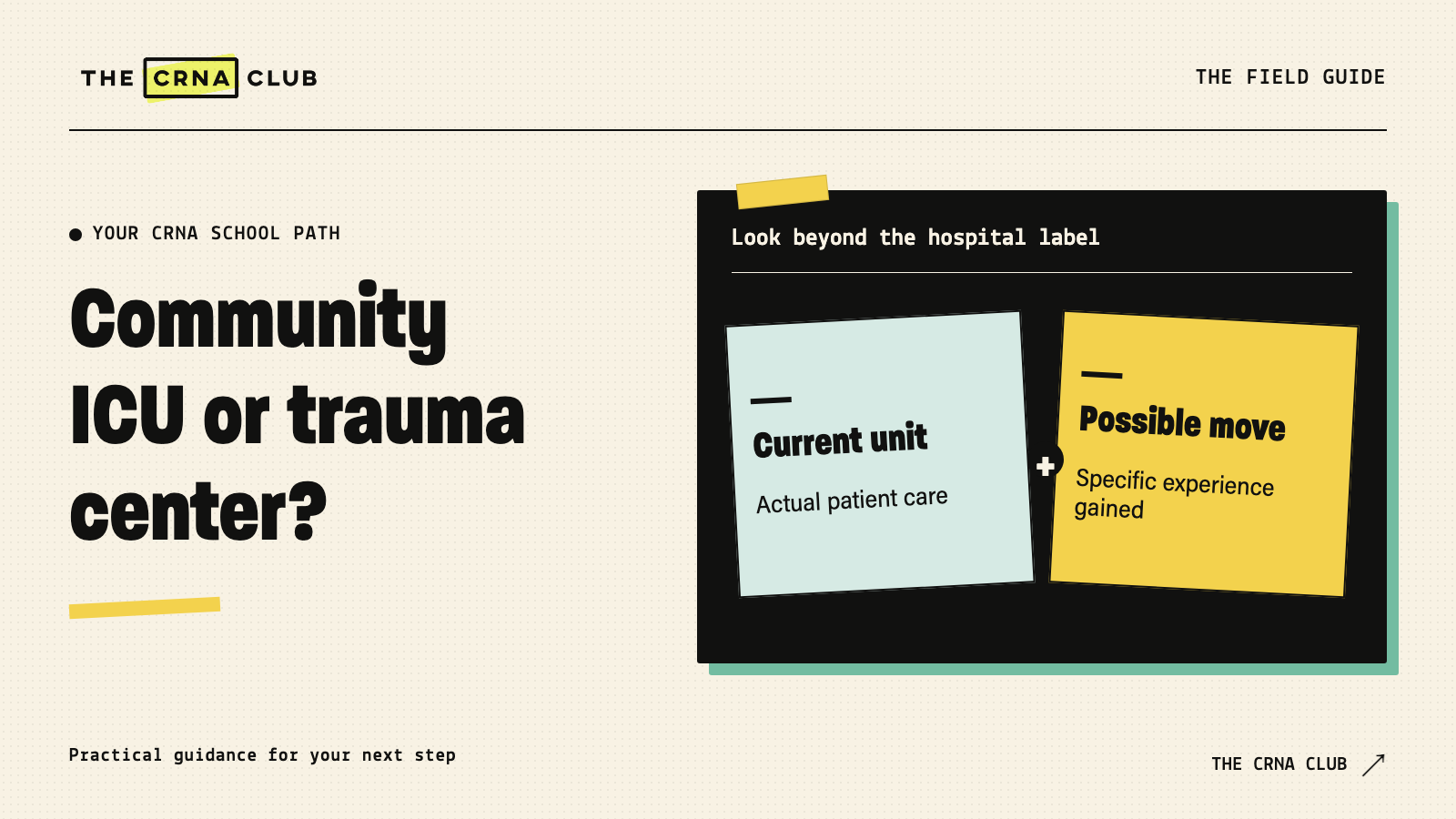
You don’t automatically need to leave a community ICU for a Level I trauma center before applying to CRNA school. Compare your actual patient care, responsibility, teaching and target programs’ experience rules. A transfer makes sense when it addresses a specific clinical or eligibility gap and the new role reliably offers the experience you need.
Maybe you like your unit. You care for ventilated patients, manage unstable hemodynamics and have an educator who pushes your reasoning. Then you start wondering whether a bigger hospital name would make that experience count more.
We’d start with our Preferred ICU Experience lessons and an honest look at your current assignments before you transfer. Use our Clinical Experience Tracker to log what you actually do and spot the exposure you still need. Explore the lessons and tracker with the seven-day trial, then compare that record with your target schools’ rules.
What does a trauma-center level tell you?
A trauma-center designation or verification describes institutional trauma-care resources and capabilities. It does not describe every ICU nurse’s assignment, orientation or opportunity to develop clinical judgment. The hospital’s status is useful background. Your assignment and teaching tell you more about the experience you’ll gain.
The American College of Surgeons’ trauma verification program evaluates institutional resources and performance across several areas. You shouldn’t reduce the distinction between centers to a single research requirement or assume the label answers your CRNA preparation question.
At the same time, don’t pretend institutions have identical resources. Some transfers open meaningful exposure to patient populations, procedures and teaching you cannot access in your current role. The question is what you would actually gain.
Our best-ICU guide explains the broad experience comparison. This article focuses on whether a transfer solves a real problem in the experience you already have.
What experience does your current ICU provide?
Describe your routine direct care, the unstable patients you manage and how you use monitoring and treatment information to make decisions. Include the limits: which patients transfer out, which responsibilities belong to other teams and what training you haven’t yet completed. Write down what you do often and what you haven’t learned yet.
The COA’s current critical-care definition connects experience with critical decision-making, assessment and interpretation of advanced monitoring. Programs determine whether applicants’ experience meets their requirements. Check those rules before treating any unit as automatically sufficient.
Start with questions such as:
- Which unstable patients do I directly care for on a routine basis?
- How often do I manage ventilation, invasive monitoring or vasoactive therapy in my actual role?
- What do I understand about the physiology behind those decisions?
- Where am I repeatedly relying on someone else’s explanation because I haven’t learned the concept yet?
- Which types of care are not available here?
Use factual descriptions. You don’t need to invent a percentage of your patients to satisfy an unofficial checklist.
Is the gap in exposure, understanding or access?
Separate care that your unit never provides from care you haven’t been trained for and concepts you need to understand more deeply. Those gaps call for different actions. A job transfer can change exposure, but it won’t automatically teach the reasoning you still need to practice with the patients already in front of you.
Suppose you routinely care for patients with several forms of shock but struggle to explain why the same blood pressure can occur with different cardiac outputs. That’s a learning need you can begin addressing now.
Suppose instead your unit stabilizes complex ventilated patients briefly and transfers them, so your sustained management experience is limited. A role with more ongoing critical care could address an exposure gap.
Or maybe your unit offers the relevant care, but you’re still in the queue for training. Ask the educator about a realistic pathway and timing before assuming you need to leave.
The COA competencies overview can help you organize the clinical questions. It shouldn’t become a claim that collecting every possible device is the goal.
What do your target programs actually require?
Check the accepted ICU population, employment pattern, duration and recency for each program. If a policy appears to require a particular setting or you’re unsure whether your role qualifies, ask for clarification with a concise factual description. Don’t substitute an applicant’s opinion for a program’s current written rule.
Your email could say:
I’m an RN in a community medical-surgical ICU and am reviewing your critical-care experience requirement. In my role I routinely manage ventilated, hemodynamically unstable patients with invasive monitoring and vasoactive infusions. Could you clarify whether this setting is eligible under your current policy, or what additional information you need to assess the role?
Use only details true of your work. If a device is rare or managed by a separate team, explain that accurately when relevant.
An eligibility answer is useful, but it isn’t an admissions prediction. You still need to assess the rest of your application and your ability to explain the work you do.
What would the new unit actually add?
Ask the prospective unit the same detailed questions you asked about your current job. Find out which patients you would care for, how training works and when you could access advanced assignments. A large hospital might offer valuable opportunities while still requiring time before a new hire participates in them.
Use a comparison like this:
| Question | Current unit | Proposed unit |
|---|---|---|
| Direct patient care | Document the care you provide now | Ask what new hires actually do |
| Training pathway | Available next steps and dates | Orientation and specialty criteria |
| Clinical reasoning support | Educator and feedback access | Specific teaching process |
| Missing experience | What you cannot obtain here | What the new role reliably offers |
| Application effect | Current supervisor and documented work | New reporting relationship and timing |
A blank in the proposed-unit column is an unresolved question. Don’t fill it with an assumption based on the hospital’s reputation.
Our ICU job-change worksheet helps you review the broader transition once the clinical benefit is clear.
How do two hypothetical nurses reach different decisions?
The same hospital labels can lead to different reasonable choices because the nurses’ current experience differs. Compare the gap, the proposed benefit and the practical cost of moving. You don’t need to copy another applicant’s transfer simply because they were later accepted.
Nurse A works in a community ICU with frequent unstable ventilated patients, invasive monitoring, a strong development plan and a manager who knows her work. Her target programs accept the experience. She identifies several concepts to study and a leadership project she can contribute to. A transfer based only on prestige doesn’t address an established gap.
Nurse B’s ICU frequently transfers complex patients before sustained management. The local training pathway cannot provide the exposure he needs, and the proposed job has a clear orientation and assignment progression. He confirms how the timing fits his target programs. The transfer has a specific clinical purpose.
Neither decision proves community ICUs are always enough or always inadequate. It shows why the facts of the role belong in the decision.
What costs and timing changes come with transferring?
Consider orientation, new supervisory relationships, commute, shift changes and any employment obligations. Ask the programs how a job change affects the experience they assess, especially when they specify current or continuous work. Don’t assume every experience clock resets, and don’t assume the change has no effect.
If you planned to apply in four months, starting a new job now might change who can assess your work and how much of the new experience you can honestly report. That might still be worthwhile. You need to compare it with the actual benefit rather than avoid the timing question.
Review the ICU experience guide for the broader policy questions. Ask your own programs about any ambiguous requirement before making an irreversible work decision based on an application assumption.
What can you do if you stay?
Choose a concrete development goal, arrange feedback and document the learning you do. We recommend choosing one thing to learn next instead of waiting for another month of experience to pass. Ask for appropriate training opportunities, improve your explanation of familiar physiology and contribute to work your unit actually needs.
For example, make a plan to explain one common patient problem each week, review the reasoning with an educator and correct a gap you discover. Keep any learning notes de-identified and separate from employer records.
Log the experience in our Clinical Experience Tracker, then choose a clinical lesson for the concept you couldn’t explain. If you have the exposure but struggle with the reasoning, studying that concept gives you something to work on now. You don’t need to change hospitals to start learning it.
Our Final Thoughts
Name what the transfer would teach you that your current role cannot. If you can’t answer that yet, ask the new unit about assignments and training before giving up a job where you’re still developing.
Take the Next Step
Compare one current assignment with what the new job would add. We recommend our Preferred ICU Experience lessons and Clinical Experience Tracker for making that comparison, plus clinical review for the concepts you need to learn. Try them with the seven-day trial.