Can You Reuse Your Personal Statement for Multiple CRNA Programs?
Sachi, CRNA
CRNA
In This Article (8 sections)
- What parts of a personal statement are reusable?
- How do you organize different school prompts?
- How can the same experience support two different answers?
- How much of the wording should you change?
- What should you verify before writing about program fit?
- How do you prevent a wrong-school submission?
- Our Final Thoughts
- Take the Next Step
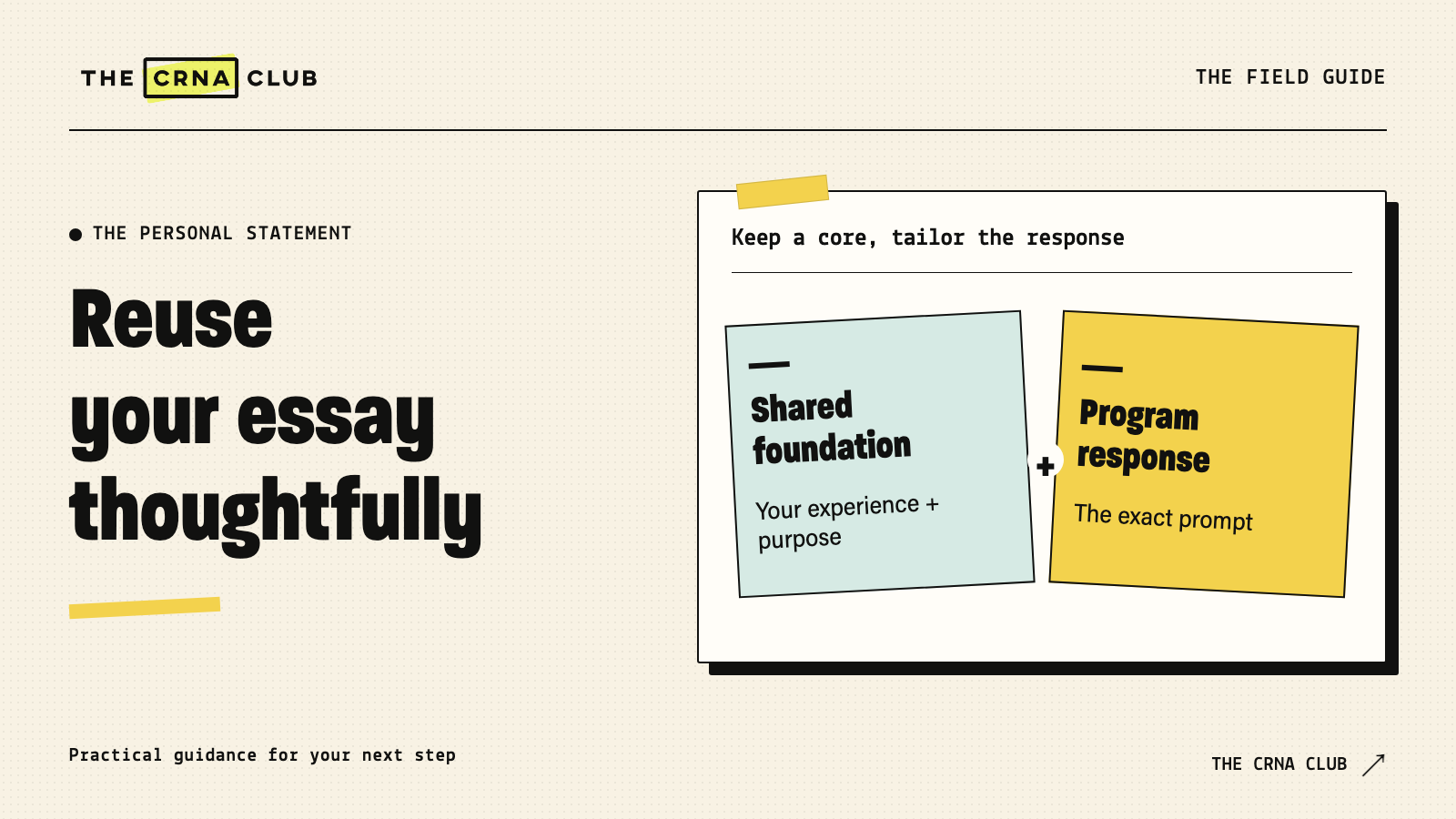
You can reuse truthful experiences and ideas across CRNA personal statements, but each final essay needs to answer that program’s current prompt and follow its rules. Start with a bank of your own evidence, then build the answer each school asks for. Changing the school name alone won’t adapt an essay written for a different question.
Writing several applications is a lot of work. You don’t need to rediscover your reasons for pursuing anesthesia every time you open a new document. Your experiences are still your experiences. The task is deciding which ones help answer the question in front of you.
We suggest keeping a separate draft for each program and reviewing it with our Essay Critique tool. Use the exact school prompt so you can catch a missing answer before spending time polishing the wrong paragraph. Our personal-statement lessons help you choose what to reuse and what needs a fresh explanation.
What parts of a personal statement are reusable?
Your real experiences, reasons, and reflections are reusable source material. Keep accurate notes about what happened, your role, and what you learned. The way you arrange that material depends on the prompt. A story that supports a leadership answer might need a different focus when you’re explaining professional growth or motivation.
Create an evidence bank before writing separate final essays. A simple document works. The goal is to find your own experiences quickly when a school asks a different question.
Use one entry per experience:
- Experience: Give it a plain description you recognize.
- Your role: Record what you personally did, observed or contributed.
- Learning: Note what changed in your thinking or behavior.
- Support: Keep dates, coursework or other details you can verify privately.
- Useful prompts: Mark motivation, leadership, growth, preparation or goals.
- Privacy: Identify details that must stay out of an application.
For example, precepting might help explain how you respond to questions and recognize a gap in your own understanding. It doesn’t become a leadership example merely because you label it “leadership.” You still need to explain the action and why it matters.
Keep the entries in rough notes at first. Polished paragraphs become harder to cut because you’ve already spent an hour making them sound good.
How do you organize different school prompts?
Put each school’s current instructions into a separate row before adapting any prose. Record every question, the limit, the submission format, and any rules about assistance. Now you can see where the schools ask different things. A great answer about motivation won’t cover a separate question about feedback.
NursingCAS Program Materials guidance explains that program-specific questions and documents vary. Its current guidance also warns that submitted documents can’t simply be edited or replaced. Check the version before you submit it.
Here’s a fictional prompt matrix. These are practice tasks we invented, not published requirements from actual schools.
| Program | Practice prompt | Material to consider | Material to leave out or reduce |
|---|---|---|---|
| School A | Why nurse anesthesia, and how have you explored the role? | Shadowing observations, follow-up questions, motivation | A long account of an unrelated leadership activity |
| School B | Describe growth after challenging feedback | Specific feedback, response, later change | A broad list of anesthesia interests |
| School C | Explain a professional goal and why this program fits | Goal development, verified curriculum detail, learning need | Generic praise of the school |
For your actual matrix, copy the instructions from the current application. Note where they came from and when you checked them. If a portal and public page disagree, email the program before choosing a format.
How can the same experience support two different answers?
The same truthful experience supports different answers when you focus on the part relevant to each prompt. Keep the underlying facts consistent. Change the explanation, emphasis, and connection to the question. You aren’t changing what happened to make an example fit; you’re deciding what the reader needs to understand about it.
Let’s use one entirely fictional evidence-bank entry. This isn’t a real applicant’s story or a sample to submit.
Shared source material: During shadowing, the applicant noticed how a CRNA explained a plan to a patient. Afterward, the applicant asked about the preparation behind that conversation and investigated the educational pathway.
Fictional adaptation for School A’s motivation question:
During shadowing, I became interested in the preparation behind a conversation that looked straightforward from the outside. The CRNA explained a plan to the patient and answered questions without losing the thread of the assessment. I wanted to understand the knowledge supporting that work. Asking about the role afterward helped me turn a general interest in anesthesia into a more deliberate decision to explore the education.
Fictional adaptation for School C’s goals question:
Shadowing made me more aware of how much knowledge supports a clear explanation to a patient. I want to develop that depth while improving how I communicate. School C’s case seminars interest me because students explain their reasoning and respond to questions from classmates. That approach connects with the habit I began during shadowing: asking what supports a decision, then checking the part I don’t yet understand.
School C’s seminars are an invented feature for this example. A real submission needs a verified program detail and your own reason it matters. “Excellent faculty” doesn’t explain that connection.
Also notice that neither passage answers School B’s feedback question. The material doesn’t contain feedback or a response to it. You need another real experience for that task. That’s where a flexible evidence bank helps more than one master essay.
Give each finished version to a reader with only that school’s prompt. Don’t explain what you meant to include. Ask which questions they see answered and where the evidence is missing. Their response helps you find a leftover gap before you submit.
How much of the wording should you change?
Change enough to answer the actual question clearly and stay within the rules. There isn’t a useful percentage of new wording that makes an essay properly tailored. Sometimes one paragraph remains accurate and relevant. Sometimes a different prompt requires rebuilding the entire structure. Read for what the answer accomplishes, rather than counting replaced words.
The personal statement guide helps you build an argument before polishing it. If your draft reads like several unrelated application answers joined together, return to that argument. What do you want this particular reader to understand?
In our podcast discussion of personal statement mistakes, answering the exact prompt is a central point. Having impressive material doesn’t make it relevant to every writing task.
If this is the part where you get stuck, our learning library has personal-statement lessons on developing your material and responding to common prompts. Explore them through the seven-day membership trial, then apply the process to the schools on your list.
What should you verify before writing about program fit?
Verify the feature you plan to mention and explain why it connects to your learning goals. Read the program’s current official curriculum or admissions information. Don’t treat a course title, clinical opportunity, or faculty interest as a guarantee of a specific assignment or individual mentoring relationship.
Suppose you care about learning to evaluate evidence. Find what the school actually says about that part of its education. Then describe how it connects to your own preparation or goals. “This is a prestigious program with exceptional opportunities” tells the reader very little about your reasoning.
Your school research notes can support both essays and later interview preparation. Keep the source beside the note so you can return to it when your memory gets fuzzy.
Columbia’s nurse anesthesia application instructions also address accurate and authentic materials. Review the corresponding instructions for every school you apply to, including any restrictions on editing or AI assistance.
How do you prevent a wrong-school submission?
Use a separate final-file check for each program. Search the document for other school names, faculty names, city names, and leftover placeholders. Then read the prompt beside the complete essay one last time. A correct school name doesn’t prove the answer is tailored, but an incorrect one is an avoidable error.
Keep filenames recognizable. A format such as “School A personal statement final date” is easier to check than “essay final final new.” Don’t rely on the filename alone: open the file you are about to upload.
Before submitting, confirm:
- Every required part of the prompt has an answer.
- Each experience matches your actual role and records.
- Program details are accurate and relevant.
- The word, page, or character limit is satisfied.
- The final uploaded or pasted version has the expected formatting.
For one specific editing problem, our annotated essay examples show how to replace broad claims with evidence. Keep your own voice when making that revision. Your goal isn’t to sound like a sample applicant.
Our Final Thoughts
Put the next school’s prompt beside your evidence bank before opening the last finished essay. Decide what belongs, then check the exact file you upload for leftover school details.
Take the Next Step
Use the free essay critique with the exact prompt for the version you’re revising. If comparing programs is slowing you down, the free school database gives you a place to begin your research and save an initial shortlist.