How Can Travel Nurses Get Strong CRNA School Recommendations?
Sachi, CRNA
CRNA
In This Article (10 sections)
- Which evaluator does your CRNA program require?
- How do you map your relationships across assignments?
- What should you do before your contract ends?
- How can a short assignment produce specific evidence?
- What if your best evaluator is a former manager?
- Can your agency recruiter write a clinical recommendation?
- How do you manage recommendations for several schools?
- What should you do if a supervisor becomes unreachable?
- Our Final Thoughts
- Take the Next Step
Travel ICU nurses can build strong CRNA recommendations by identifying eligible evaluators who directly observed their work, documenting each working relationship and asking before a contract ends. Start with each school’s required roles. An agency recruiter can verify employment logistics, but that relationship doesn’t automatically provide the clinical assessment a program requests.
Travel work can leave you with several good professional relationships and no single manager who has known you for years. You might have spent nine months at one hospital, thirteen weeks at another and then returned to a previous unit. The experience is real. Your application needs to make those relationships understandable.
We recommend keeping those relationships with your school list as you go. Our recommendation tracker lets you record the person, relationship, email, dates and notes for each target program. Try it with the seven-day trial. You won’t have to reconstruct who evaluated you three contracts ago when a deadline is approaching.
Which evaluator does your CRNA program require?
Match the required relationship before choosing a familiar name. Some programs ask for a current or immediate supervisor, while others describe recent supervisors or additional clinical leaders. A former contract manager might know your work well and still fall outside a particular school’s required slot. Clarify the role before sending the request.
VCU’s DNAP admission requirements identify an immediate supervisor responsible for performance evaluations among the required references. That wording directs you toward the actual evaluation relationship, not simply the person who arranged the contract.
Another program’s instructions might differ. Marquette’s nurse anesthesia FAQ describes employer references from critical care, including a current direct supervisor with substantial observation of the applicant’s knowledge and skills. Read the requirement at the programs on your list instead of assuming travel status creates a common exception.
If your assignment has a unit manager, assistant manager and clinical coordinator, ask who formally evaluates your performance. Then describe that structure accurately when the school asks about the relationship.
How do you map your relationships across assignments?
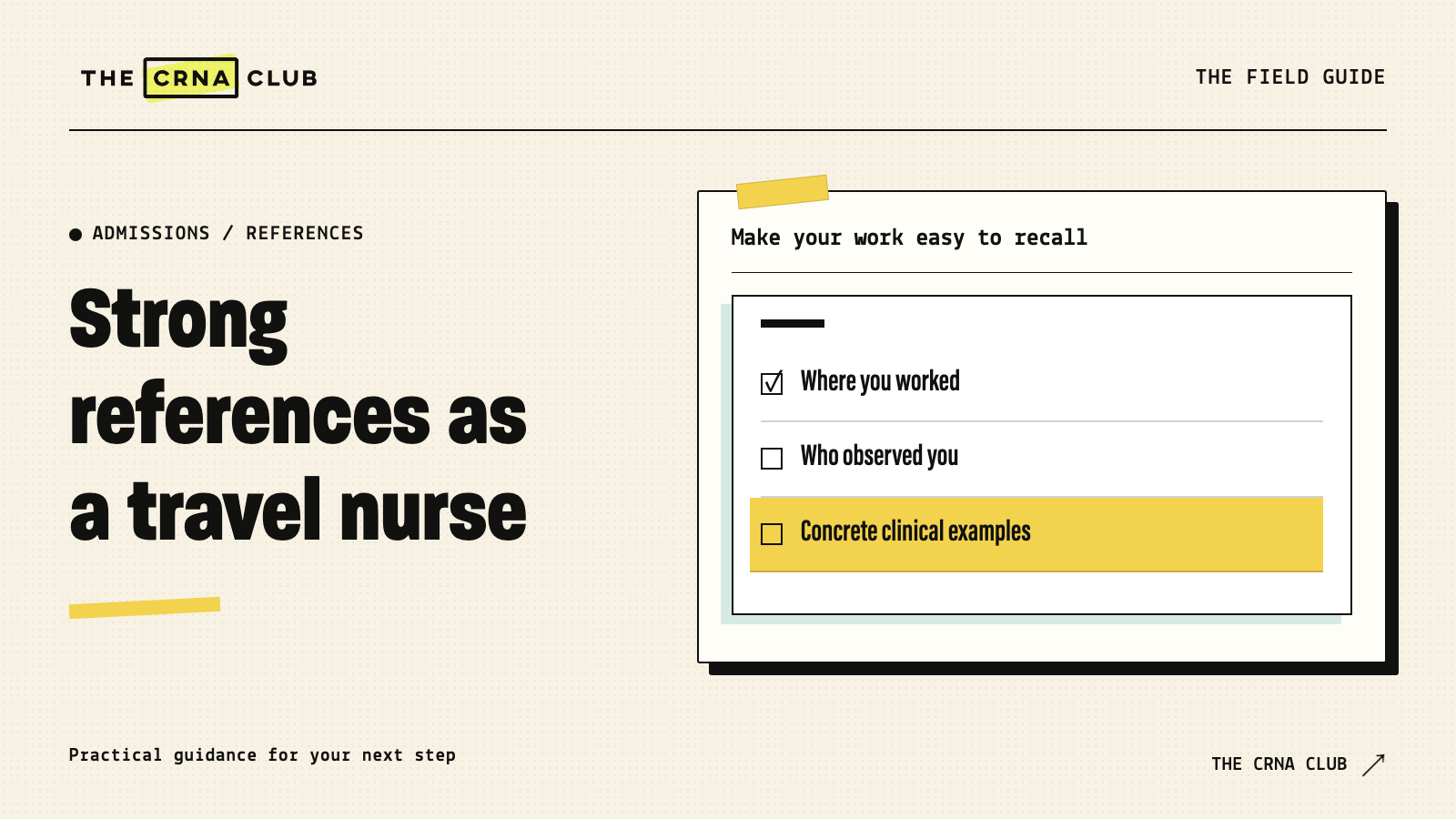
Make a short list of the people who supervised or worked with you at each assignment. Record the hospital, assignment dates, person’s role, what they observed and whether they’re willing to be contacted later. This lets you compare actual supervision rather than choosing whichever person’s email address is easiest to find.
Use this hypothetical example:
| Assignment | Potential evaluator | Relationship | Firsthand evidence | Next question |
|---|---|---|---|---|
| Hospital A, January–September | Assistant manager | Assigned evaluations and coached progress | Repeated reviews and clinical feedback | Does the school accept this supervisor role? |
| Hospital B, October–December | Unit manager | Formal supervisor | Observed several shifts and reviewed educator feedback | Will they provide a recommendation after contract completion? |
| Hospital C, January–April | Charge nurse | Shift coordination and direct collaboration | Frequent bedside work | Is this an additional professional slot or an eligible supervisor? |
| Agency, same period | Recruiter | Contract and employment coordination | Reliability in administrative communication | Can they verify dates separately from a clinical reference? |
Look at what each person actually saw. That tells you which kind of recommendation to ask for.
Add a contact-permission column and the date you last confirmed the address. Someone who agreed a year ago might have changed hospitals. Check their address before you send the portal request.
What should you do before your contract ends?
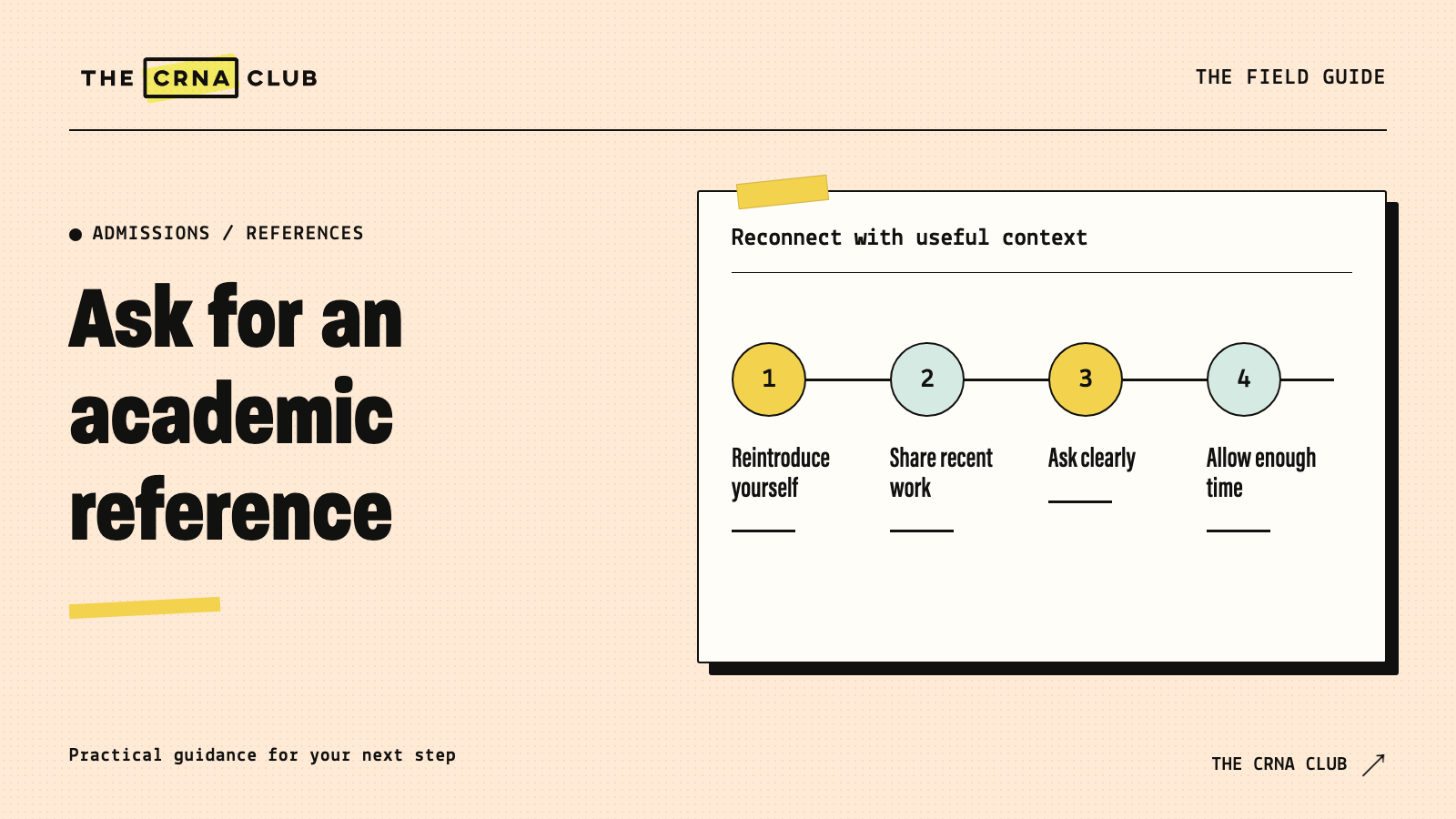
Have the conversation before your contract ends, while your work is still familiar.
- Ask for feedback and whether an eligible supervisor would be comfortable recommending you later.
- Confirm how to stay in touch.
- Check what employment information you’re permitted to retain.
A timely conversation is more useful than trying to recreate the relationship months after you leave.
You could say:
I’m planning CRNA applications for next year. You’ve supervised my work during this assignment and reviewed my progress. Would you be comfortable serving as a reference when the applications open? I can send the specific school requirements before any request, and I’d appreciate feedback on anything I should work on before then.
That gives the person a realistic choice. It also creates space for developmental feedback while you can still act on it.
Don’t ask them to promise a positive recommendation regardless of what happens during the rest of the contract. Their eventual assessment should reflect their actual experience with you. If performance concerns arise later, the earlier conversation doesn’t obligate them to ignore those concerns.
You also don’t need to collect a generic signed letter from every assignment as if it replaces future application forms. Schools can require their own current assessment and submission method.
How can a short assignment produce specific evidence?
Focus on observable work within the time you shared. A short relationship can still include useful examples, but don’t stretch its duration or imply the evaluator saw every part of your career. Ask whether their observations are sufficient for the requested role and let them describe the limits honestly.
For example, a supervisor might have observed how you learned the unit’s workflow, responded to feedback and communicated during a changing patient situation. Those examples are more grounded than a broad claim about years of leadership they never saw.
Your factual packet can include the assignment dates, unit, orientation responsibilities and examples the person participated in. Avoid naming patients, copying employer records or exporting confidential clinical material.
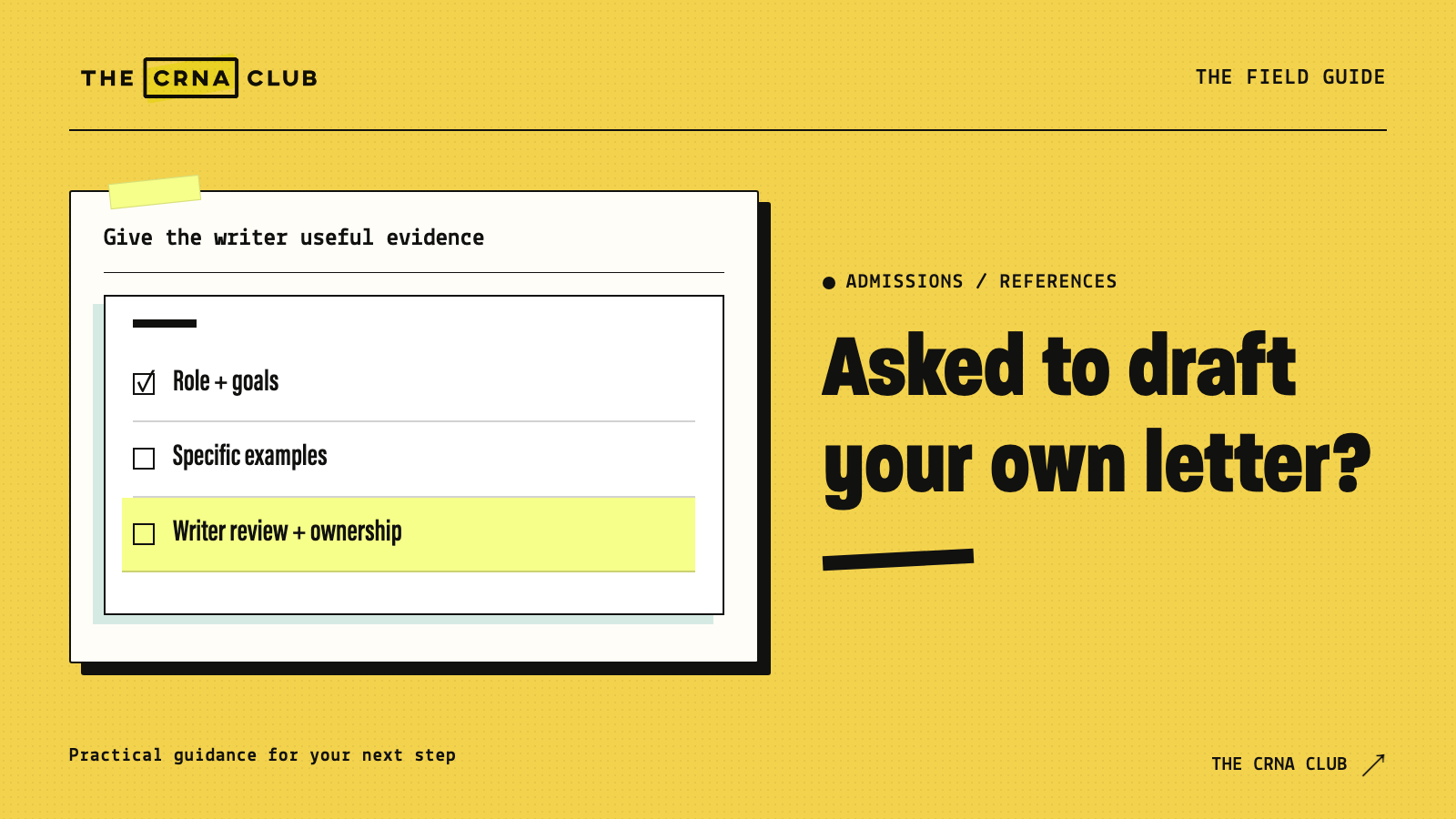
A useful reminder is specific: “You reviewed my progress after I changed how I organized the morning assessment and communicated priorities.” An unsupported instruction sounds different: “Please say I’m excellent under pressure.” The evaluator decides what your work demonstrates.
Our recommendation request packet shows how to supply background while preserving that independent assessment.
What if your best evaluator is a former manager?
Check whether that person qualifies for the required slot or belongs in an additional professional-reference category. If a current-supervisor letter is mandatory, ask the school about your assignment timeline and available supervision. A strong former relationship supports your history, but it doesn’t change the school’s published wording.
Consider a hypothetical travel nurse, Priya. Her current contract started four weeks ago. A manager from her previous nine-month assignment knows her well and has agreed to write. Priya’s first-choice program asks for a current direct supervisor.
Priya sends a short question describing both relationships and asks whether the former manager is acceptable or whether she should provide the current manager plus another clinical reference. She keeps the school’s reply and follows that instruction.
She doesn’t change the end date of the prior contract to make the manager appear current. And she doesn’t assume an answer from one program applies to the next four applications.
Can your agency recruiter write a clinical recommendation?
A recruiter can describe the work they actually observed in their relationship with you, but arranging employment is different from supervising ICU care. Use the program’s definition of an eligible reference. If a slot specifically asks for clinical performance or a direct clinical supervisor, clarify whether the recruiter qualifies before submitting their name.
Employment verification is a separate task. You might need accurate contract dates, hours or location information to document eligibility, and an agency can help with appropriate administrative records. A clinical evaluator contributes judgments based on clinical observation.
Keep these requests clear when you contact people. Asking a recruiter to verify a start date should not sound like asking them to evaluate your hemodynamic reasoning.
The travel and part-time ICU experience guide covers experience documentation. This reference plan builds on that record by identifying who can speak to your development within those assignments.
How do you manage recommendations for several schools?
Give your writer the total school count, expected dates and submission links before the automated emails arrive. In our tracker, keep a separate request under each school, even when you’re using the same former manager. Travel relationships already involve several locations and dates, so a clear request summary prevents the evaluator from having to reconstruct your career timeline from individual messages.
Your cover note might say, “I’m applying to four programs over the next ten weeks. Two accept a recent supervisor, and I’ve confirmed your relationship meets those requirements. The other two need my current manager. I’m asking you for the two requests listed below.”
That’s much easier to understand than four portal emails with no explanation.
If a program changes its instructions or you add another application, update the evaluator before sending the request. They agreed to a particular workload. Respecting that agreement helps keep the process straightforward.
What should you do if a supervisor becomes unreachable?
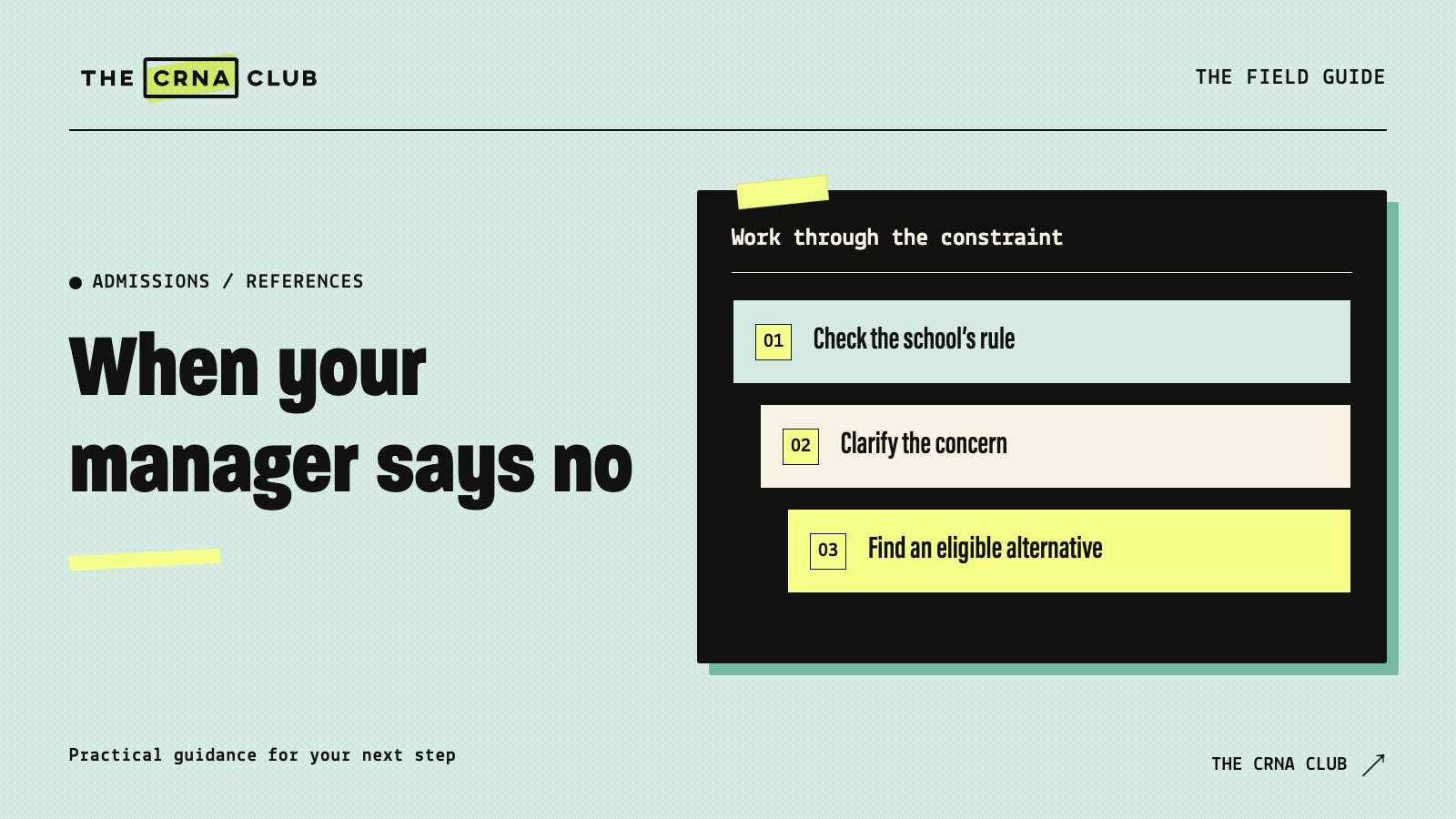
Use the last professional contact route you have permission to use, then identify an eligible alternative and ask the program about substitutions if needed. Don’t keep treating an unanswered request as a confirmed recommendation. Review your deadline and decide when you must move to the next option.
Your list gives you other people to consider without starting from scratch. It also shows where you still need to build a relationship. If no eligible current supervisor knows you well enough yet, that affects your timeline and deserves an honest discussion with the program.
Our application deadline planning guide can help you place that dependency beside your other tasks. References are easier to manage when they’re part of the application plan before the final contract week.
Our Final Thoughts
Before you leave your current assignment, find out who can discuss your work and how to stay in touch. An accurate relationship record gives you somewhere to start when each school’s reference instructions arrive.
Take the Next Step
Before your next contract ends, ask one supervisor about staying in touch for future applications. We recommend our References Basics lesson for preparing that conversation and our recommendation tracker for keeping the relationship and dates with your target schools. Explore both with the seven-day trial.