What If Your ICU Manager Will Not Write a CRNA Recommendation?
Sachi, CRNA
CRNA
In This Article (10 sections)
- What does your manager mean by “I can’t write it”?
- Can another clinical leader replace your manager?
- What should you ask admissions?
- How should you handle a time constraint?
- What if the refusal reflects performance concerns?
- What if you recently changed ICU jobs?
- How do you plan the next month without making the situation worse?
- What should you avoid putting in the application?
- Our Final Thoughts
- Take the Next Step
If your ICU manager will not write your CRNA recommendation, clarify the reason and check each program’s supervisor requirement before choosing a replacement. Ask admissions whether another evaluator is acceptable for your circumstances. A former manager, educator or assistant manager might help, but they won’t automatically satisfy a current direct-supervisor requirement.
This feels personal because your plan is personal. You’ve put time into your ICU development, courses and applications, and now someone else controls a required piece. Give yourself a minute before sending the frustrated email.
We suggest opening the reference requirements for your saved schools before choosing another writer. Our per-program checklists and recommendation tracker help you keep the unanswered question, possible replacement and ask-by date together. You can use them with the seven-day trial, along with our References Basics lesson to prepare the conversation.
What does your manager mean by “I can’t write it”?
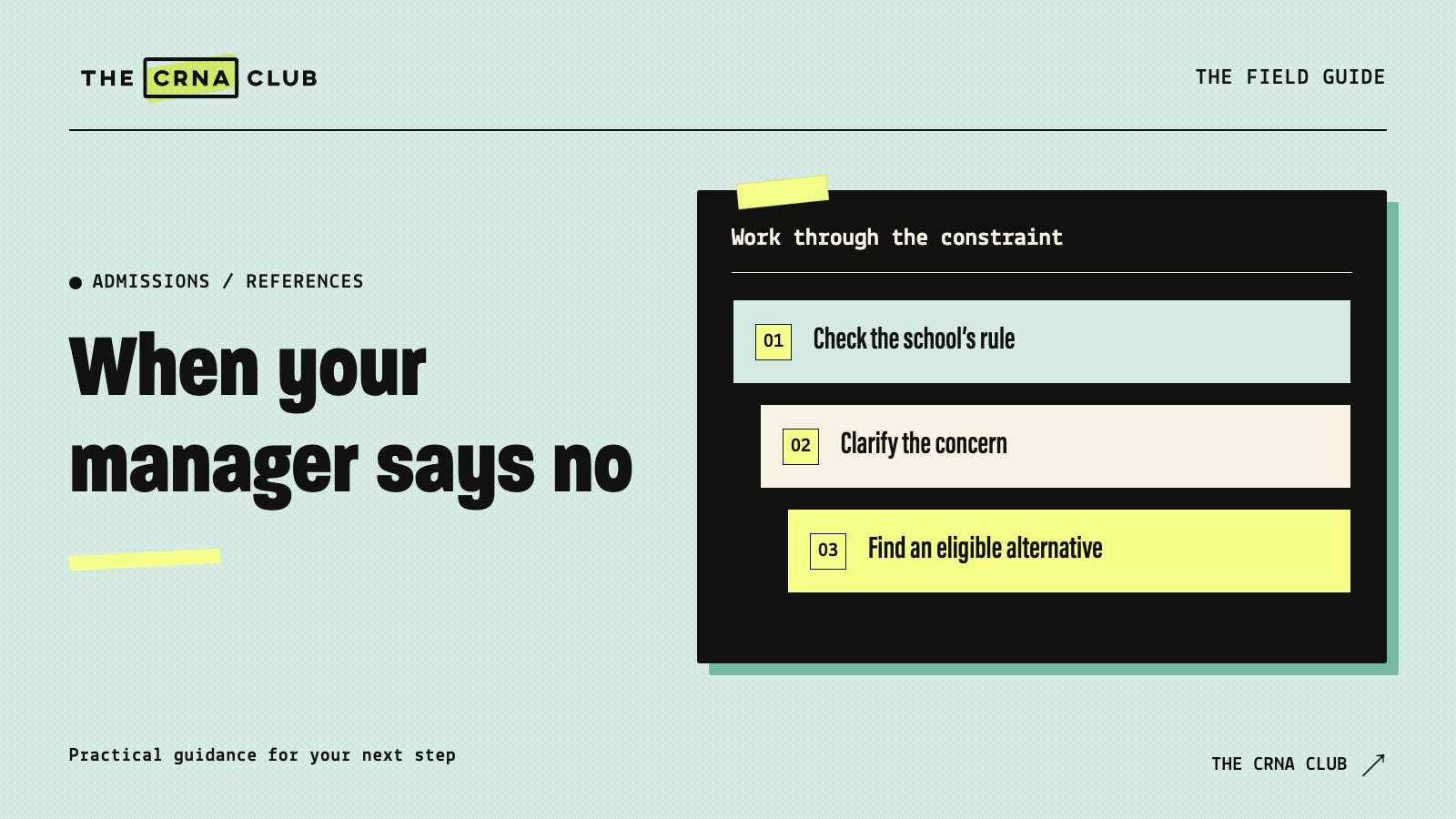
Ask whether the barrier is time, an employer policy, limited familiarity or a concern about your work. Those answers point to different next steps. A busy manager who supports your application needs a practical request and realistic timeline. A manager who cannot recommend your performance needs an honest feedback conversation.
You could say:
I understand you’re unable to complete the recommendation right now. Can you help me understand whether that’s a time constraint, a workplace policy or a concern about my readiness? I want to plan my application accurately and address any feedback you have about my work.
Then listen. Don’t arrive with five arguments about why you deserve a letter. You’re trying to learn what the refusal actually means.
If the manager says they don’t know you well enough, ask what they can accurately evaluate and whether another person formally supervises more of your work. If they say your clinical development needs more time, ask for specific observations and an agreed review point.
A vague “you’re too new” is hard to act on. “You need to complete orientation and demonstrate consistent organization with a full assignment” gives you something to work toward. You still need to determine whether your application timeline allows that development.
Can another clinical leader replace your manager?
Only the program can settle whether a different clinical leader meets its required reference role. Read the exact wording first. “Immediate supervisor,” “current supervisor,” “professional reference” and “clinical evaluator” describe different relationships. A strong letter from an ineligible person leaves the underlying requirement unanswered, even if the writer knows you well.
Duke’s current nurse anesthesia instructions specify an immediate-supervisor reference. You shouldn’t assume a colleague, shadowing contact or previous manager qualifies under that wording.
Other programs explain a process for missing reference categories. Johns Hopkins’ nurse anesthesia FAQ tells applicants unable to provide one of the described reference letters to upload an explanation. That’s a program-specific instruction, not blanket permission to replace the requirement however you like.
Use the school’s process. If the page doesn’t answer your situation, send one factual question before entering a substitute’s name.
What should you ask admissions?
State the required role, your actual reporting relationship and the alternative you can provide. Ask whether that person meets the requirement. Keep the answer in that school’s notes. You’re asking admissions to clarify a rule, so leave out the argument with your manager.
For example:
Your application requires a current supervisor reference. My current nurse manager is unable to complete recommendations. Our assistant manager has supervised my clinical development for nine months and directly evaluates my work. Would an evaluation from the assistant manager meet your requirement? If not, what process should I follow?
If the barrier is an employer policy, say that only if you’ve confirmed it. “My manager declined” and “our hospital prohibits recommendations” aren’t interchangeable.
Avoid attaching a long account of scheduling conflicts, staffing concerns or workplace disagreements. The school needs enough information to answer the eligibility question. You can provide additional detail if it asks.
And ask separately for each affected school. An approval from School A doesn’t change School B’s requirement. Our recommendation writer comparison guide helps you identify which alternative relationships provide useful, firsthand evidence once a program confirms the role is acceptable.
How should you handle a time constraint?
Find out whether a more organized request would make completion realistic. Offer the actual submission instructions, a short factual packet and an agreed date before the school deadline. Make the request easy to find and understand. They still need time to write and submit it.
Suppose your manager supports your application but has a survey visit and vacation during the next month. Your application closes in eight weeks. Ask whether a specific date after those commitments is workable. If it is, confirm the plan in writing and watch the request status.
If the answer remains no, thank them for being clear. A deadline doesn’t create additional capacity. Move to the program’s alternative-reference process while you still have time.
Don’t solve the time problem by offering to write and submit the recommendation yourself. NursingCAS requires evaluators to complete their own references. Your role is to prepare accurate background and manage your application, not become the evaluator. Read its current reference instructions.
What if the refusal reflects performance concerns?
Ask for observable examples and a development plan. Clarify what needs to change, how progress will be assessed and when you’ll revisit the conversation. You don’t need to agree with every impression immediately, but you do need to understand the concern before deciding your application’s next step.
Consider a hypothetical nurse, Elena. Her manager declines because she still needs frequent prompting to organize a complex assignment. Elena had planned to apply in six weeks. A substitute recommendation wouldn’t resolve the clinical-development issue, even if a school accepted it.
Elena asks for feedback from her preceptor and educator. Together they identify the situations in which she loses priorities and arrange focused observation. She adds a date to review her progress with them before deciding when to apply.
Your concern could be different. Maybe the manager hasn’t observed the work they’re criticizing, or the feedback conflicts with prior evaluations. Ask for clarification and use your employer’s appropriate feedback process. Keep the conversation professional. An application deadline is a poor setting for arguing about a performance evaluation for the first time.
What if you recently changed ICU jobs?
Explain the timing honestly to the program. Your current manager might know you for only a few weeks, while a former manager observed years of work. Ask which evaluator the school requires and whether it accepts an additional reference or explanation. Don’t backdate the relationship or imply the former manager still supervises you.
A useful timeline includes when your previous role ended, when the new role began and who evaluates your performance now. That’s enough to make the relationship understandable.
Changing units also affects more than references. Consider orientation, direct patient-care exposure and each school’s experience requirements. Our ICU job-change decision worksheet helps you review those questions together.
You don’t need to remain in a harmful job just to protect a letter. But don’t assume a transfer has no application consequences. Get the facts before choosing between options that affect both your work and your timeline.
How do you plan the next month without making the situation worse?
Give yourself a short, specific task list. First settle the reason for the refusal. Next identify which schools are affected. Then seek written clarification and confirm the availability of any eligible replacement. Put the request dates beside the development tasks. In My Programs, keep the replacement request under the school that approved it and note any conditions in its reply. You’ll see which school still needs an answer before asking another person.
A hypothetical schedule might look like this:
- Days 1–3: Clarify the manager’s reason. Is it capacity, policy, familiarity or performance?
- First week: Review every reference requirement. Identify the schools that specifically require this relationship.
- First week: Ask unresolved program questions. Find out whether an alternative or explanation is allowed.
- Second week: Ask an eligible evaluator, if approved. Confirm that they agree to the full request.
- Remaining weeks: Track submission and address feedback. Check whether the requirement is complete and what development remains.
This is an example planning sequence. Use the time you actually have. If a deadline is tomorrow, acknowledge that the remaining options are narrower rather than treating a rushed request as an obligation for someone else.
What should you avoid putting in the application?
Don’t mislabel a coworker as a supervisor, invent an employer policy or conceal a required explanation. Describe the relationship and situation in neutral, accurate terms. If the program asks for an explanation, answer what it asks and include the permitted alternative. You don’t need to turn a missing reference into an attack on your unit.
Also avoid interpreting a substitute evaluator as proof your manager’s feedback was wrong. Their observations could differ because they see different parts of your work. You’re responsible for deciding what development you need as well as completing the application.
Our Final Thoughts
Find out why your manager declined before you choose a replacement. Then check what each school allows. If the conversation identifies a clinical weakness, give that weakness a concrete plan alongside the paperwork. Your next decision will be clearer when those facts are separate.
Take the Next Step
Start with the school whose deadline is closest. Save the question you need answered, then put a date on your next conversation. We recommend our References Basics lesson and per-program recommendation tracker for working through those asks. Try them with the seven-day trial.