Your Recommender Asked You to Draft Your Own Letter: What Should You Do?
Sachi, CRNA
CRNA
In This Article (10 sections)
- What does the application require the evaluator to do?
- How can you respond without making the conversation confrontational?
- What belongs in the factual packet?
- What is the difference between a reminder and an evaluation?
- Can you supply bullet points about your strengths?
- What if the person says they will only sign an applicant-written letter?
- What should you do if a letter has already been drafted?
- How can you prevent this request next time?
- Our Final Thoughts
- Take the Next Step
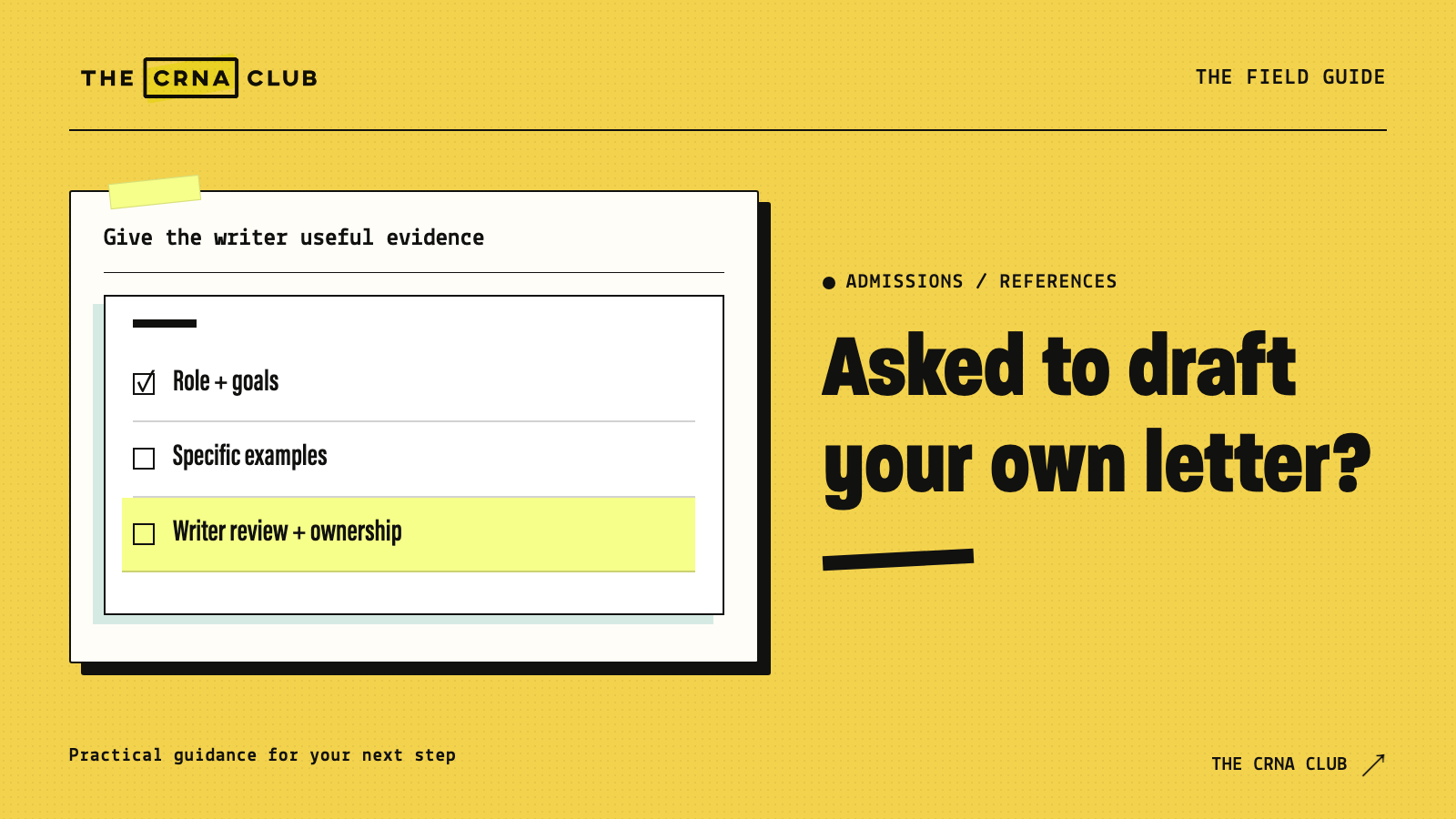
If your recommender asks you to draft your own CRNA recommendation, offer a factual background packet instead of writing their evaluation in their voice. Share the program’s instructions, your work history and examples they observed. The evaluator should make the judgments, write the assessment and submit it through the required process.
You might feel awkward pushing back. This person agreed to help you, and you don’t want to sound ungrateful. You also want the application finished. But “send me some information” and “write a letter saying how excellent you are, and I’ll sign it” ask for very different things.
We recommend giving them a short factual packet and a clear date instead. Our References Basics lesson helps you prepare that background, and the recommendation tracker keeps the request beside the right school. Try them with the seven-day trial, then use the sample reply below to start the conversation in your own words.
What does the application require the evaluator to do?
Check the actual authorship and submission instructions before responding. NursingCAS requires the reference to complete and submit the evaluation themselves, rather than having the applicant or another party do it for them. Preparing background information is different from completing that assessment. Read the current NursingCAS reference rules.
The school is asking what this person thinks of your work. Give them reminders and useful details, then let them decide what to say.
Don’t assume a different university portal allows applicant authorship because its interface looks different. Read that school’s instructions and ask admissions if you can’t tell what is permitted.
Duke’s application guidance separately routes recommendation requests to the evaluator’s online form. That’s another reminder to distinguish your own application materials from the evaluator’s work.
You don’t need to accuse anyone of wrongdoing to clarify the process. Your first response can focus on what you can appropriately provide.
How can you respond without making the conversation confrontational?
Thank the person and offer a concise packet they can use to write their own assessment. Explain that you want to keep the evaluation in their words and follow the application’s instructions. Give them useful material immediately so your response helps solve the time problem rather than simply declining the request.
For example:
Thank you again for supporting my application. I can send a short summary of my work, the projects you supervised, my resume and the school’s reference instructions. I’d like the evaluation and final wording to be yours, so I’ll organize that background for you rather than draft a letter in your voice. Would that make the process manageable?
That’s a fictional sample. Adjust it to the relationship. You can speak naturally with a manager you know well while still being clear about the boundary.
If the request came from a professor who only wants reminders of your academic work, there might be no conflict to resolve. Ask what information they need. Sometimes “draft something” is shorthand for “give me the facts so I don’t have to search for them.” Clarifying that meaning helps both of you.
What belongs in the factual packet?
Include accurate information that helps the evaluator identify your relationship and relevant work. State dates, roles, assignments, projects and feedback they directly observed. Add current goals as background. Avoid ratings, comparisons with other nurses or sentences telling the evaluator what conclusions to reach about your readiness.
A one-page packet can look like this:
| Field | Useful applicant-supplied material | Leave to the evaluator |
|---|---|---|
| Relationship | “You supervised my SICU orientation from April through July.” | How well they know your work |
| Development | “At our May review, we discussed prioritizing reassessments. We reviewed progress in June.” | Their assessment of the progress |
| Project | “I helped revise the equipment-orientation checklist you approved.” | Its quality and your contribution relative to others |
| Academic work | Course title, term, assignment and faculty comments | Academic readiness and comparison with classmates |
| Goal | Your interest in nurse anesthesia and planned application cycle | Whether and how strongly they recommend you |
Attach the relevant instructions and your current resume. If the school asks about leadership, point to a project the evaluator knows about. Don’t write, “Please call me an exceptional leader.”
The recommendation packet guide provides additional examples of factual material. You’re helping the evaluator remember. You’re not scripting their opinion.
What is the difference between a reminder and an evaluation?
A reminder identifies something that happened. An evaluation interprets its quality, significance or comparison with other people. You can provide accurate context about your work and point to existing feedback, but the recommender should decide how that evidence supports their assessment. Check each sentence in your packet against that distinction.
Compare these fictional examples.
Reminder: “During orientation, you asked me to improve my organization of reassessments. We discussed my progress at the next review.”
Applicant-written evaluation: “She rapidly became the most organized nurse on our unit and will excel in a doctoral program.”
The first gives the manager a shared event to consider. The second supplies a comparison and a prediction only the manager can decide whether to make.
Another example: “I earned an A in your graduate pathophysiology course and revised my case analysis after your comments.” That belongs in background. “My sophisticated reasoning placed me above nearly every student you have taught” does not. You don’t know how the professor would make that comparison.
You don’t have to make the packet sound cold. Explain why the work mattered to you. Make it clear when you’re sharing your own reflection.
Can you supply bullet points about your strengths?
You can identify strengths you’re working to demonstrate and connect them to factual examples, but don’t turn the bullets into required praise. Tell the evaluator which work you hope will help them assess you. They should decide whether the examples support those strengths and whether other observations deserve more attention.
For instance, “I’m trying to demonstrate that I respond well to feedback. The orientation review and subsequent improvement plan are examples you observed” leaves room for independent judgment.
“Please state that I accept all feedback gracefully” doesn’t. It prescribes a flattering conclusion and makes a sweeping claim about your behavior.
If the evaluator asks what the school values, send the actual reference prompt. Avoid reverse engineering an imagined ideal applicant and asking the evaluator to reproduce it. Their honest perspective is more useful than another version of your personal statement.
What if the person says they will only sign an applicant-written letter?
Explain the application’s rules and ask whether they would be willing to write using your factual packet. If they still decline, check your options for another eligible evaluator or ask admissions how to proceed with an unavailable required reference. Don’t submit an applicant-written assessment simply to keep the application moving.
A calm response might be:
I appreciate your willingness to support me. The application asks the evaluator to complete the recommendation, so I need to keep the assessment independent. If writing from the background packet won’t fit your schedule, I understand. I’ll check the program’s options for another eligible reference.
That conversation can be uncomfortable. It’s still better to have it before submission than discover later that you represented your own writing as someone else’s assessment.
If the person is your required manager, use the school’s clarification process rather than silently substituting a peer. Our guide to asking for recommendation letters covers choosing and approaching eligible evaluators. A different name doesn’t solve the issue unless the program accepts that relationship.
What should you do if a letter has already been drafted?
Pause before anything is submitted. Tell the evaluator which material you supplied and clarify the application’s requirements. Offer to replace the draft with a factual packet so they can write their own assessment. If an evaluation has already been submitted and you’re uncertain about compliance, ask the application service or program for guidance.
Don’t try to repair the problem by making small word changes and assuming the result becomes independent. A few changed adjectives don’t answer the question of who wrote the assessment.
Keep your request factual. You don’t need to send a long confession filled with assumptions about consequences. Explain what happened accurately and ask the responsible office what to do next. Follow the instructions it provides.
And don’t ask the evaluator for their account password so you can “fix” the form. That would create another problem rather than clarify the first.
How can you prevent this request next time?
Make the workload clear before the evaluator commits.
- Ask early and describe the actual work, especially when you’re applying to multiple programs.
- Show any school-specific questions and rating forms. Someone expecting a one-page letter might not anticipate those.
- Send the factual packet as soon as they agree.
In our recommendation tracker, enter the agreed needed-by date and the email address your writer wants you to use. Add a note that you sent the background packet, so your next reminder can name what they already have. If the timeline is too short, acknowledge that instead of trying to transfer the evaluator’s work to yourself. You can organize a strong request and still hear no. Leave enough time to respond honestly.
Our Final Thoughts
Make the task easier by sending useful background and clear instructions. If your recommender still wants you to write their assessment, clarify the application’s rules before anything is submitted.
Take the Next Step
Send the factual packet, then record the date you and your writer agreed on. We recommend our References Basics lesson if you’re unsure what to include, and the per-program tracker to keep the request moving. Explore them with the seven-day trial.