How Can You Get an Academic Reference Years After Graduation?
Sachi, CRNA
CRNA
In This Article (9 sections)
- Does your target school actually require an academic reference?
- Which former professor should you contact first?
- How do you reconnect after several years?
- What should you include in an academic reference packet?
- What if the professor remembers you only vaguely?
- Should you take a new class to get a recent academic reference?
- How should you handle the request timeline?
- Our Final Thoughts
- Take the Next Step
You can ask a former professor for an academic CRNA reference years after graduation, but first check whether the program accepts that relationship and whether the professor remembers enough to evaluate your work. Reconnect with specific course material and a clear request. If an academic evaluator is unavailable, ask the program about its permitted alternative.
You might have a great ICU manager, an educator who knows your development and a CRNA you’ve shadowed. Then an application asks for an academic reference, and you realize your last class ended seven years ago. You remember the professor’s name. Do they remember yours?
We suggest sorting the school requirement before you pay for another class. Save your programs in our School Database, keep the academic-reference question in each school’s checklist, and use our References Basics lesson to plan the reconnection. You can explore those tools with the seven-day trial.
Does your target school actually require an academic reference?
Read the reference instructions for each program before you email former faculty. Some programs specify an academic evaluator, while others use different categories. Check who qualifies, whether the relationship must be recent and whether the application offers an explanation process. A requirement at one school doesn’t create the same requirement everywhere else.
Johns Hopkins’ nurse anesthesia program includes an academic faculty letter in its reference guidance and describes an explanation process when a listed reference is unavailable. That’s a specific school’s process. Use it as a reminder to look for detailed instructions at your own programs.
Compare the academic category with “professional reference.” A clinician with a doctorate doesn’t automatically become your academic evaluator. If they never taught or formally evaluated your academic work, describe the relationship as it actually exists.
Make a small table before you start reaching out:
| Program | Academic evaluator required? | Published recency rule | Unanswered question |
|---|---|---|---|
| School A, hypothetical | Yes | No limit stated | Does a former undergraduate instructor qualify? |
| School B, hypothetical | Optional category | Not stated | Would a recent graduate-course instructor add useful evidence? |
| School C, hypothetical | Yes | Relationship window listed | Does my older course fall outside the rule? |
“No limit stated” means you haven’t found a rule. If the age of the relationship affects your choice, ask rather than filling the gap with a guess.
Which former professor should you contact first?
Start with a professor who reviewed substantial work, gave individual feedback or saw how you learned over time. A high grade helps identify a successful course, but it doesn’t prove the instructor knows you personally. Choose the person who has real work to remember.
Maybe your anatomy lecture had 180 students, but your research-methods professor met with you twice about a project. The second person has more material for a detailed assessment even if the first course sounds more obviously related to anesthesia.
Consider the academic work itself. Did the professor observe your analytical writing? Did you revise after feedback? Did you work through a difficult concept in office hours? You’re looking for examples the professor actually saw, not a story you want them to believe about your current abilities.
Johns Hopkins’ admissions guidance on references identifies professors and academic advisors among academic connections and discusses using earlier relationships when appropriate. Your program’s own eligibility rule still controls the choice.
A retired professor isn’t automatically unavailable, and a current professor isn’t automatically familiar with you. Check both availability and knowledge of your work.
How do you reconnect after several years?
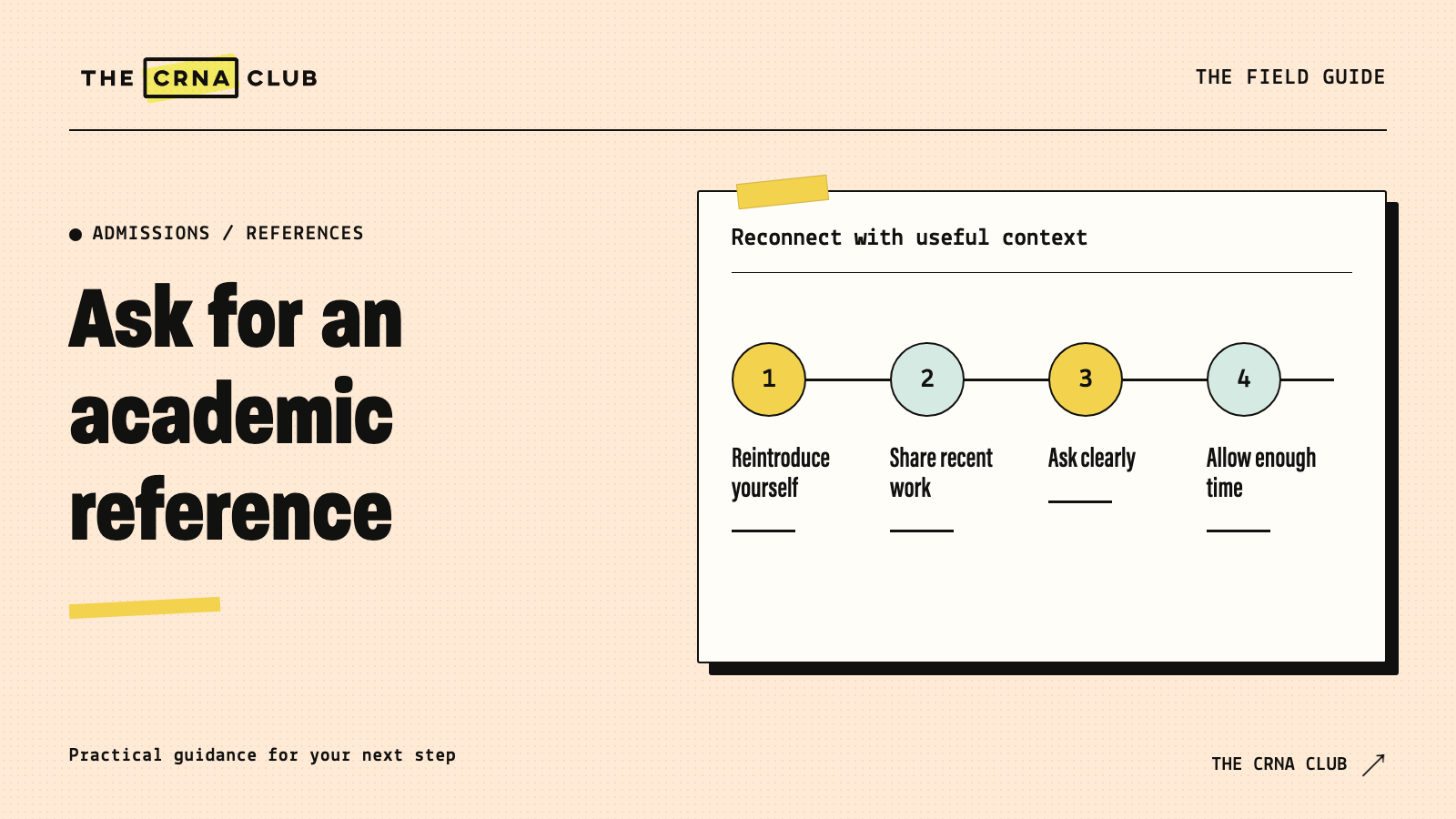
Send a short message identifying the course, term and project before asking whether the professor has enough familiarity to write. Acknowledge the time since you last worked together. Give them an easy way to decline or request more information. You’re restarting a professional conversation, not testing whether they remember your name.
For example:
Professor Lee, I took your undergraduate research-methods course in fall 2019 and completed the project on patient education materials. Your feedback on narrowing the question changed how I approached the final paper. I’m now an ICU RN preparing CRNA applications. One program requires an academic reference. Would you feel comfortable evaluating my academic work from that course? I can send the assignment, your feedback and the current reference instructions to help you decide.
That’s a fictional example, and the details need to be yours. Don’t borrow a flattering story about feedback because it sounds good. If you have only the course name and transcript, say that.
Use the faculty member’s current institutional contact information when available. If the email bounces, check the department directory or ask the department office whether there’s an appropriate forwarding route. You don’t need to chase a professor through personal social accounts to show persistence.
What should you include in an academic reference packet?
Help your professor remember what you worked on together. Include the course and term, an assignment with feedback, the program’s reference instructions, your current resume and a brief update. Keep the packet short enough to review, and separate what they observed academically from what happened later in your career.
A practical cover sheet could have these fields:
- Our academic connection: Course title, term and any supervised project.
- The work I’m attaching, including the version with your comments if I still have it.
- What I’ve done since the course, in a short paragraph.
- What this application requests: Academic reference wording and submission method.
- The school deadline and the completion date we’ve agreed on.
Don’t send your entire learning-management archive. Choose material that shows the work you want them to remember. If your final paper includes confidential data from a clinical project, review what you’re permitted to share before attaching it.
Your update provides context, but the professor shouldn’t be asked to certify recent clinical skills they never observed. “I’ve worked in a medical ICU for four years” is background. “Please state that I’m excellent at managing shock” asks for an unsupported evaluation.
Our factual reference packet guide can help you keep that boundary clear.
What if the professor remembers you only vaguely?
Ask whether reviewing the original work gives them enough basis for a strong recommendation. Let them make that judgment. If they can only confirm your grade or attendance, you might need another eligible evaluator or the program’s alternative-reference process. Repeatedly sending more flattering background won’t create observations they never made.
Consider a hypothetical applicant, Jonah. His professor remembers the course but doesn’t remember his work. Jonah sends the original capstone with comments. The professor recognizes the project and feels comfortable discussing his writing and revision process. That’s a useful recovery of an existing relationship.
Now change the facts. Jonah has no work samples, and the professor taught hundreds of students. The professor says they can verify the grade but cannot evaluate his academic development. Jonah thanks them and asks the program how to proceed. He doesn’t interpret the response as proof he lacks academic ability. It tells him this evaluator has limited evidence.
Either way, you know what to do next. If the professor agrees, put the request and needed-by date under each relevant school in our recommendation tracker. If they decline, note which schools still need an academic writer before you contact someone else.
Should you take a new class to get a recent academic reference?
Take a new course when it serves an academic purpose you’ve identified, such as meeting a prerequisite, addressing course age or demonstrating recent performance. A new faculty relationship is a useful extra. Check the school’s requirement and the instructor’s opportunity to evaluate you before paying for a course primarily to obtain a letter.
An asynchronous class with automated quizzes might provide little individual interaction, even if you earn an A. A course with writing, discussion and feedback can offer more opportunities to demonstrate how you learn. Neither format guarantees an instructor will recommend you.
If you enroll, participate in the actual academic work. Ask thoughtful questions, use office hours and respond to feedback because those behaviors help you learn. Waiting until the final grade posts and immediately requesting a strong letter gives the instructor less context.
The science-course retake decision guide helps you review whether another course addresses a real application gap. Don’t create an expensive academic project before confirming what you need.
How should you handle the request timeline?
Start while you still have room for a no, a delayed response or an eligibility question. Identify the requirement, contact your first-choice faculty member and keep another appropriate option in mind. Once the person agrees, send the official request and track the correct program’s completion status.
A month-old email with no response isn’t a confirmed reference. Follow up politely, then decide when you need to move to another option. Consider the school deadline, your remaining alternatives and any published program process.
If several programs need the same professor, explain the total workload before generating requests. Our guide to asking for recommendations covers the broader request process. Your academic reconnection needs that same respect for the evaluator’s time, plus enough original work to make the relationship clear.
Our Final Thoughts
You don’t need to enroll in another class before asking the school what it accepts. Start with one eligible professor who has real work to remember, and give them room to tell you whether they can write a meaningful reference.
Take the Next Step
Pick one former professor and find the course or project that will help them remember you. Then use our References Basics lesson to prepare your request and the per-school tracker to keep the dates straight. Try them with the seven-day trial.