How Do Recommendation Letters Work When You Apply to Multiple CRNA Schools?
Sachi, CRNA
CRNA
In This Article (10 sections)
- Does one NursingCAS recommendation go to every CRNA program?
- Can your recommender reuse a letter?
- How should you track recommendations for several schools?
- How do you ask without overwhelming someone?
- What belongs in the packet you send your evaluators?
- How should you stagger the requests?
- What does a useful follow-up say?
- What changes if you reapply in another cycle?
- Our Final Thoughts
- Take the Next Step
You can ask the same people to recommend you to multiple CRNA programs, provided each person meets each program’s reference requirements. But you still need to track every required request and submission. A shared application service can reduce repeated work, and some recommender portals support reuse. Neither means one finished letter automatically covers your whole school list.
Six programs sounds manageable until your manager gets six emails, two schools ask different questions, and a professor tells you they already submitted everything. Everything where? That’s the detail you want settled before deadline week.
We recommend keeping those requests inside each saved school in the Club. Our recommendation tracker keeps the person, request status, planned ask-by date and needed-by date beside that target program. You can try it with the seven-day trial. Then check the actual application portal before you remind someone, because the tracker doesn’t submit or sync letters for you.
Does one NursingCAS recommendation go to every CRNA program?
Treat each program’s reference section as its own requirement. Confirm the evaluator, reference type and submission status for each school. NursingCAS explains that references are requested through Program Materials and completed by the evaluator through Liaison Letters. Check that every required request is complete. Read the current NursingCAS reference instructions.
Don’t read “same platform” as “same reference rules.” One program might require an academic reference. Another might require a current supervisor. A third might use a different assessment form. The person who works beautifully for one slot won’t automatically qualify for the next.
Before adding names, copy each school’s exact role wording into your planning document. Keep “current direct supervisor” intact. Shortening it to “professional” can hide the requirement you’re trying to meet.
Our guide to asking for recommendation letters covers the initial request. Once you have several programs, keep a separate request record for each school, even when the same manager is writing for all of them.
Can your recommender reuse a letter?
Liaison Letters supports automatic reuse for participating services when an applicant requests another recommendation of the same type. The evaluator chooses whether to activate that option. Different reference types, school-specific questions and separate university portals still need attention, so confirm what the evaluator sees instead of promising a one-click process. Liaison describes the reuse feature here.
That’s helpful. Your professor doesn’t necessarily need to rewrite the same description of your academic work five times. But a reusable assessment also needs to remain appropriate for its destinations.
Suppose a letter names School A and praises its curriculum. You later request reuse for School B. The letter’s underlying evaluation might still be strong, but the school-specific language now creates an avoidable problem. Tell your evaluator which requests could share material and which require a tailored response. Let them decide what to reuse.
Never log into the recommender’s account or submit the evaluation for them. You can organize the work without taking over their role.
How should you track recommendations for several schools?
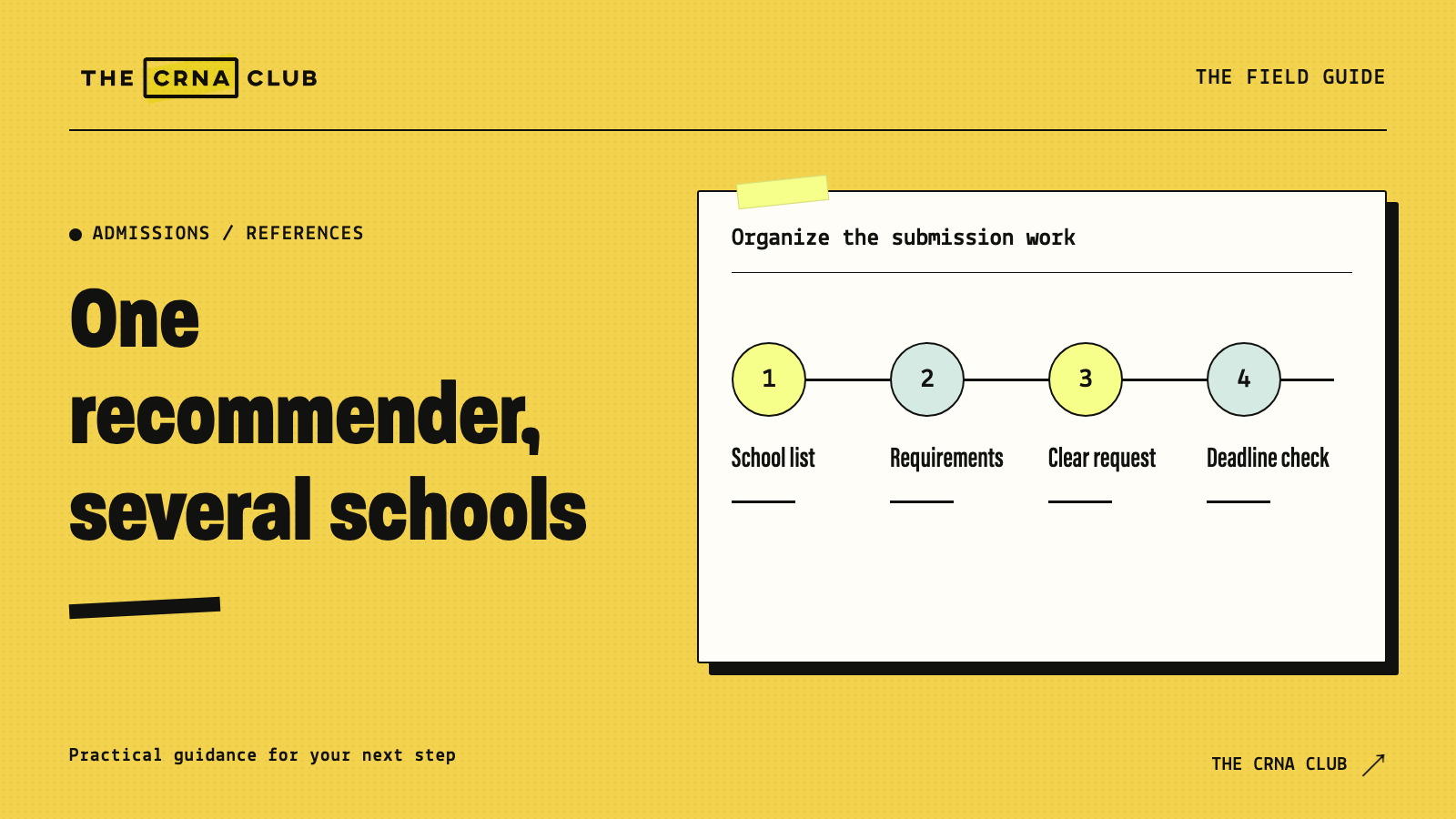
Build one row for each program-reference pairing. Include the required role, evaluator, submission system, school deadline, agreed completion date and current status. A single checkbox beside your manager’s name doesn’t show which of four schools still needs their evaluation. The tracker should answer that question immediately.
Consider this hypothetical plan. The dates and requirements are examples, not real school policies.
| Program | Required slot | Evaluator | Route | Agreed date | Status |
|---|---|---|---|---|---|
| School A | Current supervisor | ICU manager | NursingCAS | June 3 | Complete |
| School B | Supervisor | ICU manager | University portal | June 10 | Request received |
| School C | Academic faculty | Pathophysiology professor | NursingCAS | June 17 | Accepted |
| School D | Academic faculty | Pathophysiology professor | University portal | July 1 | Permission confirmed |
| School E | Professional reference | ICU educator | NursingCAS | July 8 | Not requested |
Keep the actual school deadline separate from the date you agree on with your writer. Inside My Programs, use the planned ask-by and needed-by dates to work backward. Update the request status as you go, and use the notes for details like “professor away June 20–28.” That way you know which request needs attention without rereading every email.
Keep only the logistics you need: the request, the dates and what the portal shows. Don’t store passwords or confidential evaluations in the notes.
How do you ask without overwhelming someone?
Ask for the whole commitment before sending a pile of automated requests. Tell the person how many programs you’re considering, the approximate time span, and whether the schools use one system or several. They deserve enough information to decide whether they have the capacity.
A useful message sounds like this:
I’m applying to five CRNA programs between June and August. Three use NursingCAS and two have separate university portals. Would you feel comfortable providing a strong recommendation for these applications? I can send one summary of the deadlines, your required role at each school, and the submission links when they open.
You’re asking permission and explaining the workload. That gives the person room to say, “I can do these three, but I’m unavailable in July.”
Don’t make the number sound smaller by saying you only need “a letter” when the work includes several rating forms and school-specific questions. Acknowledging the workload is respectful, and it lets you solve scheduling problems early.
If your list is still changing, say so. A tentative list of five is different from a promise never to add another program. You can be honest about uncertainty without asking someone to sign up for unlimited requests.
What belongs in the packet you send your evaluators?
Send a short packet that helps the evaluator remember your work and understand the assignment:
- Your current resume.
- A short explanation of your goal.
- The reference-role instructions.
- A concise deadline list.
- A few factual examples they personally observed, such as how you responded to feedback during orientation or contributed to an education project.
Keep the examples bounded. “You supervised my orientation from March through June and reviewed my progress meetings” gives context. “Please describe me as the best nurse you’ve supervised” tries to direct an evaluation they need to make themselves.
A one-page cover note can identify changes since your last conversation. Maybe you completed a graduate course or began precepting. They should know what’s new, but they shouldn’t feel obligated to assess an activity they never saw.
Our factual recommendation request packet walks through the distinction between giving useful background and writing someone else’s assessment. Give them facts they remember. Let them write the assessment.
How should you stagger the requests?
Organize requests around the schools’ opening dates and actual deadlines. You don’t need to generate every email on the same afternoon. But don’t postpone an open application simply because another school on your list won’t open for two months.
For the hypothetical five-school plan above, you could send the first available requests after your evaluator agrees, then share a dated summary of what’s coming next. When the second university portal opens, send a short message identifying that specific school and its agreed date.
A sensible sequence is:
- Confirm the person’s willingness and required role.
- Check their preferred email address before entering it.
- Generate the request through the correct application.
- Confirm they received it, including any spam-folder issue.
- Update the tracker when the application shows completion.
Give yourself time for an absent evaluator or a technical problem. You don’t control either one. Your application deadline plan should include these dependencies alongside transcripts and your own materials.
What does a useful follow-up say?
Name the specific outstanding request and provide the context needed to find it. “School B’s university portal still shows the supervisor evaluation as pending. We had planned for June 10. Would you like me to resend that request?” is much easier to answer than “Did you finish my letters?”
Check the portal before you send the reminder. If the evaluator says they submitted yesterday and the application still shows pending, ask about the completion confirmation and use the appropriate support channel. Repeated reminders won’t fix a platform mismatch.
If the person can no longer complete the request, thank them for telling you. Then check whether the school permits a replacement and what you can change at that submission stage. Don’t delete or replace a completed evaluation based on an assumption about how it reads.
And when your list grows, ask again. “Would you be willing to add one more program?” is a real request. Sending a sixth automated request without asking skips that conversation.
What changes if you reapply in another cycle?
Keep a new-cycle checklist. NursingCAS says references and program-specific information don’t copy into a new application cycle. You’ll need to review the current instructions and arrange the necessary requests again, even if the same people support your next application. Check NursingCAS reapplication guidance.
A returning evaluator also needs an update. Send a short account of what changed since the previous cycle and identify which changes they actually observed. Don’t ask them to resend a year-old evaluation without reviewing whether it still represents your work.
Our Final Thoughts
Applying to several programs creates more coordination, even when you use the same evaluators. Make that work visible. A clear role-and-deadline table gives your references a fair picture of the request and gives you a specific way to solve missing submissions before they become urgent.
Take the Next Step
Open your school list and enter the next recommendation request you need to make. Our References Basics lesson and per-program tracker help you choose your writers and keep the requests and dates together. Try both through the seven-day trial. If you’re still mapping the whole application, start with our 9-Step Applicant Checklist.