What Questions Reveal a CRNA Program’s Student Support and Remediation Policies?
Sachi, CRNA
CRNA
In This Article (11 sections)
- Which documents should you request?
- What does the program mean by passing and progressing?
- When does support begin?
- What does an academic remediation plan contain?
- How are clinical concerns handled?
- What practical consequences should you clarify?
- What should you ask about accommodations, leaves and appeals?
- Can attrition data tell you whether students receive support?
- How should you ask these questions at an open house?
- Our Final Thoughts
- Take the Next Step
Ask a CRNA program how it identifies difficulty, gives feedback, provides help and decides whether a student can progress after remediation. Read the written policies alongside the school’s explanation. A passing grade, an attrition percentage or a friendly open house doesn’t show the whole support process. You need to understand what happens when learning gets difficult.
You’re allowed to ask these questions before you enroll. Preparing for doctoral education includes understanding the expectations you’re agreeing to and the resources available when you need help.
We recommend keeping the handbook questions with each saved school in the Club. Start your shortlist in our School Database, then use the program notes to compare what happens when a student needs help. Explore the school tools and program-planning lessons with the seven-day trial.
Which documents should you request?
Ask for the current program handbook, academic progression policy, clinical evaluation process and relevant university support information. Confirm which versions apply to the cohort you’re considering and how updates are communicated. The university and nurse anesthesia program might have different rules. Ask which one applies to the situation you’re checking.
The Arkansas State 2026–2027 nurse anesthesia handbook is an example of a program publishing detailed student and program policies. Reading a real handbook shows why a brochure can’t answer every progression or support question.
The COA standards effective January 2026 address student evaluation, advising, discipline, dismissal and due process. Your program’s documents should help you understand how its processes work in practice.
Save the document version and date with your program notes. If faculty explain a policy differently from the text you found, ask which version is current. You don’t need to resolve the discrepancy by guessing.
What does the program mean by passing and progressing?
Ask whether course grades, individual assessments, cumulative performance and clinical evaluations each have separate requirements. Then find out what happens when a student falls below one of those expectations. A single passing percentage won’t tell you whether reassessment is available, whether a course can be repeated or whether progression pauses.
Consider a hypothetical comparison. School A requires a particular course average and separate passing clinical evaluations. School B uses a different grading structure and requires a competency assessment before moving to the next clinical phase.
You can’t rank these systems by choosing whichever number looks lower. You need the full sequence and the consequence of missing a requirement.
Ask:
- What must a student complete to move into the next semester or clinical phase?
- Are any assessments independently required to pass, even when the course average is acceptable?
- How are students notified about a concern?
- What happens after a failed reassessment or repeated concern?
Use the actual terminology in the handbook. “Remediation,” “probation,” “repeat” and “dismissal” can refer to different stages. Ask the program to explain them rather than treating them as interchangeable.
When does support begin?
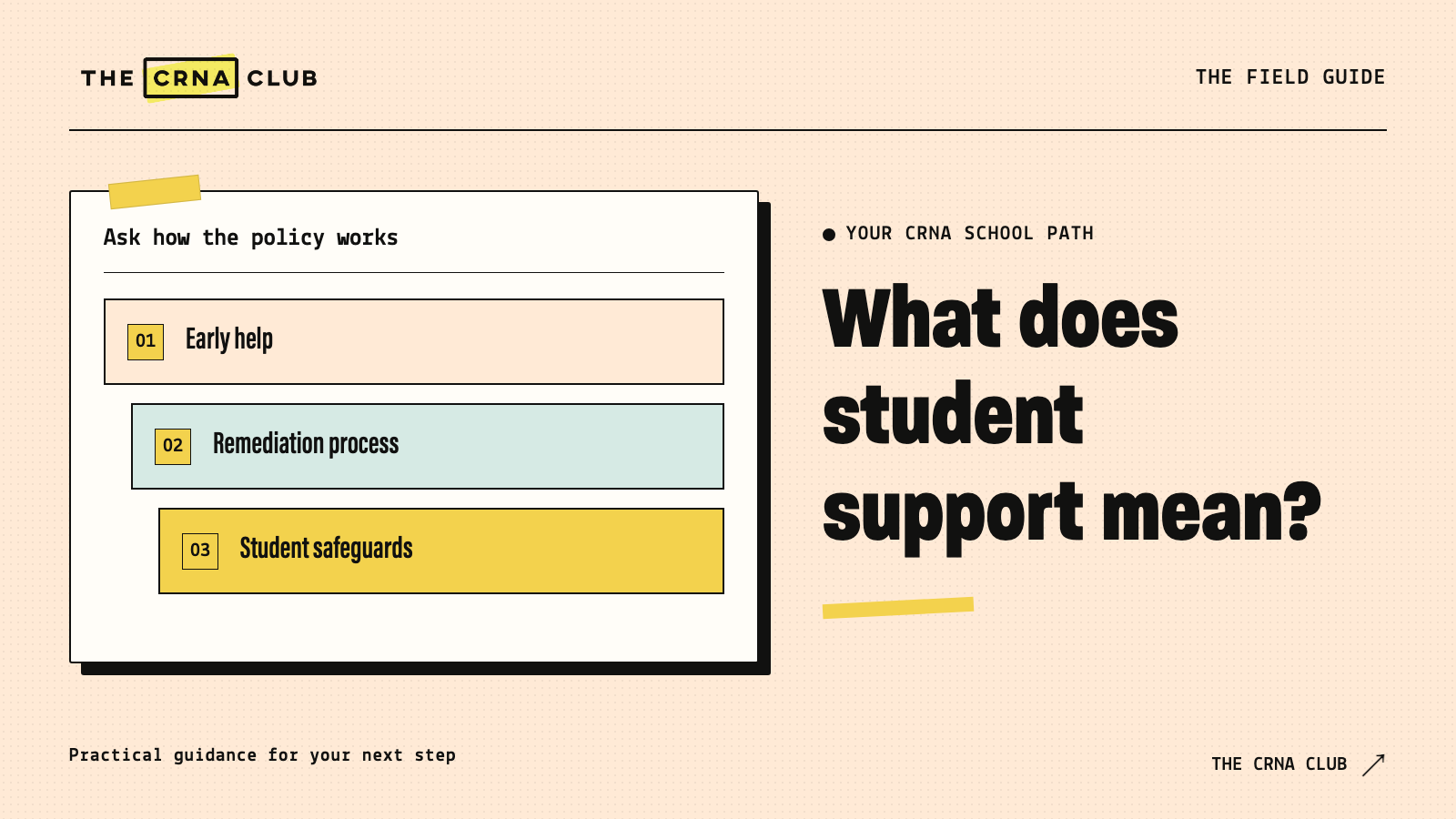
Ask how faculty identify a student who needs help and what contact occurs before a final grade or major progression decision. Find out whether students receive regular advising, useful assessment feedback and a clear way to request help. Ask what prompts a meeting and what happens afterward.
For example, “Faculty are always available” sounds warm, but ask what availability means during a difficult week. Can students arrange meetings? Who helps when the usual advisor is unavailable? How does support work at a distant clinical site?
You can also ask how students are expected to seek help. A program might have formal advising meetings and still expect you to raise concerns early rather than wait for the next scheduled review.
Don’t assume every difficulty automatically leads to formal probation. Learning support, a focused improvement plan and a progression sanction are different processes. The program should explain where each fits.
What does an academic remediation plan contain?
Ask how the program identifies the learning problem, chooses the work required and assesses whether the student has improved. Clarify the timeline and what happens if the plan is not completed successfully. A useful explanation connects the intervention to the identified difficulty rather than describing remediation only as “study harder.”
A hypothetical student, Jess, understands course content while reading but struggles to apply it to unfamiliar questions. Repeating the same highlighting routine won’t necessarily address that problem.
A targeted plan could involve identifying the reasoning error, practicing retrieval and application, meeting with faculty and demonstrating improved performance through the program’s approved assessment. Those are examples of questions to ask about the process, not a promise that every program offers the same plan.
Ask who writes the plan, whether the student participates and which criteria show completion. Also ask whether remediation changes the course grade or simply allows progression under a separate rule. The answer affects how you understand the policy.
How are clinical concerns handled?
Ask how clinical feedback is documented, who reviews repeated concerns and how the student learns what needs improvement. Find out who coordinates a plan across preceptors and sites, and how readiness to continue is assessed. A collection of daily evaluation forms needs an actual review process behind it.
You can ask, “If one student receives conflicting feedback from different preceptors, how does faculty help clarify expectations?” That’s more useful than asking whether every preceptor is supportive.
Another question: “If a student needs more practice with a skill, what teaching and reassessment process is available?” Keep the question focused on the educational response, while recognizing that patient safety can require immediate action in a particular situation.
Our clinical program research guide helps you connect these questions to placement structure. Support at the main campus needs to remain reachable during off-site training too.
What practical consequences should you clarify?
Ask whether a delayed course or clinical progression affects the cohort sequence, graduation date, tuition, financial aid or placement availability. Don’t assume an extra month means simply joining the next group with no additional cost. Understand the possible consequences so your financial and support plans reflect the program’s actual structure.
You’re not asking the school to predict your future performance. You’re asking how its rules work if a student needs more time.
A comparison worksheet can include:
| Situation to understand | Policy question | Office that can clarify |
|---|---|---|
| Course repeat | When is the course offered again, and is repeat permitted? | Program and registrar |
| Delayed clinical progression | How is the next placement arranged? | Program clinical leadership |
| Additional enrollment | What tuition and fees would apply? | Student accounts |
| Change in academic status | How does it affect aid eligibility? | Financial aid |
| Leave or return | What conditions govern return to the cohort? | Program and graduate school |
You might need answers from several offices. In your saved-program notes, keep the office, date and answer together. We suggest adding an unanswered cost or progression question to that school’s checklist so it stays visible before your deposit date.
What should you ask about accommodations, leaves and appeals?
Find the official routes for disability accommodations, leave requests, grievances and appeals before assuming an informal conversation will cover them. Ask who handles each process, what documentation is requested and what deadlines apply. Keep academic support separate from formal access or review procedures, even when several offices collaborate.
If you need an accommodation, contact the institution’s designated office to discuss your circumstances and the applicable process. You don’t need to put private medical details into a general open-house question.
For leaves, ask how return is determined and whether the sequence of courses or clinical placements creates timing limits. For appeals, read the stated grounds and deadlines rather than assuming every decision can be reconsidered indefinitely.
If a handbook points to a separate university policy, save that link too. Check the relevant deadline before assuming a general advising meeting starts a formal request.
Can attrition data tell you whether students receive support?
Attrition is one outcome to investigate, but it doesn’t explain every student’s circumstances or reveal how support worked. Read the year, cohort size and definition, then ask what the program learned and changed. Avoid assigning a cause to a rate without information that actually supports that explanation.
A small cohort can show a noticeable percentage change from one student leaving. A low rate also doesn’t tell you every detail of the educational experience.
Use our NCE and program-outcomes guide to read the published results carefully. Pair those results with policy and process questions rather than treating either one as a complete evaluation of the school.
How should you ask these questions at an open house?
Ask in neutral, specific language and give faculty room to explain. “How does the program help a student who is struggling academically?” invites a useful answer. “Do you fail people unfairly?” assumes a conclusion and doesn’t identify the process you need to understand.
Bring the question your document review left unanswered. If a policy is already clear, ask about implementation rather than making faculty repeat the entire handbook. Our program interview research guide helps you choose questions that fit the setting.
Our Final Thoughts
Bring one unanswered handbook question to the program. Ask what happens after a student struggles and who helps them improve, so you understand more than the passing grade.
Take the Next Step
Save up to three schools in our School Database preview, then bring one unanswered support question to each program. For the full planning tools and lessons while you compare their answers, try the seven-day trial.