Who Should Write Your CRNA Recommendation: A CRNA, Professor or ICU Supervisor?
Sachi, CRNA
CRNA
In This Article (9 sections)
- What does the program require for each recommendation?
- Is a CRNA reference always better than an ICU supervisor?
- When should you choose a professor?
- What if your supervisor doesn’t work beside you every shift?
- How should you compare the people who meet the requirement?
- How do you ask whether someone can write a strong recommendation?
- What should you do when the reference choices don’t fit neatly?
- Our Final Thoughts
- Take the Next Step
Choose a CRNA recommendation writer by checking the program’s required role first, then the person’s firsthand knowledge of your work. A CRNA, professor or ICU supervisor can be the right choice for a particular slot. The strongest fit is someone who meets that slot’s rules and can give an honest, specific assessment.
The temptation is to compare credentials. A CRNA seems closest to your goal. A professor has a doctorate. Your manager knows you well but rarely works beside you on a full shift. Which name looks better?
We suggest choosing your writers with your saved school requirements open. In the Club, you can keep each school’s checklist and recommendation requests together, then use our References Basics lesson to plan the asks. Try them with the seven-day trial. You’re looking for someone who knows the work that school wants them to describe.
What does the program require for each recommendation?
Copy the exact reference categories from the program’s current application instructions before choosing names. A requirement for an immediate supervisor is more specific than a request for a professional reference. A preference for an anesthesia provider is also different from a mandatory anesthesia-provider letter. Write down whether each role is required or preferred.
For example, Duke’s nurse anesthesia admissions page requires one reference from an immediate supervisor. That wording matters. Someone with a prestigious title who has never supervised you won’t become your immediate supervisor because they know anesthesia.
Then read the FAQs and Program Materials, not only the summary checklist. The detailed instructions can explain who counts as a supervisor, whether a former evaluator is acceptable or what to do when a particular reference is unavailable.
The Johns Hopkins nurse anesthesia reference guidance distinguishes a supervisor letter, an academic letter and a preferred anesthesia-provider letter. This is a useful example of why one universal recommendation lineup won’t work for every application.
School A and School B below are hypothetical. Their rules illustrate a planning problem, not an actual institution’s policy.
| Application slot | School A’s hypothetical rule | School B’s hypothetical rule | Question to settle |
|---|---|---|---|
| Supervisor | Current direct supervisor | Recent supervisor | Does your former manager qualify for both? |
| Academic | Faculty member | Professional or academic | Is a professor mandatory or an option? |
| Additional | Anesthesia provider preferred | Clinical leader | Who knows the relevant work firsthand? |
Don’t shorten this table to three names until you’ve answered the last column.
Is a CRNA reference always better than an ICU supervisor?
A CRNA’s title alone doesn’t make their reference more useful. Consider whether they observed your professional behavior, discussed your understanding of the role and have enough experience with you to write specifically. An ICU supervisor often has a different view, including your progress, reliability, judgment and response to feedback over time.
Suppose you shadowed a CRNA twice. You arrived prepared, asked thoughtful questions and reflected on the practice setting afterward. That person can speak honestly about those interactions. They haven’t necessarily observed you managing an unstable ICU patient or completing a demanding graduate course.
Your ICU manager, meanwhile, might have followed your development for two years, reviewed your performance evaluations and discussed a difficult team interaction with you. If the required slot is supervisor, that relationship is directly relevant.
You don’t need to downplay the shadowing experience. Describe it accurately and ask whether the CRNA feels they know you well enough for the requested type of reference. “Would you be comfortable writing about our shadowing conversations and my understanding of the role?” is a fair question. Asking them to evaluate clinical abilities they haven’t seen creates a problem neither of you needs.
When should you choose a professor?
Choose a professor when the school requires an academic evaluator or when that person can provide useful evidence about your learning. Look for someone who reviewed your reasoning, written work, participation or progress. A grade by itself tells less about the relationship than the feedback and academic work behind it.
Think about two potential writers. Professor A taught a large online course in which you earned an A but had no individual interaction. Professor B taught a smaller class, reviewed two drafts of your paper and discussed how you corrected a weak argument.
Both are faculty members. Professor B has more specific material to evaluate. That doesn’t automatically make Professor A unsuitable, but it gives you a clearer basis for the choice.
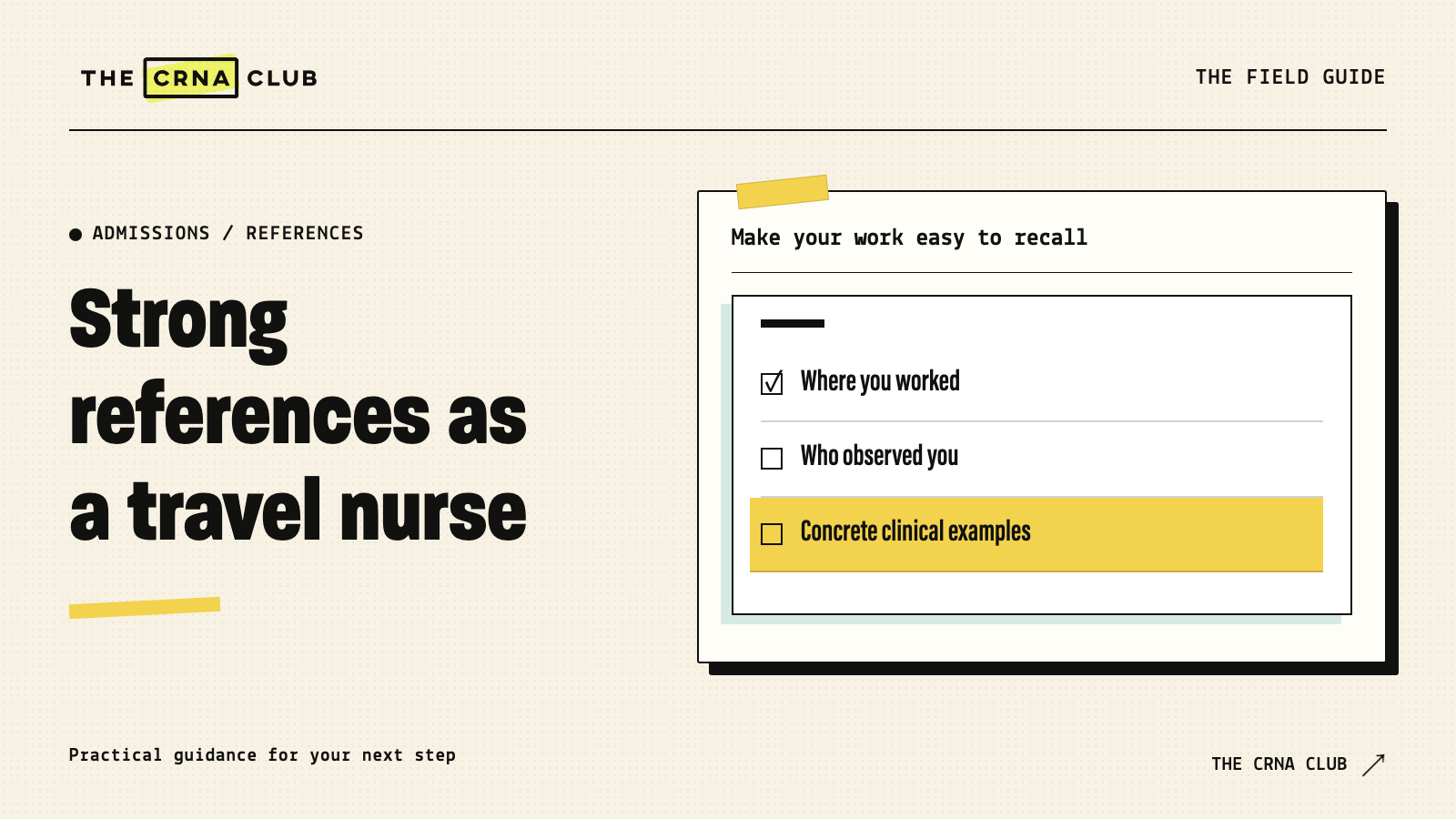
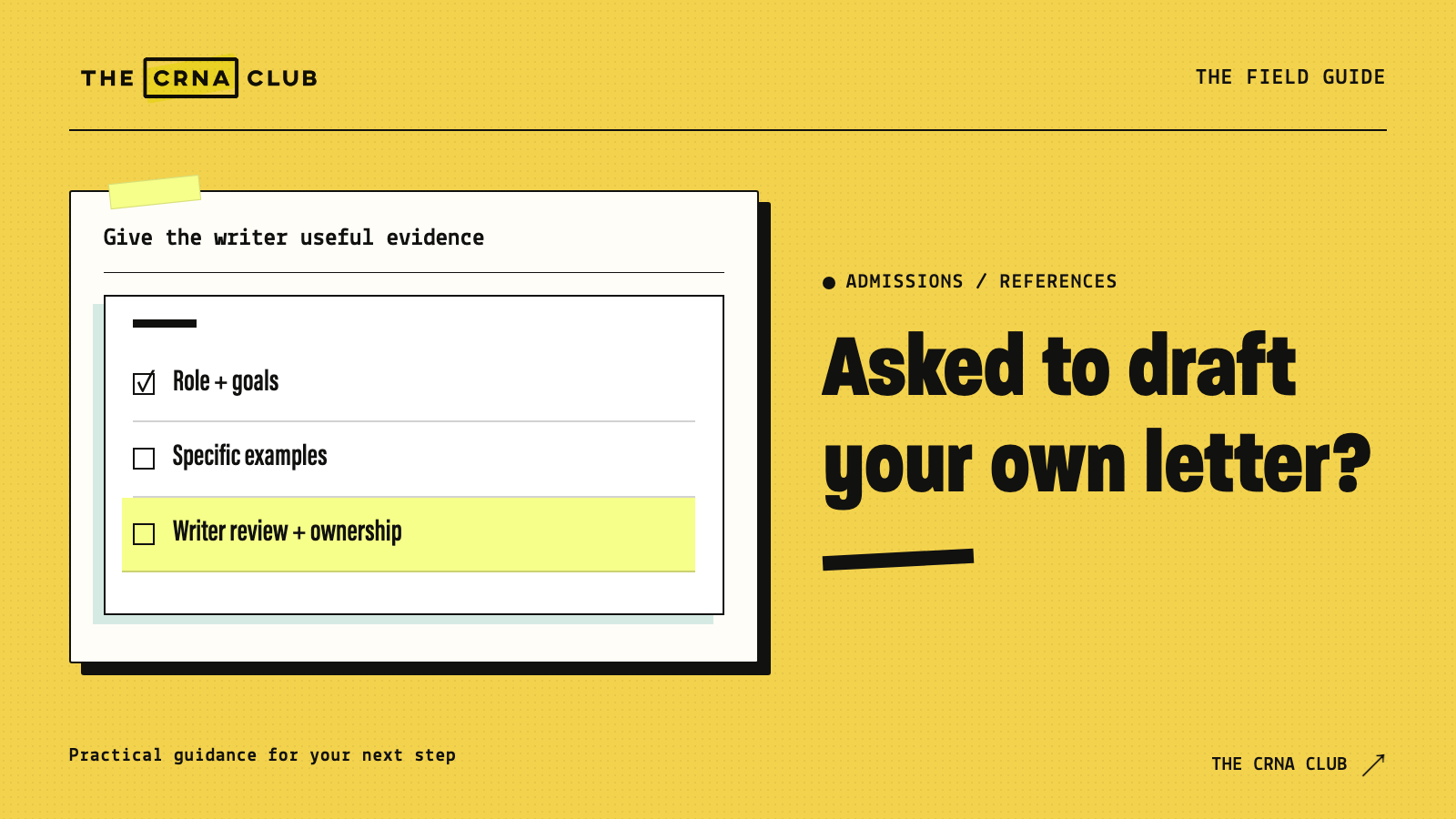
Bring the academic evaluator something concrete to remember. Include the course and term, a substantial assignment with their feedback and a short explanation of your current educational goal. If you’ve been out of school for years, ask whether they still have enough familiarity to provide a strong assessment. Our recommendation request packet guide explains how to share background without writing the evaluator’s opinion for them.
Don’t enroll in a costly class solely to obtain a letter before checking what the program actually requires. Choose the class because you need the learning or the credit too.
What if your supervisor doesn’t work beside you every shift?
Clarify who formally evaluates your performance and what that person knows about your clinical development. A manager’s role can include performance reviews and educator feedback even when they don’t take assignments beside you. Give them accurate context, then let them decide what they can evaluate confidently.
A unit educator or assistant manager might know your work more closely. That’s useful information, but it doesn’t automatically make them an acceptable substitute for a required manager. Ask the program about the role before sending a request to the wrong person.
Your clarification email can be brief:
Your application requires a current direct supervisor reference. My nurse manager completes my performance evaluation, while our assistant manager directly observes my clinical work and coaches my development. Does your requirement allow the assistant manager in this slot, or should I use the nurse manager?
You’re describing the relationship honestly. The program can then answer the question you actually need resolved.
How should you compare the people who meet the requirement?
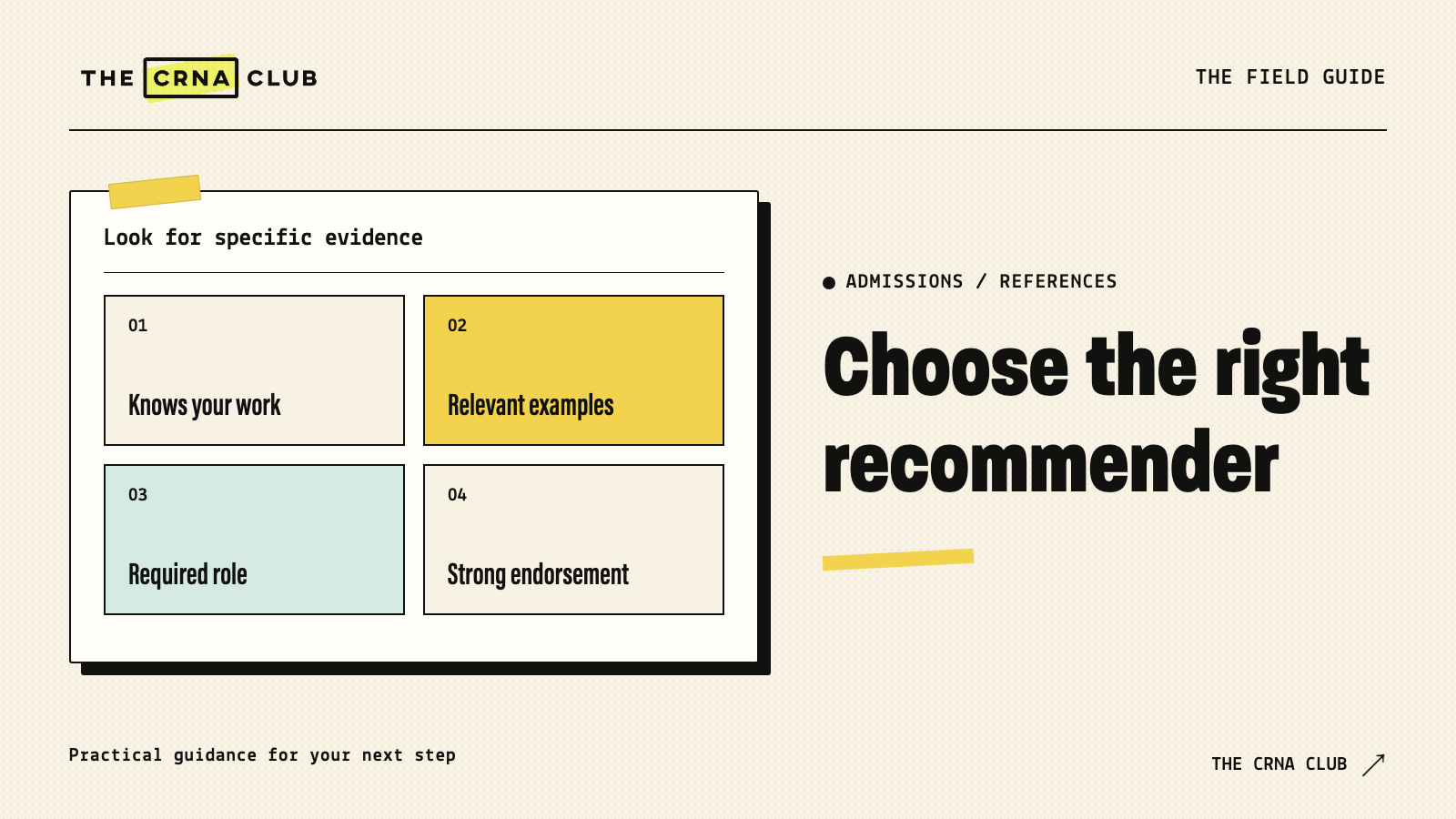
Once you know who meets the rule, ask who has actually seen your work and is comfortable recommending you. We’d choose someone who can explain how you learned or improved over someone whose main contribution is a recognizable name. Use the questions below to compare your options before asking.
- What work did they directly observe? Look for a course project, supervised orientation or repeated clinical collaboration. Pause if the relationship is mostly social.
- Can they describe your development? Look for specific feedback and a later change. A final grade or title alone gives them less to discuss.
- Is the relationship current enough? Check recent work or ongoing contact against any program recency limit.
- Are they comfortable recommending you? Ask for a clear, willing response. Hesitation, uncertainty or lack of capacity needs a conversation.
- Do they fit the requested role? Match their actual position to the instructions. Their degree does not fix a role mismatch.
A person doesn’t need a story for every question. But you should understand the limits of their perspective.
For a fictional applicant named Maya, the current manager meets the supervisor requirement and can discuss her growth after orientation. Her recent graduate science professor fits the academic slot and reviewed her analytical writing. A CRNA she shadowed across several settings fits an optional third slot if the school accepts that relationship. Now put those names under the right saved programs. In our recommendation tracker, record their relationship to you and the date you plan to ask. If you’re waiting for admissions to approve a substitute, keep that question in the program notes before you send the portal request.
How do you ask whether someone can write a strong recommendation?
Ask directly and leave room for an honest answer. “Would you feel comfortable providing a strong recommendation for my CRNA application?” gives the evaluator more room than announcing you’ve already entered their email. Mention the required role, deadline and submission format so they understand the request before agreeing.
If someone hesitates, don’t debate them into writing it. Ask whether the concern is timing, limited observation or something they want you to understand about your work. Those are different issues and deserve different responses.
A scheduling conflict calls for a different evaluator or timeline. Limited observation calls for a better relationship fit. Specific performance feedback calls for listening and a realistic improvement plan. None of these gets solved by finding a higher-ranking title for the same slot.
Once someone agrees, confirm the best email address and how many applications you’re considering. Our multi-program recommendation workflow helps you organize the requests without repeatedly asking the person to reconstruct your plan.
What should you do when the reference choices don’t fit neatly?
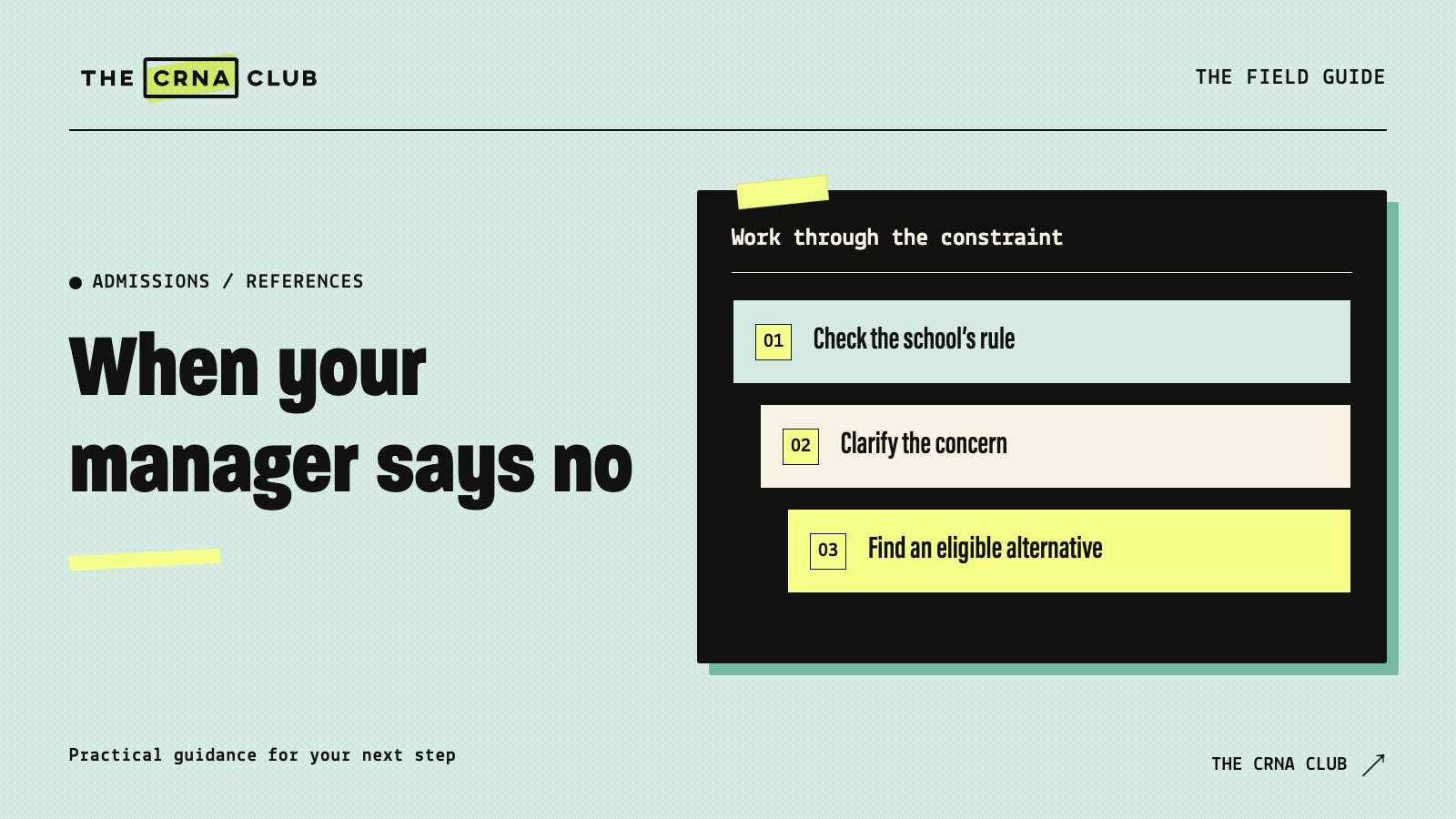
Contact admissions before you submit an ineligible reference. Briefly describe the missing category, explain the relationship you can provide and ask what the program accepts. Keep the reply with that school’s application notes. A thoughtful alternative is useful only when the school permits it for the required slot.
Maybe your professor retired. Maybe you recently changed ICU jobs. Maybe the application asks for a role that doesn’t exist in your unit’s structure. Those are real circumstances. Explain them plainly instead of changing a person’s title or selecting a misleading relationship label in the portal.
And don’t assume one school’s approval applies elsewhere. Your shortlist can include several reasonable answers to the same reference problem because the programs are asking for different things.
Our Final Thoughts
A useful recommendation starts with an eligible relationship and an evaluator who knows your work. Check the role, think about what the person actually observed and ask whether they feel comfortable writing strongly. You’ll have a clearer reason for your choice than the letters after someone’s name.
Take the Next Step
Choose one school and fill in the required recommendation roles before you ask anyone. Then use our References Basics lesson and recommendation tracker to turn those names into requests you can follow. You can explore both with the seven-day trial. Our 9-Step Applicant Checklist helps you see where letters fit with the rest of your application.